



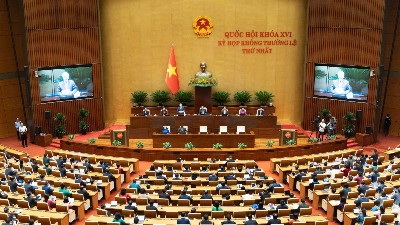
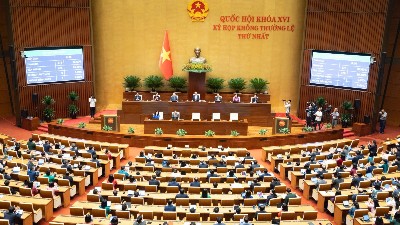
The Presidential Office on September 10 held a press conference to announce the President’s orders promulgating 15 laws passed by the National Assembly at its First Extraordinary Session.
The 2026 Petroleum Law strengthens decentralization by granting greater authority to the state management agency responsible for petroleum activities, while also delegating powers to Vietnam National Industry-Energy Group (Petrovietnam). At the same time, the law clearly defines Petrovietnam’s functions, separating its role as a petroleum contractor and investor from the special functions assigned to it by the State.
The law also introduces a number of new provisions concerning investment incentives for petroleum activities, carbon capture and storage, offshore energy infrastructure, and high-tech petroleum engineering services associated with petroleum activities, among other areas.
The Law Amending and Supplementing a Number of Articles of the Customs Law consists of four articles. It provides a legal foundation for redesigning customs management procedures and restructuring the development of customs information technology systems, while strengthening interconnected data sharing among ministries, sectors, and local authorities.
The law also promotes the reduction of administrative procedures and the costs of carrying them out; expands decentralization and delegation of authority to local customs agencies; strengthens inspections targeting smuggling and trade fraud; and enhances compliance with customs regulations.
The Law Amending and Supplementing a Number of Articles of the Investment Law adds a provision that prohibits trading N2O (nitrous oxide) for human inhalation, except for medical, food technology, testing, scientific research, and other purposes as prescribed by the Government. The provision will take effect on January 1, 2027.
The law also introduces an Appendix containing the List of Conditional Business and Investment Sectors, replacing Appendix IV attached to Investment Law No. 143/2025/QH15. Compared with the 2025 Investment Law, the new list removes 62 conditional business and investment sectors and revises 14 others.
Enhancing the effectiveness of urban management
The Law on Urban Development will take effect on October 1, 2026, establishing a stable, consistent, breakthrough, and feasible legal framework to promote the development of Ho Chi Minh City, other special-class cities, other cities, and special economic zones.
The Law establishes a comprehensive system of mechanisms and preferential policies to enable HCM City and other special-class cities to develop in a coordinated manner in terms of institutions, infrastructure, economy, culture, society, environment, development resources, and regional connectivity and development.
The Law amending and supplementing a number of provisions of 10 laws related to administrative procedures and business conditions in the agriculture and environment sectors will take effect on January 1, 2027.
The Law eliminates 40 administrative procedures, simplifies 12 others, and removes 40 business conditions. It also delegates authority over 24 administrative procedures currently handled by the Ministry of Agriculture and Environment to provincial-level People's Committee chairpersons.
The Law amending and supplementing a number of provisions of the Law on Radio Frequencies, Law on Telecommunications, Law on Electronic Transactions, and Law on Technology Transfer will take effect on March 1, 2027.
Under the Law, two administrative procedures will be abolished, 47 business conditions will be eliminated, four business conditions will be simplified, and three business conditions will be amended.


 Google translate