



Agriculture has long held an essential role in Vietnam’s economy, ensuring food security, supplying raw materials for processing industries, and providing livelihoods for millions.
However, as global and domestic markets place increasingly stringent demands on quality, cost efficiency, and sustainability standards, expanding output volume is no longer the sole determinant of market competitiveness. The critical challenge now centers on maximizing the value generated per unit of input—from farming and processing through to distribution.
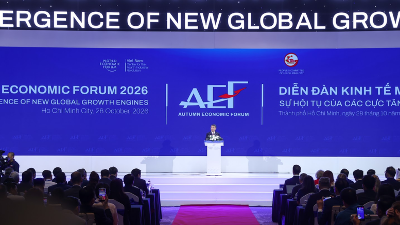
During the panel discussion "Agricultural Technology: Transparent and Sustainable Value Chains," held on October 27 within the framework of the Autumn Economic Forum 2026, experts affirmed that agritech adoption and robust data governance represent viable pathways to achieving this goal.
Specifically, technology enables more efficient utilization of irrigation water, fertilizers, and plant protection chemicals, while integrated data supports quality assurance, raw material zone oversight, and strict compliance with market specifications. When systematically implemented, these solutions can curb operating costs, bolster productivity across the entire value chain, and position Vietnamese agricultural products to move further up the high-value curve.
According to Dr. Truong Vinh Hai, Director of the Institute of Agricultural Sciences for Southern Vietnam, smart-farming pilot models executed by the institute in partnership with international organizations have proven effective in lifting yields and crop quality while reducing consumption of water, fertilizer, and agrochemicals.
The true value of technology extends beyond deploying machinery on farms; it lies in optimizing resource efficiency. Cultivation data empowers farmers to calibrate farming protocols, monitor input usage, and enhance product consistency. For food processors and exporters, uniform raw material quality and steady supply chains reduce procurement costs and mitigate operational risks.
Beyond production techniques, data governance increasingly dictates market access. Vinod Ahuja, Representative of the Food and Agriculture Organization (FAO) in Vietnam, noted that competitiveness no longer relies on volume alone, but on the ability to verify origin, document production practices, and demonstrate compliance with international sustainability criteria.
When information concerning planting areas, seed varieties, inputs, and farming methods is recorded, managed, and verified, agribusinesses gain greater control over input quality, minimize procurement vulnerabilities, and meet demanding buyer standards.
"Data also empowers enterprises to tailor production schedules to market demand, avoiding shortages or gluts of raw material supplies," Ahuja said.
Linkages to turn technology into economic value
Despite the clear benefits, agritech adoption in Vietnam still faces structural hurdles, notably smallholder farming fragmentation, scattered data, and high capital costs. When individual agribusinesses construct proprietary, siloed systems, data cannot flow seamlessly between cultivation zones, processing plants, and distributors—thereby inflating administrative and compliance verification expenses.
To eliminate these bottlenecks, Mr. Ahuja recommended establishing shared public data infrastructure, standardizing land parcel identifiers, harmonizing connectivity protocols, and instituting independent third-party verification mechanisms. Under this shared architecture, cooperatives and lead enterprises can assist smallholders with data management and co-finance verification costs, while the private sector delivers traceability solutions, agrifinance, and technical advisory services.
Nevertheless, agritech investments yield lasting economic returns only when delivering tangible outcomes: higher yields, lower overhead, superior quality, and market expansion. Achieving that demands coordinated collaboration among the State, enterprises, cooperatives, and research institutes, while ensuring that smallholder farmers can access technology and equitably share in the value created by this transition.







 Google translate