


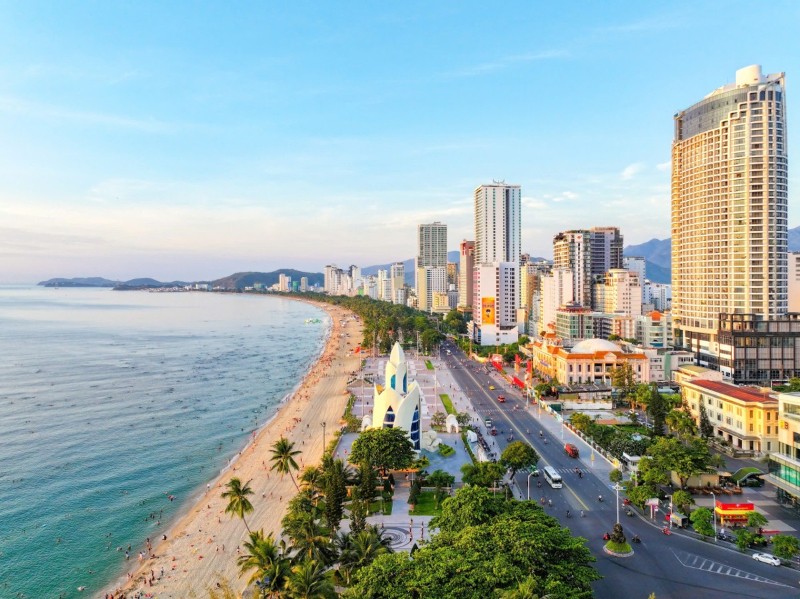
Under Prime Ministerial Decision No. 2007/QD-TTg, dated October 20, 2026, a master plan for Khanh Hoa urban area through 2050, with a vision extending to 2075, has been approved.
The plan aims to develop Khanh Hoa into a Grade I urban area and a centrally-governed city by 2030, with a focus on modern, smart, green and sustainable development.
The central province is also expected to strengthen its role as a centre for the marine economy, international tourism and services, as well as a competitive gateway for trade.
Khanh Hoa’s urban space will follow a multi-polar, multi-centre model comprising two development zones, three growth poles and four connectivity corridors.
The two zones will consist of an eastern marine economic growth area and a western zone focused on agriculture, forestry and ecological urban development.
The three growth poles will include the north, centred on Van Phong Economic Zone as a hub for industry and maritime logistics; the central area covering Nha Trang, Cam Lam and Cam Ranh, focused on services, tourism, administration and high-tech industries; and the south, linked to Phan Rang, with priorities including tourism, culture, clean energy and green industry.
The urban population is projected to reach 2.7–2.8 million by 2030, 3.7–3.8 million by 2040 and 5–5.1 million by 2050. Tourist arrivals are forecast at 30–33 million, 40–42 million and 55–60 million, respectively.
To support this growth, the plan calls for expanded urban development areas and coordinated investment in transport, electricity, water supply, drainage, waste treatment and social infrastructure.
Commercial, financial, service, innovation, high-tech manufacturing and clean-energy centres will also be developed in line with local strengths, supporting higher-value services, modern industry and the marine economy.


 Google translate