


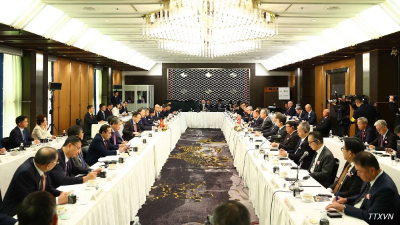
On the morning of November 11 (local time), at the Tokyo Stock Exchange, General Secretary of the Communist Party of Vietnam and President To Lam and a high-level Vietnamese delegation attended a meeting with leading Japanese financial institutions under the theme "Financial Cooperation and Capital Mobilization for Strategic Infrastructure Development," as part of their official visit to Japan.
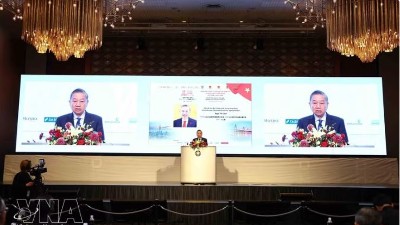
Speaking at the meeting, General Secretary and President To Lam emphasized that the Comprehensive Strategic Partnership between Vietnam and Japan is opening up deeper cooperation opportunities. While financial cooperation between the two countries contributed to building many important projects in past decades, in the coming decades, both sides need to jointly develop modern capital mobilization methods, create strategic infrastructure projects, and foster new competitive capabilities, he proposed.
Developing Capital Markets, Innovating Resource Mobilization Methods
For the period 2026–2030 and beyond, Vietnam aims to focus on developing high-speed railways, urban railways, airports, seaports, logistics, energy, digital infrastructure, and strategic economic corridors. These tasks require substantial, diverse, and long-term investment resources, exceeding the capacity of the state budget alone or a single capital mobilization channel, according to the top Vietnamese leader.
General Secretary and President To Lam expressed a desire for Vietnam-Japan financial cooperation to shift significantly from a relationship of capital supply and reception to a partnership for joint financial market development, co-designing effective capital mobilization solutions, and co-investing in projects and sectors that build long-term competitiveness.
Regarding cooperation orientation, the top Vietnamese leader proposed that both sides jointly develop modern, transparent, and safe financial and capital markets, enhancing the capacity to mobilize long-term capital for their respective economy. Vietnam encourages Japanese banks, securities companies, investment funds, insurance organizations, and financial institutions to strengthen cooperation in developing market infrastructure, modern financial instruments, long-term investment products, and risk management capabilities, the leader said, adding that Vietnam also encourages exploring participation in consulting, arranging, and investing in appropriate international capital mobilization instruments for the Vietnamese government and businesses.
The General Secretary and President also proposed strengthening the connectivity of financial markets between the two countries and the region. He expressed a wish for the International Financial Center to become a platform for connecting investment flows, developing financial products, promoting innovation, and enhancing the economy's integration capacity. Areas of cooperation mentioned include trade finance, capital markets, asset management, green finance, financial technology, and high-quality human resource training.
Notably, General Secretary and President To Lam emphasized the need to innovate capital mobilization methods and investment capital structures, transforming cooperation opportunities into feasible projects and concrete works. For public infrastructure projects with significant socio-economic benefits but limited direct capital recovery, it is necessary to leverage public investment, ODA, and preferential loans. For commercially viable projects that generate stable revenue, mobilizing corporate capital, infrastructure investment funds, project finance, and public-private partnerships (PPP) should be encouraged. For projects with substantial development benefits but insufficient commercial appeal, both sides could explore blended finance models, combining public and private resources with reasonable, lawful risk allocation and sharing mechanisms, consistent with resource balancing capabilities.
General Secretary and President To Lam expressed a desire for Japanese partners to work with Vietnam in selecting potential cooperation projects, aiming to establish modern and efficient infrastructure. He also called for expanding cooperation in green finance and sustainable finance, promoting energy transition, and upgrading industrial value chains.
From signing agreements to implementation, measured by practical results
General Secretary and President To Lam affirmed Vietnam's commitment to maintaining macroeconomic stability, ensuring fiscal discipline, improving institutions, and enhancing the business investment environment. Vietnam aims to build a transparent, modern, safe, and highly predictable financial market. Vietnam consistently protects the legitimate rights and interests of investors, creating favorable conditions for international financial institutions and businesses to invest and operate effectively and long-term in Vietnam, based on compliance with laws, fair competition, and harmonious interests.
General Secretary and President To Lam assigned the Government, the Ministry of Finance, and relevant ministries, sectors, and localities of Vietnam to proactively coordinate with Japanese agencies, financial institutions, and businesses to select feasible cooperation areas, projects, and programs. This includes clarifying capital needs, investment methods, risk management mechanisms, and the responsibilities of each party.
The General Secretary and President requested a strong shift from introducing investment opportunities to preparing projects eligible for capital mobilization; from discussing orientations to developing specific cooperation plans; and from signing agreements to organizing implementation and evaluating by practical results.
Earlier, in his opening remarks at the meeting, Vietnamese Minister of Finance Ngo Van Tuan stated that Vietnam is entering a new development phase with immense investment needs. Vietnam advocates for effectively combining public investment, ODA, and preferential capital with mobilizing private resources, public-private partnerships, and developing capital market instruments, while ensuring efficient capital utilization and risk management.
At the meeting, Japanese financial institutions and investors focused on discussing capital market development, Vietnam's International Financial Center, medium- and long-term capital mobilization solutions, and exploring the possibility of issuing bonds in international markets when market conditions, capital costs, and risks are appropriate. They also discussed financing models for transport infrastructure, energy, and green transition.
Representatives of Vietnamese businesses also discussed cooperation in developing power energy infrastructure, connecting capital sources and markets for private enterprises, and mobilizing Vietnam-Japan resources for strategic infrastructure projects.
At the conclusion of the meeting, General Secretary and President To Lam rang the bell at the Tokyo Stock Exchange.
 Google translate