


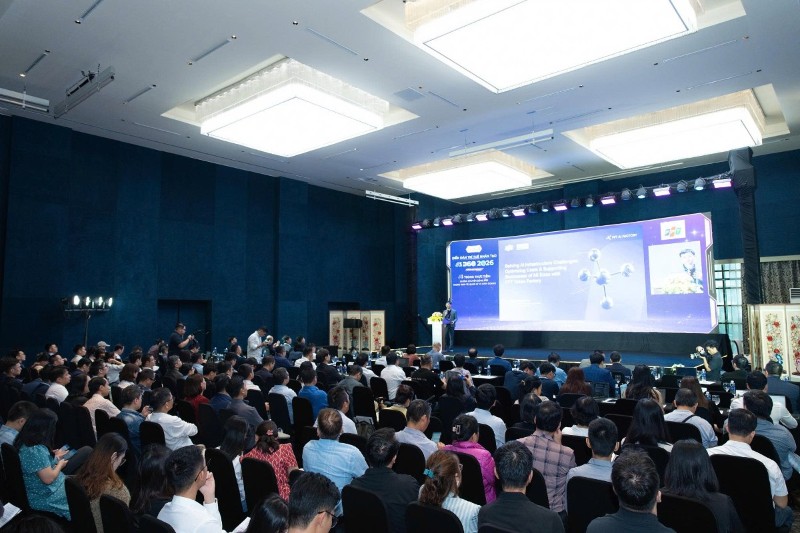
Speaking at the Vietnam Artificial Intelligence Forum (AI360 2026) organized by the Vietnam Software and IT Services Association (VINASA) on November 18, Mr. Tran Anh Tu, Deputy Director General of the Authority of Digital Technology and Artificial Intelligence under the Ministry of Science and Technology, emphasized that mastering core technologies is vital for sustainable domestic growth.
Passed by the National Assembly on December 10, 2025, and effective since March 1, 2026, the Law on Artificial Intelligence comprehensively regulates both AI application development and governance. On August 28, 2026, the Government approved the National Strategy on Artificial Intelligence through 2030, with a vision to 2045 (Decision No. 1671/QD-TTg), shifting the focus from basic AI adoption to comprehensive national transformation powered by AI.
According to the strategy, by 2030, Vietnam aims to rank among the top three Southeast Asian nations in AI research and development, integrate AI into 100 percent of online public services, and build 10 regionally and globally competitive Vietnamese AI brands. By 2045, the country targets joining Asia’s top 10 AI leaders.
Addressing the forum, VINASA Chairman Nguyen Van Khoa noted that Vietnam’s institutional and legal framework for AI is now largely complete, featuring controlled sandbox mechanisms, development funds, and business support policies.
He estimated that AI's impact could be at least 100 times greater than that of the internet in scale, influence, and speed of change, identifying Vietnam as one of the fastest-moving nations in Asia regarding AI awareness and adoption.
To capitalize on this momentum and support Vietnam’s double-digit economic growth target, Mr. Khoa put forward four recommendations to regulators, including swiftly operationalizing the Artificial Intelligence Development Fund, supporting small and medium-sized enterprises (SMEs) using local AI solutions, and increasing public procurement for shared AI platforms.
He also urged authorities to expand access to shared datasets, Vietnamese language data, and computing infrastructure, while simplifying compliance procedures and concretizing tax incentives and interest rate support for AI investments.
Acknowledging VINASA’s proposals, Mr. Tu reiterated that building domestic AI industrial capacity must go hand in hand with national AI transformation, backed by the Law on Artificial Intelligence and Decree No. 142/2026/ND-CP on risk-based governance.
He outlined four implementation priorities.
First, AI transformation must link directly to practical efficiency, requiring leaders to set clear priorities, adjust workflows, prepare data, and upskill workers.
Second, domestic AI capacity must align with market demand, positioning Vietnamese AI firms as the core force in mastering key models and algorithms while meeting international standards on data protection and intellectual property under Decision No. 982/QD-TTg.
Third, stakeholders must expand access to quality, legally compliant datasets and shared computing infrastructure, offering transparent, easy-to-deploy solutions for SMEs and household businesses.
Fourth, AI governance must follow a risk-based approach across high, medium, and low risk tiers, clearly defining accountability for providers, deployers, and users alongside controlled sandbox testing to ensure safety, transparency, and market trust.






 Google translate