



Vietnam’s oil and gas industry does more than supply conventional fuels; it is a strategic pillar of national energy security and macro-economic stability, supporting Vietnam’s transition to a new growth model. Amid geopolitical uncertainty, an accelerating energy transition, and a technology race driven by AI, semiconductors, and data, the industry must evolve from a traditional growth pillar into a driver of innovation, green transition, and strategic autonomy.
Vietnam is entering a new phase of development, targeting double-digit economic growth as it pursues its ambition of becoming a developed country by 2045. Achieving this goal will require vast energy and raw material supplies, alongside extensive industrial infrastructure. Party resolutions on high-quality growth, the maritime economy, and national security underscore the need to safeguard energy security, placing the oil and gas industry at the center of the country’s development ambitions and efforts to strengthen economic autonomy and international integration.
Major contributions
Together with policies strengthening the leading role of major State-owned economic groups and promoting the private sector, the country’s development orientations through 2030 and vision for 2045 provide a framework for the oil and gas and energy sectors. These priorities set clear expectations for the industry and guide its contribution to Vietnam’s long-term development.
Macro-economic data and development indicators show that the oil and gas industry makes five major contributions.
First, safeguarding national energy security. The industry supplies essential fuels and energy for industrial production and transportation. It accounts for approximately 15 per cent of the country’s total electricity output, supplies 35 per cent of the gas used for power generation, meets 70-80 per cent of household gas demand, and provides up to 70 per cent of the nitrogen fertilizer required by the agriculture sector. The Nghi Son and Dung Quat refineries help ensure a stable domestic petroleum supply at competitive prices relative to regional markets.
Second, making a substantial contribution to the State budget. The Vietnam National Industry - Energy Group (Petrovietnam) consistently ranks among the largest contributors to the national budget among State-owned enterprises (SOEs), with payments totaling VND165.9 trillion ($6.38 billion). Overall, the oil and gas industry contributes approximately 9-9.2 per cent of national GDP, providing an important source of funding for development investment.
Third, driving economic growth and completing the value chain. The industry is developing an integrated ecosystem spanning upstream activities, including exploration and production; midstream operations, including the gas industry and energy infrastructure; and downstream activities, including refining and petrochemicals, gas-fired power generation, fertilizer production, and distribution. It also encompasses high-value technical services. The industry now operates in 16 countries and territories and provides stable employment for more than 50,000 people at home and abroad.
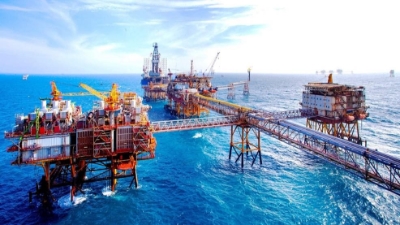
Fourth, asserting and protecting maritime sovereignty and jurisdictional rights. Oil and gas exploration and production activities extend across Vietnam’s continental shelf and exclusive economic zone, serving as “milestones at sea” that help safeguard national sovereignty and maritime security.
And fifth, taking the lead in shaping the new energy transition. The industry is proactively paving the way for greener energy sources and a more sustainable future through the development of offshore wind power, liquefied natural gas (LNG) infrastructure, green hydrogen, green ammonia, sustainable aviation fuel (SAF), and carbon capture, utilization, and storage (CCUS) technologies.
Current requirements
Despite its substantial contributions to the economy, the oil and gas industry faces an urgent need to transform its growth model. Traditionally, the industry’s value has been measured primarily by oil and gas production volumes, total revenue, and contributions to the State budget.

In the current environment, however, this approach has significant limitations. The industry must rapidly shift toward creating value across a broader range of activities, from surveying, geology, drilling, production, and processing to equipment manufacturing, technical services, digital technology applications, automation, offshore construction, and specialized services requiring advanced technical expertise.
To achieve this transformation and overcome existing challenges, the industry’s new growth model must meet five core requirements.
First, maximize the efficiency of remaining resources by optimizing exploration and production at existing and mature fields, including marginal fields, as geological conditions become increasingly complex.
Second, develop a high-technology, low-emissions energy structure by streamlining production processes, improving energy efficiency, and minimizing environmental impacts.
Third, develop an integrated energy industry ecosystem by establishing a comprehensive value chain connecting infrastructure, production, and services to generate broader economic benefits.
Fourth, contribute to the development of the maritime economy and the goal of becoming a strong maritime nation by aligning oil and gas operations with the national maritime strategy, strengthening Vietnam’s position at sea, and protecting its maritime sovereignty.
Fifth, accelerate the adoption of advanced technologies by expanding the integration of automation, predictive maintenance, and generative AI to prevent operational risks and optimize asset performance throughout its lifecycle.
Macro-economic policy directions
To enable the oil and gas industry to realize its full potential in the years ahead, policymakers need to implement five major policy priorities in a coordinated manner.
First, redirect industry development toward higher value-added activities and broader economic spillovers. The industry should move away from a growth model heavily dependent on resource extraction, production volumes, and revenue toward the integrated development of the entire oil and gas value chain. Priorities should include advanced processing, petrochemicals, technical services, support industries, and other technology-intensive sectors.
Second, strengthen national energy security to support high growth and improve resilience. Vietnam should exploit its domestic oil and gas resources rationally and efficiently while diversifying supply sources and import markets. It should also develop an integrated system of processing, transportation, storage, and distribution infrastructure. In parallel, the country needs to strengthen its capacity to forecast energy market developments, manage risks, and respond to energy price volatility and disruptions to international supply chains.
Third, improve institutions, policies, and the investment environment to unlock resources for industry development. Authorities should review and address obstacles to oil and gas projects, particularly large-scale projects involving complex technical requirements and long investment cycles. They should also consider refining investment incentives to reflect the specific characteristics of oil and gas exploration, appraisal, and production. In addition, coordination across the gas-to-power value chain must be strengthened to ensure that investment projects are developed in a synchronized and efficient manner.
Fourth, advance science and technology, innovation, and digital transformation to improve productivity, efficiency, and competitiveness. Priority should be given to researching, applying, and progressively mastering technologies for oil and gas exploration, production, processing, and facility operations. The industry should also accelerate the adoption of AI, big data, automation, and other digital technologies.
Research and technological innovation programs should be developed in response to practical industry needs, with stronger collaboration between businesses, research institutes, and universities. Developing a highly-skilled technical and technological workforce should also be a priority.
And fifth, proactively adapt to the energy transition and expand into new energy and economic sectors. The industry should leverage its existing expertise, infrastructure, and technical capabilities in surveying, design, fabrication, construction, operation, and maintenance of offshore facilities to participate in offshore wind power, offshore engineering services, and other suitable emerging energy sectors. At the same time, it should promote energy efficiency and emission reductions across oil and gas operations, ensuring a balance between economic growth, energy security, and sustainable development.
(*) Mr. Nguyen Hoa Cuong is the Deputy Director of the Institute for Policy and Strategy Studies at the Central Commission for Policy and Strategy.





 Google translate