


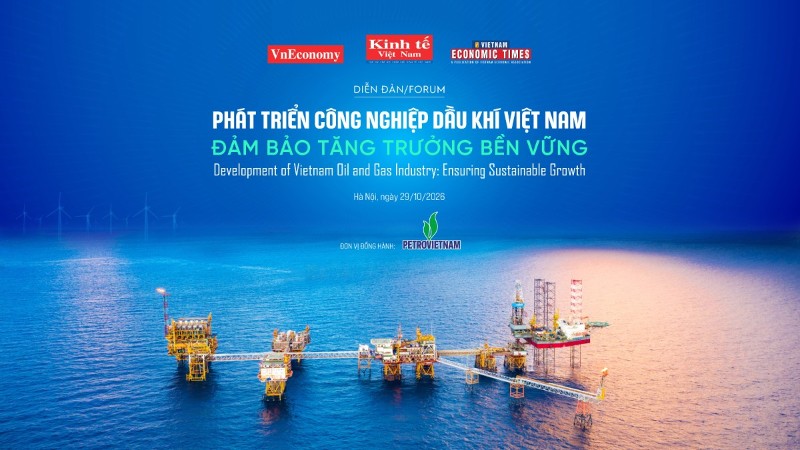
The Vietnam Economic Times – VnEconomy will host the forum titled "Development of Vietnam’s Oil and Gas Industry: Ensuring Sustainable Growth” on the afternoon of October 29 at its Business Media Center (BMC), 98 Hoang Quoc Viet, Hanoi.
The forum is held as preparations are underway to implement the Petroleum Law 2026, which will take effect on March 1, 2027. Discussions are expected to connect the key revisions of the newly passed law with future strategic directions for investment and industrial development across the sector.
Building upon outcomes of the previous forum on "Improving Policies to Create Competitive Advantages and Boost Energy Development" held on August 11, 2026, the event will focus on investment choices, value chain organization, and execution frameworks.
The central inquiry driving the program is: Where should Vietnam's oil and gas sector prioritize investments, and how should it restructure its value chain to create domestic value-add, secure national energy supply, and sustain long-term growth?
The forum will feature a keynote address by Dr. Phan Duc Hieu, Member of the National Assembly's Economic and Financial Committee, analyzing the fundamental highlights of the Petroleum Law 2026 and their direct implications for the industry's development strategy.
Subsequent presentations will examine the issues through the lenses of macroeconomic trends, corporate strategy, and global best practices.
The robust growth requirements of Vietnam's economy place dual responsibilities upon the oil and gas sector: securing a reliable national energy supply while driving domestic value addition, labor productivity, and industrial capabilities. The industry's economic contribution must be appraised across its entire value chain—spanning exploration and production (upstream) to gas distribution, refining, petrochemicals, and technical services (midstream and downstream).
Petrovietnam’s development strategy to 2030, with a vision toward 2050, identifies three core pillars: energy, industry, and high-quality technical services. This roadmap requires capitalizing on existing petroleum assets, tightening integration across supply chain segments, and selecting emerging ventures aligned with the group’s technological capabilities, market demand, and capital mobilization capacity.
Key discussion themes
The panel discussion will focus on three core areas.
First, prioritizing investment for domestic value addition. Panelists will explore strategies to increase hydrocarbon reserves, develop new fields, and enhance recovery rates. Discussions will address connecting domestic natural gas and imported liquefied natural gas (LNG) supplies with industrial and power demand, as well as developing downstream refined products, specialty chemicals, and advanced materials. Capital efficiency, off-take markets, contractual terms, and risk-allocation mechanisms will be assessed to ensure synchronized upstream-to-downstream development.
Second, technology and partnerships to unlock new growth drivers. Focus will center on advancing high-value engineering services, heavy equipment manufacturing, offshore EPC construction, and marine services. Speakers will assess data analytics and digital transformation initiatives aimed at driving operational efficiency, process safety, and methane abatement. Discussions will also highlight technology transfer mandates, domestic vendor development, and international market expansion.
Third, leveraging oil and gas infrastructure for new energy and industrial sectors. Offshore wind, hydrogen, sustainable aviation fuels (SAF), and carbon capture, utilization, and storage (CCUS) will be evaluated based on capital availability, technology maturity, market readiness, and commercial viability. The debate aims to identify priority sectors for the 2026–2030 period, assess opportunities to enhance domestic content, and ensure balanced resource allocation between new ventures and core oil and gas operations.
Through constructive dialogue between industry experts, policymakers, and corporate leaders, the forum aims to formulate practical proposals on capital deployment, technology adoption, and regulatory mechanisms, helping translate the sector’s strategic potential into concrete projects, market-ready products, and domestic industrial capacity.
Key findings, insights, and coverage from the forum will be updated continuously on VnEconomy.vn and across the digital platforms of Vietnam Economic Times.




 Google translate