


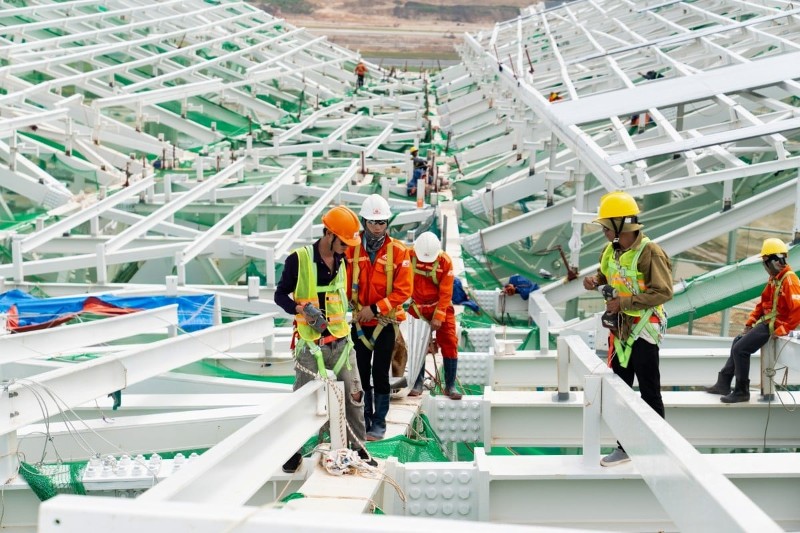
Demand for labor across numerous construction enterprises is surging while supply falls short, spanning technical workers, equipment operators, and specialized engineers in railways, underground works, and digital technology.
At the seminar titled "Resolving the Construction Industry's Labor Shortage: A Handshake Among the 'Three Parties' Needed" on October 22, representatives from regulatory authorities, educational institutions, and enterprises jointly noted that the labor deficit is placing severe pressure on the execution schedules of transport infrastructure projects.
Mr. Nguyen Quang Huy, Vice Chairman and General Director of Deo Ca Group, stated that the group currently employs over 10,000 personnel nationwide. Over the next two years, labor demand is projected to rise by roughly 30%, or about 3,000 people.
Recruitment pressures also stem from skilled laborers switching to other industries or migrating to new entrants in infrastructure investment and construction.
"If businesses merely compete on wages to poach each other's workers, the market will largely witness a reshuffling of labor rather than an increase in overall industry supply," Mr. Huy said.
This shortage is not confined solely to construction contractors. Mr. Tran Dinh Lan, Deputy General Director of Trung Chinh Trading and Construction Co., Ltd., shared that since 2025, his company's workforce demand has nearly tripled. Meanwhile, a portion of new graduates are reluctant to work on remote jobsites, preferring to stay in Hanoi or move into the services sector, widening the gap between recruitment demand and available supply.
Shortages from technical workers to specialists
According to Mr. Le Huu Cau, Head of the Science and Technology Division at the Thang Long Project Management Board, the shortage of transport construction labor has persisted for many years, tied directly to the industry's appeal, training structures, compensation policies, and technological upgrading requirements.
Crucially, the deficit affects not only engineers and specialists, but also frontline direct labor, including drivers, equipment operators, surveyors, and skilled workers.
Another factor is that unit labor costs within transport sector norms remain low relative to actual recruitment expenses, particularly for high-level specialized roles. Living and working conditions on jobsites—especially in remote areas—alongside wages, welfare packages, and social insurance, directly impair the ability to attract and retain workers.
Concurrently, digital transformation is shifting competency requirements for project management and supervision staff. According to Mr. Cau, personnel must now master technologies such as artificial intelligence (AI), Building Information Modeling (BIM), geographic information systems (GIS), and licensed specialized engineering software, in addition to core construction and transport expertise. Engineers deeply skilled in these areas remain scarce and cannot be readily filled via conventional recruitment.
Workforce demand will surge further in coming years alongside massive infrastructure projects. Mr. Cau pointed out that preliminary estimates show the North–South high-speed railway project alone will require approximately 700 to 900 personnel for project management between 2026 and 2032, excluding other operational and construction forces.
Assoc. Prof. Dr. Tran Chung, Chairman of the Vietnam Association of Road Traffic Investors (VARSI), remarked that Vietnam has yet to take a proactive approach toward long-term human resource planning, forecasting, and strategy development. Furthermore, working conditions and compensation remain unaligned with the rigorous demands of the trade, making retention a persistent challenge.
Deeper collaboration between schools and enterprises
Faced with mounting deficits, seminar attendees agreed that businesses cannot simply rely on the open labor market and must participate directly in the education and training process.
Mr. Huy proposed that the State institute commissioned training mechanisms for sectors facing severe labor deficits, particularly specialized disciplines like railways, underground construction, and tunneling. Waiting until demand peaks to recruit leaves enterprises with insufficient time to train fresh cohorts.
From the academic side, Vice President of the Academy of Construction Strategy and Cadres Training, Mr. Nguyen Vu Phuong, emphasized that the core challenge lies not merely in imparting knowledge, but in translating that knowledge into practical skills. Businesses must be deeply involved in assessing needs, developing curricula, organizing internships, and evaluating graduate competencies to ensure training aligns with jobsite requirements.
Assoc. Prof. Dr. Nguyen Hoang Long, President of the University of Transport Technology, acknowledged that past partnerships between universities and enterprises were loosely structured, with labor market demands seldom updated on a routine basis. He urged that future collaboration be anchored by concrete quotas, rigorous standards, and defined tasks, rather than superficial memorandums of understanding (MOUs).
On behalf of industry, Mr. Huy recommended extending and structuring internship periods more effectively, allowing students early exposure to jobsite environments, specialized mentoring, and hands-on professional skills development so they can adapt seamlessly to the workplace upon graduation.





 Google translate