


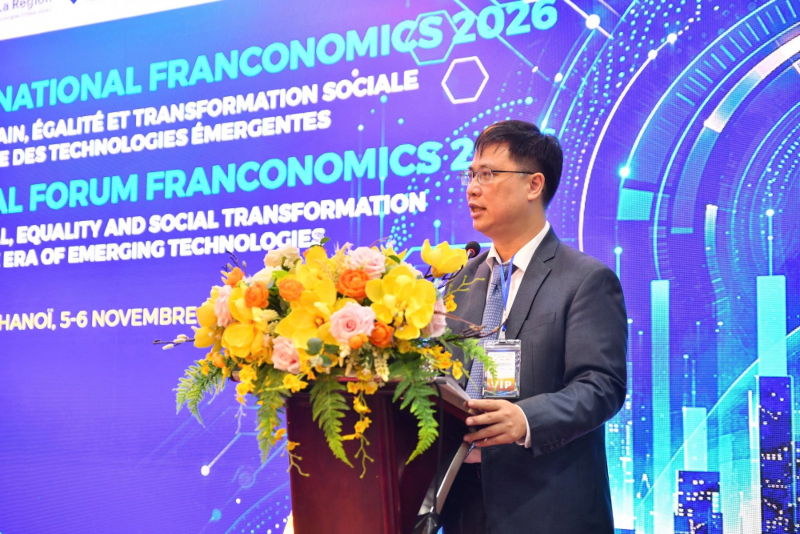
Developing human capital to meet the requirements of emerging technologies, bridging scientific research with practical applications, and ensuring equitable access to technology were focal points at the 7th International Francophonomics Forum held on November 5 in Hanoi, themed "Human Capital, Equality, and Social Transformation in the New Technological Era", according to the Government's online newspaper (chinhphu.vn).
Addressing the forum, Assoc. Prof. Dr. Nguyen Anh Tuan, Rector of the International School at Vietnam National University, Hanoi (VNU-IS), identified a critical bottleneck: scientific research conducted by universities and researchers often remains disconnected from real-world market demands.
To bridge this gap, he emphasized the "Triple Helix" collaboration model among the State, Academia, and Industry. Under this framework, the State commissions solutions for specific development challenges, universities mobilize their research capacity, and enterprises partner in development to transition research outcomes into practical applications.
VNU-IS is currently operationalizing this model through a partnership with a foreign-invested enterprise in the low-altitude economy sector in Bac Ninh City. The enterprise manufactures unmanned aerial vehicles (UAVs), while the university designs the flight control software.
According to Mr. Tuan, if the solution proves effective, Bac Ninh authorities will commission orders for commercial deployment. Through the forum, the school seeks to connect with additional corporate partners to scale this collaborative model across other sectors and localities.
In his remarks, Mr. Rigobert Pinga Pinga, Acting Regional Director for Asia-Pacific at the International Organisation of La Francophonie (OIF), noted that the rapid rise of AI, robotics, biotechnology, and cybersecurity presents novel challenges globally. Against this backdrop, technology must place humans at the center of advancement, sustained investment must be channeled into workforce development, and equal access must be safeguarded to ensure the public benefits from emerging innovations.
The OIF representative commended Vietnam’s growth model transition anchored in science and technology, innovation, and human capital development.
From an applied technology perspective, Prof. Laurent El Ghaoui, Vice Provost for Research and Innovation at VinUniversity, highlighted the potential of AI in addressing environmental and energy challenges in Vietnam.
He underscored pressing headwinds regarding air pollution, climate change, natural disasters, and the infrastructure needed for green transitions. According to Prof. El Ghaoui, AI extends far beyond conversational tools, offering sophisticated capabilities in high-performance computing, predictive modeling, and resource allocation.
In the transport sector, AI can forecast traffic density, optimize flow management, and cut energy consumption. In energy management, the technology enables precise forecasting to balance grid loads across diverse power supplies.




 Google translate