


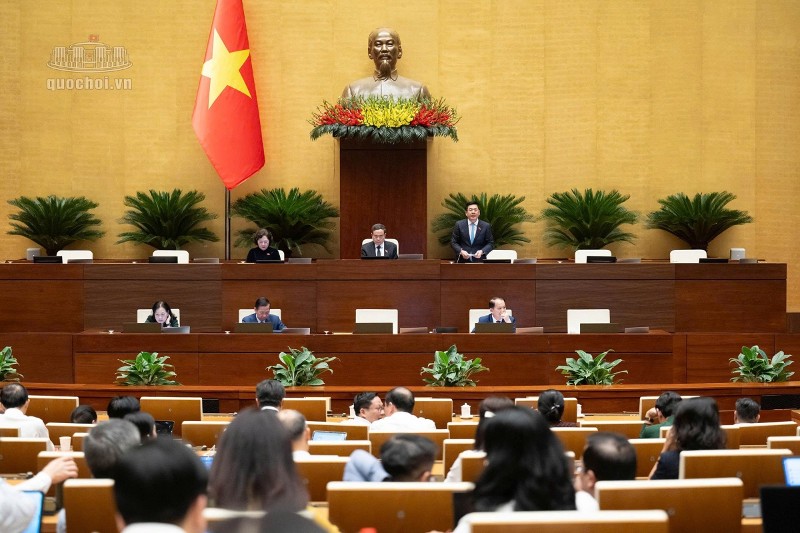
During its ongoing second session, the 16th National Assembly (NA) on November 3 discussed the draft amendment to the Electricity Law.
NA deputies focused their discussions on policies regarding biomass energy, rooftop solar power, offshore wind power, and transmission infrastructure. Concurrently, Minister of Industry and Trade, Mr. Le Manh Hung, explained key orientations to address difficulties, unlock resources, and ensure national energy security.
Unlocking mechanisms for biomass and solar energy
Proposing to maximize the use of agricultural by-products for electricity generation, especially straw, Mr. Doan Hung Vu from the Dong Thap delegation highlighted that the Environmental Protection Law mandates the collection of by-products as fuel and prohibits open burning. Resolution No. 70/NQ/TW on national energy security until 2030, with a vision to 2045, requires maximizing cogeneration biomass electricity and allows unlimited development beyond planning.
However, the new draft law only has special mechanisms for waste-to-energy, lacking clear pricing for biomass energy, leaving it to the government to decide based on economic and social development needs, causing investor concerns and large stockpiles of straw among farmers.
Therefore, Mr. Vu suggested adding the terms "biomass energy" and "biogas using agricultural by-products and livestock waste" alongside waste-to-energy in point b, clause 9, Article 5, to enjoy similar special policies.
Additionally, he proposed codifying in point e, clause 1, Article 51, the principle that electricity prices should fully reflect fuel collection costs, with fuel price components adjusted according to actual fluctuations and stable throughout the electricity purchase contract term.
Regarding rooftop solar power, Mr. Le Cong Dinh from the Tay Ninh delegation noted the lack of long-term foundational regulations, despite it being a valuable resource to reduce supply pressure during dry seasons and a "green passport" for exports.
Emphasizing that both citizens and businesses would hesitate without a legal basis, the deputy urged the drafting committee not to overlook this type of energy but to clearly define core principles in the law. He also made three specific recommendations to complete the legal framework for rooftop solar power in the draft law:
First, the law should codify the principle of self-production and self-consumption, clearly defining rights and obligations, particularly affirming the roadmap for surplus electricity sales as a legitimate right to strengthen investment confidence.
Second, supplement regulations on technical standards and digitalization of grid dispatching, mandating the application of technologies such as smart inverters and modern metering to develop virtual power plant models, allowing remote load shedding in case of incidents to ensure system safety.
Third, the law should orient policies to leverage the development of on-site battery storage systems and flexible electricity pricing mechanisms based on usage time.
This is an inevitable trend of the green economy, effectively unlocking resources; therefore, the law needs to stipulate strict framework provisions, while detailed mechanisms are assigned to the government to issue by decree, Mr. Dinh emphasized.
Resolving bottlenecks for offshore wind power
Regarding offshore wind power, Mr. Tran Van Tuan from the Bac Ninh delegation stressed the need to identify specific difficulties and risks to have appropriate support mechanisms. This is a highly complex investment field, difficult to forecast electricity mobilization and consumption throughout the project lifecycle. In reality, projects may be completed and meet technical standards but cannot fully generate capacity due to transmission bottlenecks or operational limitations.
Emphasizing the need to clearly identify the electricity purchaser and share risks, the deputy proposed adding clause 3, Article 26, stipulating that the designated electricity purchaser must be responsible for negotiating and signing contracts to ensure a minimum long-term output according to the ratio and duration prescribed by the government. When a project is ready to generate but is not mobilized or has reduced capacity due to the grid, the electricity purchaser or objective reasons must have a mechanism to compensate reasonable costs to share risks, ensuring balanced benefits among parties.
Sharing similar concerns, Ms. Le Dao An Xuan from the Dak Lak delegation noted that the draft guiding decree introduces tools not clearly defined in the law, such as priority area lists, deposit receipt funds, and concentrating too many functions on a state-owned enterprise (both listing, approving survey programs, managing data, and having the right to invest), which easily creates a risk of conflict of interest.
Therefore, she proposed supplementing Article 26 with legal grounds for priority area lists, clarifying the principle of prioritizing survey units when selecting investors, and delegating authority to provincial People's Committees with coastlines for nearshore wind power projects, substations, and connection lines.
Regarding point d, clause 1, Article 18 of the draft law, which allows large-scale offshore wind power projects not to undergo bidding, but does not specify criteria for defining "large scale," leaving it to sub-law documents, Ms. Xuan argued that this poses a risk of lack of transparency, leading to "reservation" and limiting competition. Therefore, she suggested defining framework criteria for minimum capacity, financial capability, and technology; while also adding application deadlines, public disclosure requirements, and post-audit mechanisms.
Explaining at the session, Minister of Industry and Trade Le Manh Hung outlined the objectives, scope of amendments, and consistency of the legal system in the process of adjusting and amending the Electricity Law. Accordingly, this amendment focuses on three core objectives:
First, institutionalizing the Party's policy on ensuring energy security through Resolution No. 70-NQ/TW and codifying contents already implemented according to Resolution No. 253/2025/QH15.
Second, resolving synchronously the decentralization, delegation, and administrative procedures implemented in recent times.
Third, addressing and resolving bottlenecks and obstacles in the process of planning, implementing planning, and implementing electricity projects.
Regarding renewable energy development and offshore wind power, the Minister emphasized that renewable energy has three very important characteristics: intermittency, marginal cost is essentially zero, and no spinning reserve. Therefore, the proportion and development progress of renewable energy must be synchronized with the completion and upgrading of the smart grid system. Hence, the draft law has also proposed specific mechanisms.
For offshore wind power, this is a very new field, requiring large capital, high technology, and directly linked to national defense and security. The Minister stated that the drafting agency would absorb the deputies' opinions to further improve this mechanism. However, it is necessary to clearly distinguish between offshore wind power and nearshore wind power to build appropriate mechanisms.
Minister Le Manh Hung emphasized that this amendment to the Electricity Law aims to address the requirements of removing bottlenecks in investment, operating the electricity system, decentralization, and reforming procedures associated with implementation responsibilities, ensuring transparent, consistent policies and cost control.
The government will continue to closely coordinate with National Assembly agencies to absorb deputies' opinions, complete the law project with the highest quality to present to the National Assembly for consideration and decision.






 Google translate