


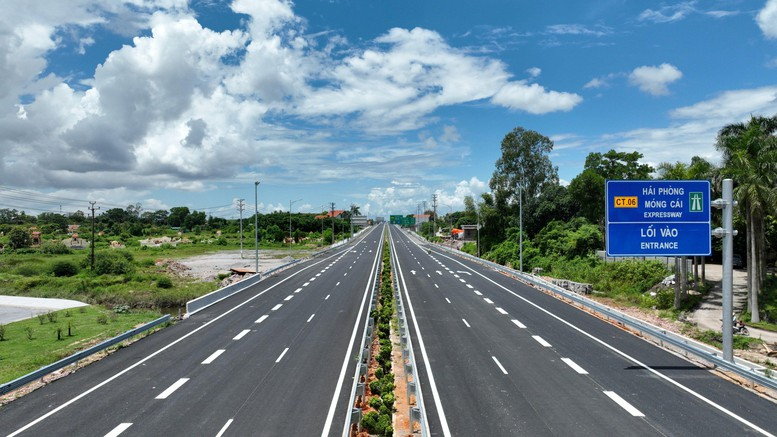
The Department for Roads of Vietnam has submitted a proposal to the Ministry of Construction for the appraisal of an adjusted road network plan for the 2021-2030 period, with a vision toward 2050.
Notably, the department has proposed the inclusion of five national highways to be developed to expressway standards, comprising Beltway 1, Beltway 2, the Ha Tinh - Cau Treo route, the Hue - A Luoi route, and the Phan Thiet - Bao Loc - Gia Nghia route.
Beltway 1 is planned to be approximately 315 km long with four lanes, starting at the junction with the Dong Dang - Tra Linh Expressway in That Khe (northern mountainous Lang Son proovince) and ending at the junction with the Hanoi - Hoa Binh - Son La - Dien Bien Expressway in Muong E (northern mountainous Son La province). Traversing the provinces of Lang Son, Thai Nguyen, Tuyen Quang, Lao Cai, and Son La, the project is slated for investment after 2030.
Meanwhile, Beltway 2 will span roughly 378 km with four lanes, connecting Hoang Van Thu (northern mountainous Lang Son proovince) to Mai Son (northern mountainous Son La province). While the overall route is proposed for development after 2030, the section between Lang Son and Thai Nguyen may be researched and implemented both before and after that milestone.
The Ha Tinh - Cau Treo route is designed to be 85 km long with four to six lanes, running largely parallel to National Highway 8. It begins at the intersection with the eastern North-South Expressway in Truong Luu (central Ha Tinh province) and terminates at the province's Cau Treo International Border Gate. Proposed for investment throughout the pre- and post-2030 phases, this route is expected to form a high-speed transport axis connecting the border gate with the national transport system, seaports, and logistics centers, while simultaneously easing traffic pressure on National Highway 8.
In Central Vietnam, the Hue - A Luoi route will cover 45 km with four lanes, running parallel to National Highway 49. Scheduled for investment after 2030, the route will enhance connectivity between western Hue and the Hong Van and A Dot border gates.
Finally, the Phan Thiet - Bao Loc - Gia Nghia route is proposed to span 194 km with four lanes, with investment planned for both the pre- and post-2030 periods. This route is envisioned as a vital East-West economic corridor, strengthening links between the Southern Central Highlands, the South Central Coast, and the Southern Key Economic Region.





 Google translate