



The year 2026 is the first year of Vietnam’s Socio-Economic Development Plan for the 2026-2030 period and also marks the country’s largest public investment program on record. The National Assembly has approved approximately VND1,080 trillion ($41.5 billion) in State budget investment, while the allocation assigned and updated by the Prime Minister through mid-July stood at some VND1,014 trillion ($39 billion).
Despite the unprecedented funding, implementation has fallen short of expectations. According to the National Statistics Office at the Ministry of Finance (MoF), State budget-funded investment implemented during the first half of 2026 was estimated at VND335.6 trillion ($12.9 billion), up 12.7 per cent year-on-year but well below the 22.6 per cent growth recorded in the same period of 2025.
Yet the challenge extends beyond spending the allocated budget. The priority is to convert public funds into completed infrastructure, new productive capacity, and higher value-added output. That requires shifting the focus of public investment management from headline disbursement rates to project-level execution, with greater emphasis on critical paths, bottleneck resolution, and clear accountability.
Heavy disbursement burden
Under the original allocation, total State budget investment amounted to VND995.35 trillion ($38.3 billion), including VND345.12 trillion ($13.3 billion) from the central government budget and VND650.23 trillion ($25 billion) from local governments. Following subsequent revisions, the allocation had increased to VND1,014 trillion ($39 billion) by mid-July.
Public investment disbursement reached VND356.9 trillion ($13.7 billion) in the first half of the year, equivalent to 35.5 per cent of the Prime Minister’s annual target and VND38.4 trillion ($1.5 billion) higher than in the same period of 2025. Progress continued in July, with disbursement rising to VND370.85 trillion ($14.3 billion), or 36.8 per cent of the annual plan, by July 9, and VND378.01 trillion ($14.5 billion), or 37.3 per cent, by July 16.
The pace of implementation, however, remained uneven. Only about VND7.16 trillion ($275 million) was disbursed during the week of July 10-16, equivalent to 72 per cent of the previous week’s total. By July 16, just eight ministries and central agencies and 22 cities and provinces had achieved disbursement rates at or above the national average.
It is also important to distinguish between “investment implemented”, as estimated by statistical authorities, and “investment disbursed”, which refers to payments processed through the treasury system. Implemented investment measures the actual volume of work completed during the reporting period, while disbursement may include advance payments, settlements for work completed in earlier periods, or expenditures that have yet to create productive assets. As a result, public investment’s contribution to GDP depends primarily on investment actually carried out rather than the total amount disbursed.
To achieve 95 per cent of the annual plan, Vietnam would need to disburse an additional VND585.5 trillion ($22.5 billion) between the second half of July and year’s-end. Reaching 100 per cent would require another VND636.2 trillion ($24.5 billion), equivalent to average monthly disbursement of VND100-110 trillion ($3.8-4.2 billion); well above the pace recorded in the first half of the year.
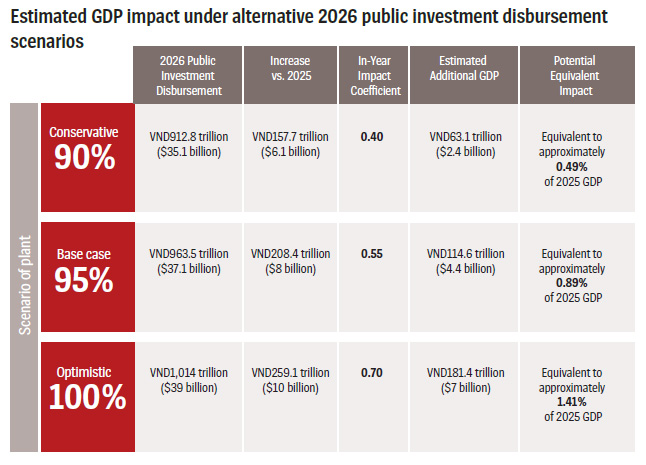
Without significant improvements in project implementation, spending could once again become concentrated in the closing months of the year. That would increase the risk of technically-driven disbursement, including advance payments unsupported by corresponding construction progress, while placing additional strain on contractors, material supplies, project acceptance, and payment controls. Ultimately, it could also weaken public investment’s contribution to GDP growth in 2026.
Contribution to GDP growth
Public investment supports economic growth through three main channels. First, it directly contributes to gross fixed capital formation; a key expenditure component of GDP, as spending on construction, machinery, equipment, and fixed assets increases both investment and aggregate demand.
Second, it stimulates demand across related industries, including construction, building materials, engineering, transport, consulting, and financial services. Total investment implemented across the economy reached VND1,808 trillion ($69.5 billion) in the first half of 2026, up 12.9 per cent year-on-year. State budget investment accounted for VND335.6 trillion ($12.9 billion), or about 18.6 per cent of the total, highlighting its significant role in supporting overall investment demand.
Third, public investment generates longer-term spillover effects. Completed infrastructure can reduce logistics costs, strengthen regional connectivity, improve electricity and digital infrastructure, enhance irrigation systems, and increase climate resilience. Once projects become operational, they can also crowd in private investment and raise the economy’s long-term productive capacity.
However, not every dollar of public investment disbursed translates directly into GDP growth within the same year. Land acquisition and compensation largely involve asset transfers, while advance payments that have yet to be converted into construction output create no immediate value-added. Imported machinery and materials increase imports rather than domestic production, and payments for work completed in previous years do not necessarily represent new output in 2026. As a result, one dollar of disbursement cannot be equated with one dollar of GDP.
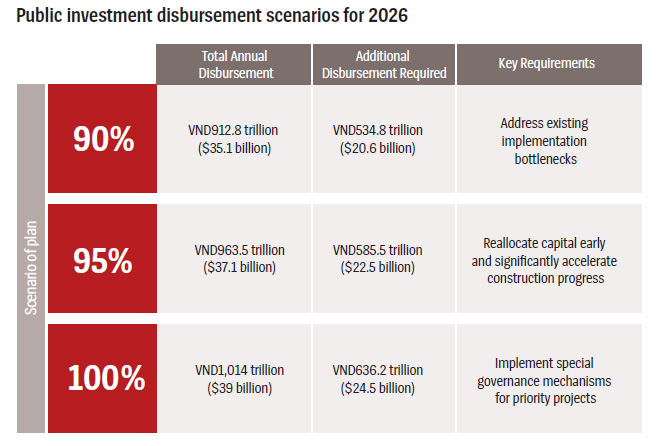
Using a scenario-based approach that compares 2026 with 2025’s public investment disbursement of VND755.14 trillion ($29 billion) and applies an “in-year impact coefficient” of 0.4-0.7, the estimated outcomes are presented in the accompanying Table. The lower coefficient is broadly consistent with World Bank findings for developing economies, while the higher coefficient assumes investment is concentrated in projects with high domestic value added, rapid completion, and strong crowding-in effects for private investment.
Under this framework, achieving approximately 95 per cent of the annual public investment plan could generate an incremental economic impact equivalent to about 0.89 per cent of Vietnam’s 2025 GDP. If the government achieves full implementation and investment is quickly converted into construction output, generates high domestic value added, and stimulates private investment, the potential impact could rise to around 1.41 per cent of 2025 GDP. By comparison, achieving only 90 per cent of the annual target would produce an estimated impact of about 0.49 per cent.
These figures are scenario estimates rather than direct measurements. They illustrate the potential economic impact relative to Vietnam’s 2025 nominal GDP, not the absolute share of public investment in GDP. Part of public investment’s contribution has already been reflected in first-half GDP growth, while its impact during the remainder of the year will depend on the pace of project execution, investment prices, import intensity, and the economy’s capacity to absorb additional investment.
Execution gap
Several structural factors continue to constrain public investment disbursement.
First, project preparation and capital allocation remain poorly aligned with implementation capacity. Weak project preparation continues to be a fundamental bottleneck. In some cases, funding has been allocated before investment procedures, technical designs, cost estimates, environmental impact assessments, or site clearance have been completed. In addition, capital allocation in some localities has relied heavily on registered funding requests rather than realistic implementation schedules and actual absorption capacity. As a result, some projects face funding shortages despite active construction while others receive substantial allocations but are unable to move forward.
Second, land acquisition and site clearance remain the biggest bottlenecks on the ground. Challenges include determining land ownership, setting compensation levels, arranging resettlement, approving land-use conversion, and coordinating between project owners and local authorities. Many projects receive cleared land only in fragmented sections rather than continuous stretches, preventing contractors from organizing efficient construction and increasing costs.
Third, shortages of construction materials, price volatility, and limited contractor capacity have become increasingly apparent. Multiple large transport projects getting underway simultaneously have driven exceptionally-strong demand for sand, fill material, construction stone, and waste disposal sites. In some cases, procedures for licensing, expanding production capacity, or allocating material quarries have failed to keep pace with construction schedules. Rising material and fuel costs have also reduced contract profitability, particularly under lump-sum or fixed-price contracts.
At the same time, some contractors are engaged in multiple major projects, stretching their workforce, equipment, and working capital. Contractor assessments also continue to rely heavily on documentation rather than reflecting actual workloads across other projects.
Fourth, project implementation and interagency coordination remain inefficient. Capacity varies significantly across project management units, many of which still lack specialists in legal affairs, contract management, valuation, and schedule control. Coordination between agencies responsible for land, construction, environmental management, finance, and local administration often remains sequential rather than concurrent, slowing down decision-making.
Project acceptance and payment documentation also frequently lag behind completed construction. In some cases, works have been completed but payment dossiers remain unfinished, delaying reimbursement. Existing monitoring systems continue to focus primarily on aggregate disbursement rates rather than tracking critical milestones, actual construction progress, and delay risks at the contract-package level.
Fifth, accountability and implementation discipline remain insufficiently strong. Some officials continue to adopt a risk-averse approach, delaying decisions while awaiting further guidance. Though greater authority has been decentralized, it has not always been matched by stronger accountability. Individual performance is rarely measured against project outcomes, while decisions to reallocate funding, replace underperforming contractors, or restructure weak project management units are sometimes delayed, reducing the time available to resolve implementation issues during the year.
Overall, three issues remain at the core of slow public investment implementation: inadequate project preparation, prolonged site clearance, and weak implementation capacity and accountability. Legal procedures, material shortages, and adverse weather can all contribute to delays, but their impact depends largely on the quality of project preparation and the ability of project leaders to respond effectively.
Six priority measures
The first priority is to manage implementation at the project level rather than relying on aggregate disbursement targets. Authorities should identify the projects that account for 70-80 per cent of the remaining undisbursed capital and place them under enhanced supervision. For each project, the critical path, major bottlenecks, responsible agencies, accountable officials, and completion deadlines should be clearly identified.
A digital dashboard should be updated weekly, tracking construction progress, certified work completed, payments made, and issues requiring intervention. Government and local task forces should shift from general oversight to resolving project-specific bottlenecks directly on site.
The second priority is to reallocate capital earlier based on actual implementation capacity. Funding should be reallocated immediately rather than waiting until the fourth quarter. Projects lacking cleared land or incomplete procedures or are delayed for subjective reasons should face budget reductions, with funding redirected to projects demonstrating construction progress, strong completion prospects and high domestic value-added content.
Each ministry and locality should maintain a pipeline of reserve projects that have completed all procedures and are ready to receive additional funding. Projects that have repeatedly posted weak disbursement due to poor implementation should no longer receive priority for new allocations. The public investment performance assessment system established under Decision No. 1129/QD-TTg, dated June 24, 2026, should also be linked to future capital allocation, performance evaluations of agency heads, and the selection of project owners.
The third priority is to remove bottlenecks in land acquisition and construction materials. For major national projects, interdisciplinary task forces should be empowered to resolve issues related to land ownership, compensation, resettlement, material quarries, and waste disposal sites. Site clearance should be handed over in sufficiently long continuous sections rather than fragmented parcels, to enable uninterrupted construction.
For large, multi-year projects, land acquisition should be separated into an independent project whenever legally feasible. Resettlement areas should be completed before, or alongside, land acquisition, while site clearance progress should become a Key Performance Indicator (KPI) for local governments rather than remaining solely the responsibility of project owners.
The fourth priority is to accelerate project acceptance and payment procedures. Acceptance should be carried out by construction phase, project component, or completed work volume rather than accumulating documentation until the end of each quarter or year. Documentation exchanged between contractors, project owners, project management units, and the State Treasury should be fully digitized, with clear processing deadlines at every stage.
Authorities should also distinguish genuine disbursement from advance payments. Performance indicators should track both payments made and certified construction output, while overdue advances, or those unlikely to be converted into completed work, should be recovered promptly to prevent artificially higher disbursement rates without corresponding gains in output or GDP.
The fifth priority is to strengthen accountability and address underperforming organizations. Monthly implementation targets should be assigned to agency heads, project owners, project management units, and contractors, with results disclosed publicly and measured against both national averages and agreed commitments. Delays caused by subjective factors should lead to lower performance ratings, reassignment of responsibilities, or replacement of officials.
Contractor evaluations should also be updated regularly to reflect actual workloads, equipment, workforce availability, and financial capacity. Contractors with persistent implementation failures should face reassignment of work packages, the appointment of additional subcontractors, or contract termination, in accordance with regulations.
The sixth priority is to maximize public investment’s contribution to GDP growth. Funding should be prioritized for projects that can be completed and become operational before the end of 2026 or early 2027, particularly those involving regional connectivity, logistics, energy, digital infrastructure, flood control, and climate adaptation. Preference should also be given to projects capable of expanding development space and attracting private investment.
The use of domestically-produced materials, equipment, and services should be encouraged whenever they meet quality, pricing, and procurement requirements. This would reduce import leakage while strengthening spillover effects across the domestic economy. Authorities should also publish land-use plans, land reserves, and connected project pipelines early so that private investors can develop industrial, service, and urban projects alongside new public infrastructure.
Implementation roadmap
During July and August, authorities should complete a comprehensive review of all public investment projects, carry out the first round of capital reallocation, identify critical implementation paths, and resolve administrative procedures within their authority. This period will largely determine the volume of construction work that can be generated during the third quarter.
Between September and October, efforts should focus on accelerating construction, implementing a second round of capital reallocation, addressing underperforming contractors and project management units, and preparing project acceptance documentation concurrently with construction.
During November and December, priority should shift toward completing construction, project acceptance, and payments, while avoiding reliance on advance payments simply to improve disbursement statistics. Authorities should simultaneously evaluate project quality and investment efficiency and prepare the pipeline of continuing projects for 2027.
The MoF should lead the monitoring of capital allocation, disbursement, reallocation, and payments. Sectoral ministries should be responsible for technical standards, pricing mechanisms, and construction material supply. Local governments should oversee land acquisition, resettlement, and procedures within their jurisdiction, while project owners and project management units should bear direct responsibility for implementation schedules, construction quality, and payment documentation.





 Google translate