


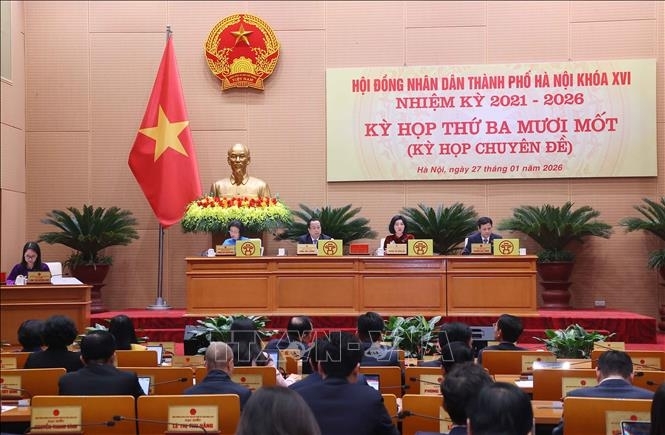
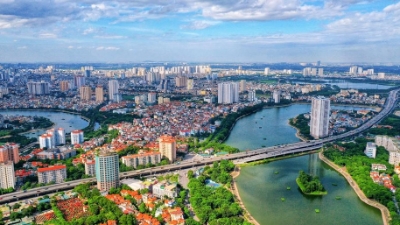
The Hanoi People’s Council officially approved a Resolution on the Capital’s Master Plan during its 31st session on January 27, establishing a strategic 100-year vision for the city’s development.
The plan identifies a "multi-polar, multi-center, multi-layered, and multi-tiered" urban development model as the core solution to alleviate overcrowding in the city center. This model aims to ensure the rational distribution of population, infrastructure, and socio-economic activities while creating a sustainable development space for the long term.
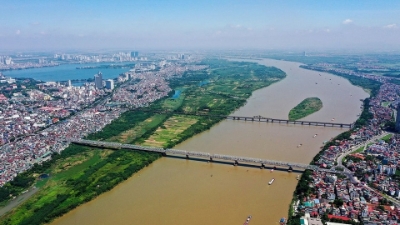
A central pillar of the Master Plan is the establishment of nine growth poles, which will serve as the primary drivers for the Capital’s spatial and economic transformation: the Central Urban Area (right bank of the Red River); the Northern Pole (Dong Anh – Me Linh – Sóc Son); the Eastern Pole (Gia Lam – Long Bien); the Southern Pole – Central Urban (Thuong Tin – Phu Xuyen); the Southern Van Dinh – Dai Nghia Pole; the Southwestern Pole (Xuan Mai – Chuong My); the Western Pole (Hoa Lac); the Northwestern Pole (Son Tay – Ba Vi); and the Red River Pole.
In parallel with the growth poles, the Master Plan establishes nine major urban centers based on their scale, characteristics, and competitive advantages.
These centers include: the Southern Red River Urban Center; the Northern Red River Urban Center; the Eastern Urban Center; the Olympic Urban Center; the Phu Xuyen Urban Center; the Van Dinh – Dai Nghia Urban Center; the Xuan Mai Urban Center; the Hoa Lac Urban Center; and the Son Tay Urban Center.
Each center is assigned distinct functions—ranging from political-administrative and economic activities to logistics, science, technology, education, healthcare, culture, tourism, and ecology—to form a balanced and mutually supportive development network.
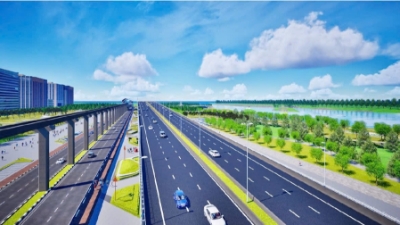
Regarding dynamic development axes, the plan establishes nine spatial axes and economic-urban corridors following major traffic arteries. Notably, the Nhat Tan – Noi Bai / Bac Thang Long – Noi Bai axis will serve as the backbone for the development of the northern gateway urban area, utilizing an "Airport City" model.
The West Lake – Co Loa – Gia Binh Airport axis will connect the city center with the new northeastern economic region, driving the development of creative, financial, and high-tech urban zones. Meanwhile, the National Highway 5 / Hanoi – Hai Phong Expressway axis is designated as a smart service, commercial, and logistics corridor connecting the Capital to the sea.
Other key corridors, including National Highway 1A / Phap Van – Cau Gie, National Highway 21B – 21C, National Highway 6, Thang Long – Ba Vi Boulevard, National Highway 32 – Tay Thang Long, and the Red River Landscape Boulevard, will play vital roles in spatial connectivity, fostering economic, cultural, and tourism growth while forming sustainable development corridors.
The Resolution also sets out a system of specific development indicators to serve as a foundation for the long-term implementation of the Master Plan.
Regarding land use, by 2045, urban construction land will account for approximately 45–50% of the total natural land area. This figure is projected to reach 55–60% by 2065 and may increase to a maximum of 70% by 2100, depending on the context and practical requirements.
Hanoi’s population is projected to reach 15–16 million by 2045 and 17–19 million by 2065. By 2100, the population is expected to stabilize at under 20 million to remain consistent with land-use standards and alleviate urban pressure.



 Google translate