


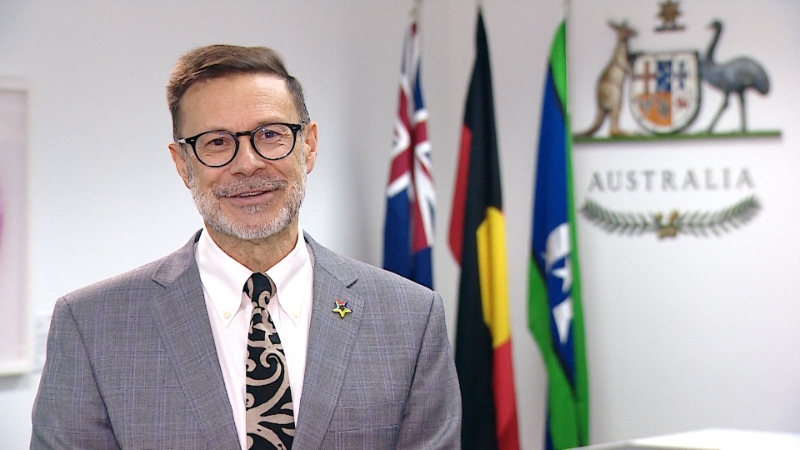
As Vietnam enters 2026, from a foreign observer’s perspective, how would you view the country’s current stage of development?
I think Vietnam is probably the most interesting country in Asia right now, and possibly one of the most interesting in the world. It is attracting a great deal of positive attention, certainly from Australia, but also more broadly. People are looking at Vietnam through different eyes than they were even a few years ago, because the country is going through rapid change and, unlike almost everywhere else, its story is a positive one.
When we look around the world, we see negative disruption - war, injustice, and economic difficulty. Vietnam, by contrast, stands out as a positive story, and I think there is a real appetite globally for that at the moment.
The past year has been remarkable. Vietnam’s economic growth reached some 8.02 per cent, with the final quarter coming in at 8.46 per cent. FDI rose by roughly 9 per cent, and manufacturing by about 10 per cent. Even though US tariffs hit Vietnam harder than almost any other country, manufacturing investment continued to grow, and Vietnam’s trade surplus with US also expanded. That is quite extraordinary.
Reform is another key part of the story. What we are seeing now is, in many ways, a reboot of “Doi Moi” (Economic Renewal). I believe the 14th National Party Congress will be the most important in at least half a century. I do not expect Vietnam’s political system to change fundamentally in the foreseeable future, but I do think the country will continue to align itself more closely with international norms. That would be politically significant, but not radical, and I do not think it would surprise or concern overseas partners.
What is genuinely radical and interesting are the policy resolutions adopted last year. These include strengthening the role of the private sector relative to the State sector, reinforcing the importance of FDI, and positioning Vietnam as a safe haven for financial institutions, with initiatives such as the Ho Chi Minh City and Da Nang financial centers. Even decisions like prioritizing English-language education at the primary school level send strong signals. All of these measures help set Vietnam up for long-term success.
I am optimistic, but execution will be the real challenge. Making these policy pronouncements is already a significant commitment by the leadership, but delivering on them is much harder. There will always be vested interests, bureaucratic inertia, and political headwinds. As Vietnam’s leadership has correctly identified, the country does not have the luxury of moving slowly. It either moves forward quickly or risks falling behind. The world will not wait.
Demographics underline this urgency. Vietnam needs to become wealthy before it becomes old. Birth rates are declining rapidly, similar to what we have seen in South Korea, and technology, competitors, and partners are not going to slow down. Moving fast inevitably means taking risks and sometimes breaking things, but that is a choice Vietnam has to make.
So the challenge now is translating policy commitments on paper into real-world implementation?
Exactly. Translating policy from paper into practice is the hard part. And one major challenge that still has not been fully addressed is trust.
In an international investment context, trust comes from a predictable and transparent legal system, and a predictable and transparent bureaucracy. The legal system, in particular, is critical. When investors are committing hundreds of millions or even billions of dollars, they expect disputes to arise. That is normal. What matters is confidence that the law will be upheld, that courts will be fair, and that cases will be handled without corruption. If one party can influence the outcome by bribing a judge, confidence in the entire system collapses.
This remains a work in progress in Vietnam. That said, there are encouraging signs. Moves to introduce foreign judges in International Financial Centers would be a major step forward and potentially a game changer. If that principle could then be extended more broadly - not necessarily through foreign judges, but through a judiciary that is fully trusted to apply the law impartially - it would significantly reduce investor concerns.
When I speak with potential investors, including two large Australian companies I am currently advising, this issue always comes up. They tell me they understand the legal systems in Singapore and Malaysia. Vietnam’s system, they say, they do not yet fully understand. There is a perception that judges can sometimes be influenced by one side or the other.
For me, this is an important priority that I hope the government continues to address. I am comfortable saying this publicly, because when foreign investors assess Vietnam, legal predictability and trust in the system are among the key factors they take into account.
How do you assess Vietnam’s diplomatic positioning in 2025, particularly its ability to maintain an independent and balanced foreign policy amid an increasingly complex global environment?
It is a tricky time for everybody, but I am an admirer of Vietnam’s foreign policy. I think it has managed the balance extremely well.
When I first became Ambassador to Vietnam, the country had only three comprehensive strategic partners: Russia, China, and India - its traditional partners. Since then, it has added eleven more. That expansion is not accidental. It is very deliberate. Vietnam is sending a clear signal that it is not abandoning its traditional partners while actively engaging new ones. This matters because Vietnam understands that if it wants to build a world-class, high-tech economy, it needs to work closely with these newer partners. That kind of economic transformation will not come from Russia or India alone.
Vietnam is also practicing very active diplomacy. Rather than waiting for other countries to come to it, Vietnam is going out into the world. The frequency of overseas visits by the top leadership is a signal of that approach. It is a form of strategic hedging - Vietnam is not putting all its eggs in one basket, but spreading them carefully. I think that is very smart.
Another important trend is Vietnam’s growing leadership role in the region. Within ASEAN, leadership has often shifted between countries such as Indonesia, Singapore, and Malaysia. Vietnam is now clearly joining that group. As its economy grows and its confidence increases, it is natural and positive for Vietnam to play a larger role in setting agendas, leading discussions, and potentially helping to broker regional disagreements.
Another area to watch is Vietnam’s growing engagement at the multilateral level. I sense that it increasingly wants to play a role in shaping global norms, whether in peacekeeping, treaty-making, or setting the broader “rules of the road.” These were areas traditionally dominated by Western countries, but middle powers like Australia and Vietnam now have greater scope to contribute constructively.
I cannot yet prove this, but there are signs in Vietnam’s language and diplomatic messaging that point in this direction, including greater emphasis on multilateral diplomacy, multipolarity, and global rule-setting. These are areas where I expect Vietnam’s contribution to be positive.
Vietnam is also one of the world’s most exposed countries in terms of foreign trade, land borders, and maritime boundaries. It cannot afford to be aloof. It has a great deal at stake, and that reality underpins the careful, active, and balanced foreign policy we are seeing today.
Looking at Vietnam’s economy in 2025, what do you see as the most important drivers of growth, and where do the main structural challenges still lie?
The main driver of growth at the moment is the government, particularly its push to create a more enabling environment for business. That effort is real and significant, but it is not finished. There is still a lot more to do.
The government’s role remains crucial, but structural reform is essential. Around 50 per cent of Vietnam’s economy is still controlled by the State or State-owned enterprises (SOEs). In Australia, that figure is closer to 15 per cent. That gap matters. If Vietnam is to move from its current position to becoming an upper-middle-income economy by 2030, and a high-income developed economy by 2045, the share of the economy controlled by the State will need to fall.
This is not easy. Some SOEs are very large and powerful, and some sectors are politically sensitive. Mining is a good example. Vietnam has traditionally kept mining within the State sector, but SOEs rarely perform well in mining anywhere in the world. Modern mining is highly technological, capital-intensive, and sophisticated. It is not dirty or old-fashioned. It is driven by computers and robotics.
This matters because Vietnam holds the world’s second-largest reserves of rare earths. If it wants to play a serious role in critical minerals, it will need to open up these sectors, including mining and high-end processing, to more private and foreign participation. That can be done without compromising sovereignty or national interests. The government can still set the rules, while allowing others to do the work.
The same logic applies to financial services. Vietnam is moving towards bringing in more foreign banks and higher-end services such as brokerage and insurance. These institutions help create the conditions that attract broader FDI.
Technology is another major area. Vietnam is well positioned to participate in sectors such as AI, quantum computing, and semiconductors, but success again depends on trust. I recently read an insightful article about why China cannot compete with Taiwan (China) in high-end semiconductors. The key reason was trust. In the one factory, Taiwanese firms produce advanced chips for Nokia, Samsung, and Apple, which are all direct competitors, because all of them trust Taiwan (China) to protect their intellectual property. Vietnam needs to become the country that everyone trusts.
Education is another critical constraint. The biggest limiting factor across all these sectors will be the availability of well-trained people. The government understands this, and education will ultimately determine how fast Vietnam can move. I would like to see Australia do even more with Vietnam in this area.
Agricultural technology is also important and often overlooked. Around 30 per cent of Vietnam’s population is still involved in agriculture. As people move into manufacturing and technology, agriculture will need to become more productive with fewer workers. Australia’s experience with large-scale, technology-driven farming is not directly transferable to Vietnam, but there is valuable cooperation under way.
Australian agencies such as the Commonwealth Scientific and Industrial Research Organisation (CSIRO) and the Australian Centre for International Agricultural Research (ACIAR) are working with Vietnamese universities on remote sensing, satellite-based monitoring of water and soil conditions, and developing more resilient crop varieties, including salt-tolerant rice. These efforts will be increasingly important as climate conditions change.
Finally, infrastructure remains critical. Vietnam can still build major infrastructure relatively cost-effectively, something that is now very difficult in countries like Australia. That window will not stay open forever. Costs will rise as incomes increase and the population ages. Now is the time to move.
How would you describe the status of Vietnam-Australia relations today compared with when you served as Ambassador, and where do you see the greatest opportunities for the partnership going forward?
I think the relationship is excellent. Both countries have clearly identified each other as key partners.
From Australia’s perspective, when we look north, Vietnam stands out as one of the fastest-growing economies. Australia is home to hundreds of thousands of Vietnamese-speaking citizens, so we understand Vietnam well. Vietnam is also one of Australia’s most popular travel destinations. There is genuine warmth and affection in the relationship.
That said, I still think Australia should have visa-free access to Vietnam. It is strange that Australians can travel visa-free to almost every country in the region but still need a visa for Vietnam. Even so, Australia is now among the top inbound tourism markets for Vietnam, which is very positive.
From Vietnam’s perspective, Australia is a familiar and trusted partner. There is a steady flow of Vietnamese Government delegations to Australia, and strong two-way movement of students. Vietnam also understands Australia as a non-threatening partner. We are not a competitor, and we are not a security risk, but we do have capabilities and experience to share.
There is also a great deal of historical goodwill. Australia was one of the earliest countries to engage with Vietnam, even during periods when Vietnam was under embargo. Diplomatic relations began in 1973, before Vietnam’s reunification. Australia helped build the first bridges over the Mekong River, established the first foreign bank and university, connected the northern and southern electricity grids through the first 500 kV transmission lines, and built Vietnam’s first undersea cable and satellite links. The first satellite phone call from Vietnam to anywhere in the world was to Canberra. Australia also began offering scholarships to Vietnamese students as early as 1973.
At one stage, Australia played a particularly important role, but then other countries discovered Vietnam. Japan and South Korea came in strongly as Vietnam developed large-scale, low-cost manufacturing. That was a smart and necessary phase of Vietnam’s development, even if it was not where Australia was most competitive.
Looking ahead to the next stage, Australia can once again become highly relevant. We bring strengths in high-end technology, strong universities, financial technology, agricultural technology, pharmaceuticals, and specialized services. Australia does not need to operate at the scale of the United States or Europe. A small number of high-quality companies can still make a meaningful difference.
For that reason, I am very optimistic. I believe the Vietnam-Australia relationship will continue to deepen and become more complex and more substantive over time.
 Google translate