


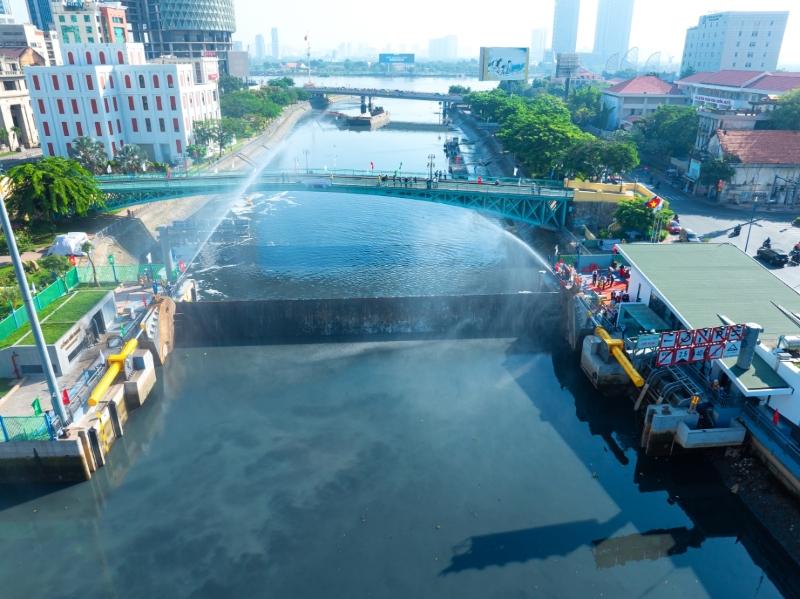
The People's Committee of Ho Chi Minh City conducted an operational inspection of the Ben Nghe tide control gate and officially resumed Phase 1 of the project titled "Flood Mitigation for Ho Chi Minh City Considering Climate Change Factors" (commonly known as the "tide control project") on February 2.
This is a critical hydraulic infrastructure project for the city, designed to manage flooding caused by high tides and heavy rains. It also aims to bolster the city’s capacity for climate change adaptation in the face of rapid urbanization and challenging geological conditions.
The scale of the investment includes the construction of six large-scale tide control gates at major river mouths: Ben Nghe, Tan Thuan, Phu Xuan, Muong Chuoi, Cay Kho, and Phu Dinh, with widths (apertures) ranging from 40m to 160m. Additionally, the project includes two smaller gates at Cau Kinh and Ba Buom.
Parallel to the gates, the project features a 6-kilometer dyke and embankment system along critical sections of the Saigon River, stretching from Vam Thuat to the Kinh River. This system is integrated with 43 smaller tide control sluices with widths ranging from 1m to 10m.
The infrastructure is also equipped with a central management facility and a SCADA (Supervisory Control and Data Acquisition) automated system. This technology will allow for proactive and flexible monitoring, operation, and regulation of water levels throughout the city.
Once fully operational, the project is expected to effectively prevent tidal flooding and provide a robust response to climate change for the city’s central areas.
Deputy Chairman of the Ho Chi Minh City People's Committee Bui Xuan Cuong noted that after several suspensions, the project has undergone a comprehensive overall review and status assessment of each component to provide a basis for further implementation. To date, the overall project has reached approximately 92% completion, with the main components largely finished.






 Google translate