


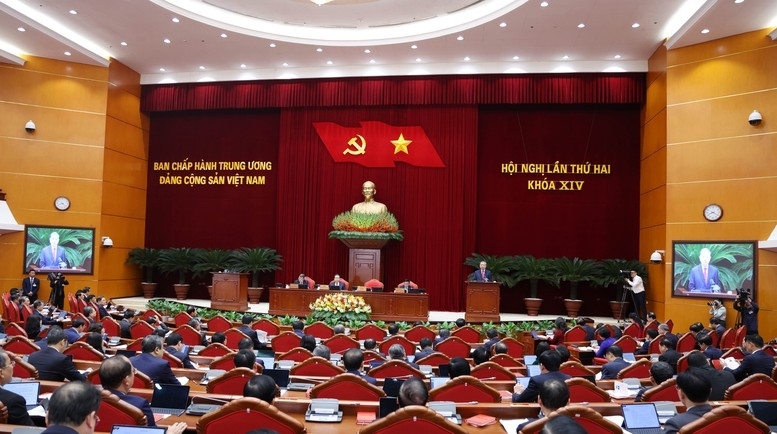
Party General Secretary To Lam on April 2 signed Conclusion No. 18-KL/TW of the 2nd plenum of the 14th Central Committee of the Communist Party of Vietnam, which highlights major tasks and solutions for socio-economic development in the 2026-2030 period.
The conclusion was quoted by the Government News as reporting that the CPV Central Committee calls for innovating governance to achieve the double-digit GDP growth goal annually while ensuring marco-economic stability between 2026 and 2030, considering this as a strategic and urgent requirement.
The Central Committee stressed the need to focus on developing synchronous and modern infrastructure system and sharpening national competitiveness to create growth breakthroughs.
Vietnam will strive to become one of three leading countries in ASEAN and among 30 leading countries around the world in terms of business environment, the conclusion noted.
The Central Committee also underscores the need to transform the growth model, with science, technology, innovation and digital transformation as the key driving force; speed up restructuring of sectors; and develop new economic models.
Vietnam will focus on improving the efficiency and competitiveness of several fundamental industries such as energy, manufacturing, shipbuilding, new materials, digital technology, biotechnology, metallurgy, and railway transport, according to the conclusion.
Policies for foreign direct investment (FDI) attraction will be innovated, shifting from tax incentives to result-based incentives, with greater focus on promoting technology transfer and partnership between domestic and FDI sectors.
Vietnam will develop domestic market to become an important fulcrum for growth; expand and diversify export markets and supply chains; effectively utilize its network of free trade agreements.
The country will give priority to developing domestic capital market to serve as a long-term capital mobilization channel while reducing reliance on the banking system; modernizing the banking and credit organization system; and increasing charter capital of State commercial banks, the conclusion confirmed.






 Google translate