


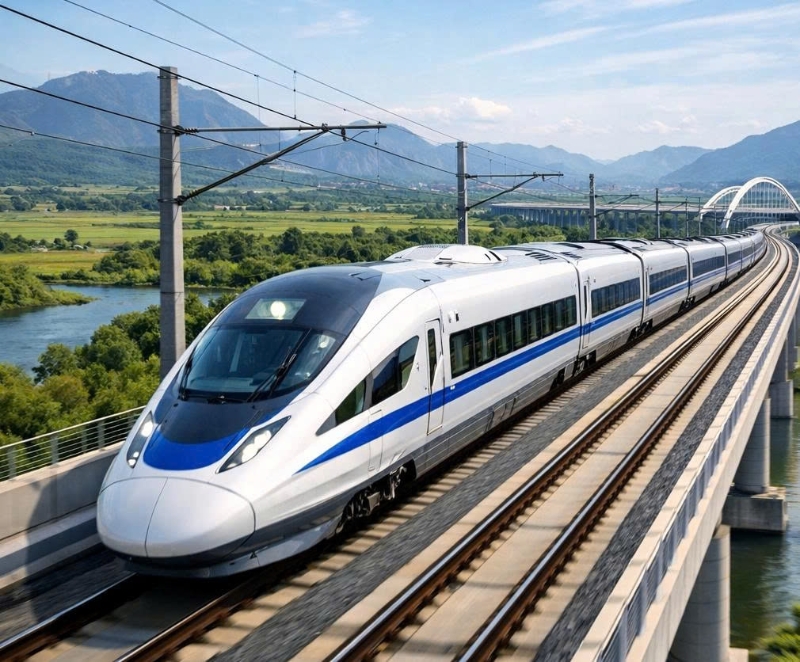
The Ministry of Construction is currently reviewing and appraising an investment proposal for a high-speed railway connecting Ho Chi Minh City with the southernmost province of Ca Mau.
According to the proposal submitted by CT Group, the Ho Chi Minh City – Can Tho – Ca Mau railway is planned as a double-track, electrified line using a standard gauge of 1,435 mm. The proposed design speed is 200–250 km/h, with further research being conducted into a 300–350 km/h variant.
The developer maintains that a speed of 200–250 km/h is optimal for the efficient transport of both passengers and freight along this vital regional corridor.
The railway is expected to start at Thu Thiem Station (HCMC), where it will connect with the projected North-South high-speed railway, and terminate at Dat Mui Station (Ca Mau). The route will pass through Ho Chi Minh City and 5 Mekong Delta localities, including Dong Thap, Vinh Long, Can Tho, An Giang, and Ca Mau.
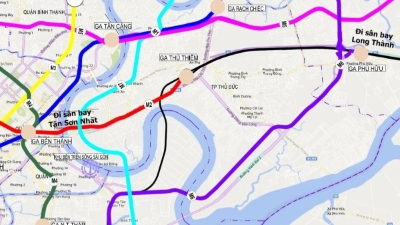
Thu Thiem Station itself is designated to serve as a major intermodal hub for three major projected rail lines: the North-South high-speed railway, the Thu Thiem – Long Thanh railway, and Phase 2 of Metro Line No. 2 (Ben Thanh – Thu Thiem).
The Ministry of Construction noted that this is a newly constructed national railway project characterized by its massive scale and total investment. The project is divided into two main segments with specific implementation phases.
Currently, the Ministry has assigned the My Thuan Project Management Board to prepare the pre-feasibility study report. Initial research indicates that the total investment required for the entire line is substantial, necessitating the mobilization of resources from multiple sectors.
Regarding site clearance, approximately VND45.675 trillion (approx. $1.74 billion) is estimated to be required for compensation, support, and resettlement.
The Ministry of Construction stated it is ready to coordinate with investors to clarify technical specifications and financial frameworks.
By 2030, Vietnam aims to develop 11 new railway lines, increasing the total national network length to approximately 3,207 km.









 Google translate