


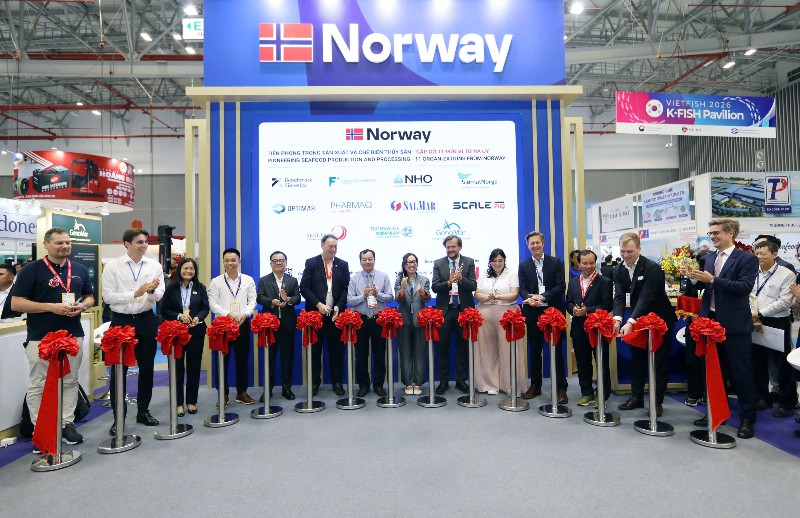
The Norwegian Pavilion was officially opened on August 19 at the Vietnam International Fisheries Exhibition (Vietfish 2026) in Ho Chi Minh City, bringing together eleven Norwegian companies and organizations. This marks the first time Norway has organized a pavilion at Vietfish.
Participating companies are showcasing solutions across various stages of the seafood value chain, ranging from aquaculture and technology to digitalization, automation, processing and by-product utilization.
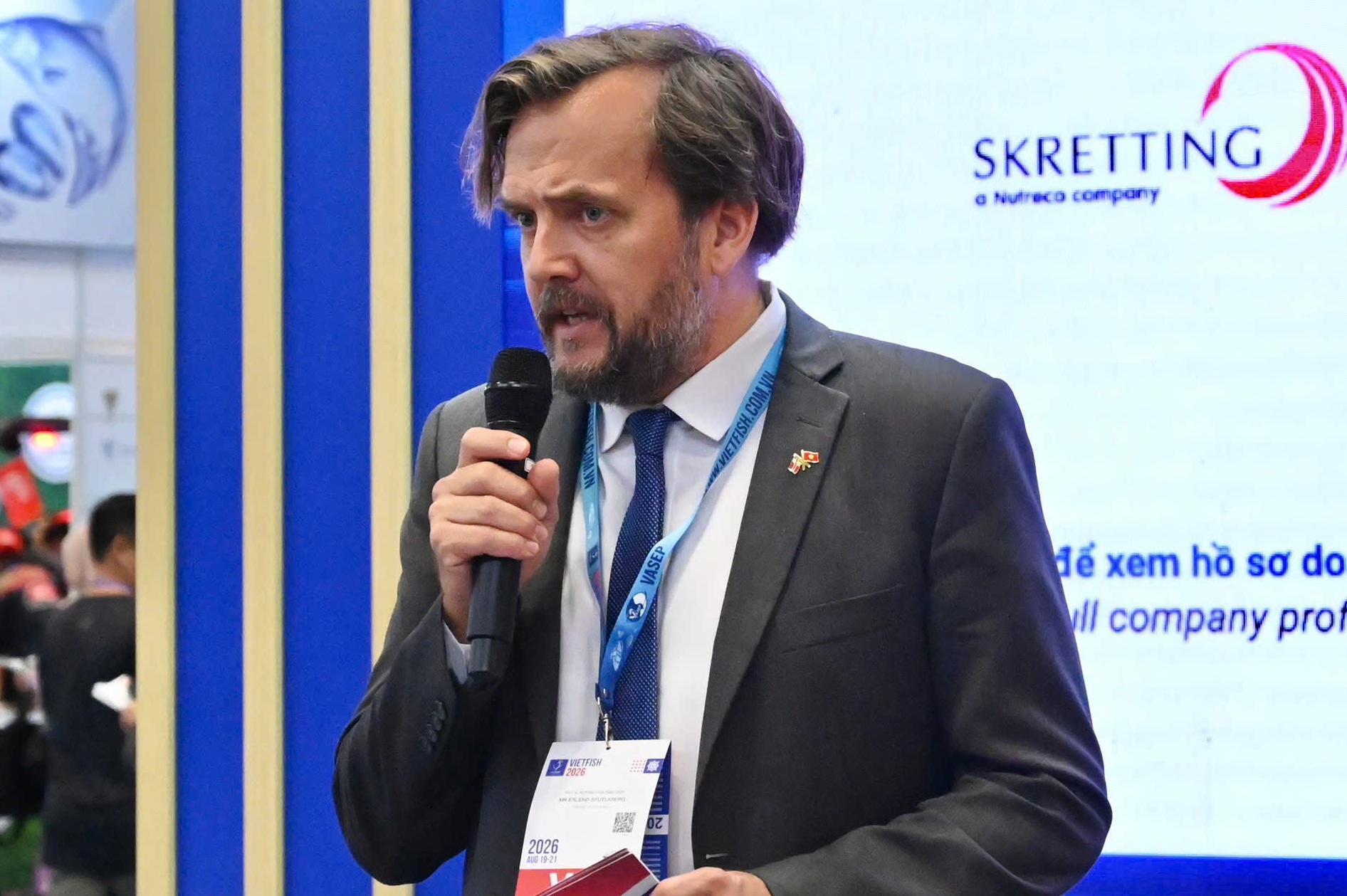
Speaking at the opening ceremony, Mr. Erlend Skutlaberg, Counsellor and Chargé d’Affaires at the Embassy of Norway in Vietnam, said fisheries, aquaculture and a sustainable ocean economy have been pillars of cooperation between the two countries for many years.
While both Vietnam and Norway have strong seafood industries, he said the two markets should be viewed as complementary rather than direct competitors. “Vietnam has set an ambition to develop its fisheries and aquaculture sectors in a more sustainable direction, while its economy is developing dynamically and rapidly," he explained. "Against this backdrop, Norway’s experience, expertise and solutions for developing a modern, efficient and sustainable seafood sector can complement Vietnam’s goals.”
Moving toward a more substantive partnership
Speaking to Vietnam Economic Times / VnEconomy, Mr. Skutlaberg said seafood accounts for around 60 per cent of Norway’s total exports to Vietnam. Norway’s participation at Vietfish is therefore expected to create more opportunities for Norwegian technology and service providers to connect with Vietnamese partners.
“This is an opportunity for Norwegian companies with expertise in technology and solutions to participate more deeply in the modernization of Vietnam’s seafood sector through technologies and solutions that improve production efficiency,” he said.
In the next phase, cooperation is expected to expand from trade into investment, technology transfer and human resource development.
Earlier this year, Norway and Vietnam’s Ministry of Agriculture and Environment signed a Green Strategic Partnership, focusing on green growth, the circular economy and a sustainable ocean economy.
“We are gradually moving the relationship between Norway and Vietnam from traditional cooperation toward a more equal partnership," Mr. Skutlaberg said. "This opens up new opportunities and shifts the focus from cooperation alone toward a partnership based on technology sharing, investment and sustainable development.”
Alongside technology, Norwegian organizations and companies also want to contribute to improving standards and the quality of human resources in Vietnam’s seafood sector.
According to Mr. Reinhard Petoris, Director of International Cooperation at the Confederation of Norwegian Enterprise (NHO), one area of cooperation is to match skills and human resources with the industry’s actual needs, while promoting greater professionalization of the value chain and improving standards and protocols for marine and aquaculture farming.
“Professionalizing the sector and raising standards will help reduce risks for foreign companies considering investment in Vietnam’s aquaculture sector,” Mr. Petoris said.
He described this as a long-term process requiring coordination among regulators, businesses and relevant organizations. Higher standards could help Vietnam’s seafood industry strengthen its competitiveness in international markets while creating more favorable conditions for foreign investment and cooperation.
Technology for efficiency and sustainability
Norwegian companies participating in Vietfish are focusing on several challenges facing Vietnam’s seafood industry, including improving animal health, reducing antibiotic use, optimizing feed, strengthening traceability and turning seafood by-products into higher-value products.
According to Mr. Johan Erling Holberg, Plant Manager at ScaleAQ Vietnam, the fragmented scale of production is one of the challenges to technology adoption. Vietnam has a large number of small-scale fish farms, while their capacity to invest in modern technologies remains limited.
He said greater cooperation and the development of larger-scale production models would help concentrate resources for technology investment. “ScaleAQ provides equipment and solutions across the fish farming process. Its plant in Vietnam focuses on underwater technology, including AI-enabled cameras and robotics” Mr. Holberg shared. These solutions can help control feed consumption, reduce overfeeding and monitor fish health, thereby reducing the need for antibiotics and chemicals.
Increasingly stringent requirements in markets such as the EU covering traceability, food safety, emissions and sustainability are also increasing demand for technologies that can monitor and demonstrate compliance. “For example, if farmers want to reduce the use of antibiotics, they need alternative solutions," he said. "One part of this is using new technologies to monitor fish health.”
Another challenge is resilience to extreme weather conditions. According to Mr. Holberg, many fish farms in Vietnam still use relatively traditional structures made from wood and nets, while Norway has developed stronger systems over several decades to withstand storms, large waves and harsh marine conditions.
Vietnam is increasingly adopting HDPE ( high-density polyethylene) for fish-farming cage structures. However, he said simply changing the material is not enough. ScaleAQ’s systems combine HDPE with internal reinforcement made from steel and other materials.
“A more comprehensive approach is needed rather than simply switching to a new material," Mr. Holberg continued. "The goal is to build modern, larger and stronger fish farms that can operate in more exposed marine areas.”
These systems are designed according to specific technical standards that determine their ability to withstand different wave and weather conditions, allowing farmers to assess operating limits and select solutions suited to their environment.
At the processing stage, Mr. Roy Olav Hovlid, Commercial Officer at Fjell Technology Group, said rising aquaculture and seafood processing output is also increasing demand for technologies that use resources and energy more efficiently while reducing environmental impacts.
Fjell Technology Group is showcasing solutions that turn fish by-products and processing waste into fishmeal and fish oil, improve energy efficiency through heat recovery and reuse, and support wastewater treatment.
According to Mr. Hovlid, increasing the value derived from by-products can both reduce waste and create additional value within the seafood production chain.
As part of Vietfish 2026, the “Norway in Spotlight” program is taking place from August 19–21, featuring presentations by nine Norwegian companies. On August 20, the Norwegian delegation will co-host a seminar on green and sustainable technology solutions for aquaculture and seafood processing, along with a roundtable on value-chain linkages aimed at producing higher-value fishmeal and fish oil.
In the context of Vietnam and Norway mark the 55th anniversary of diplomatic relations, the activities at Vietfish highlight the expansion of bilateral cooperation from seafood trade into areas with greater technological content and higher value addition.



 Google translate