


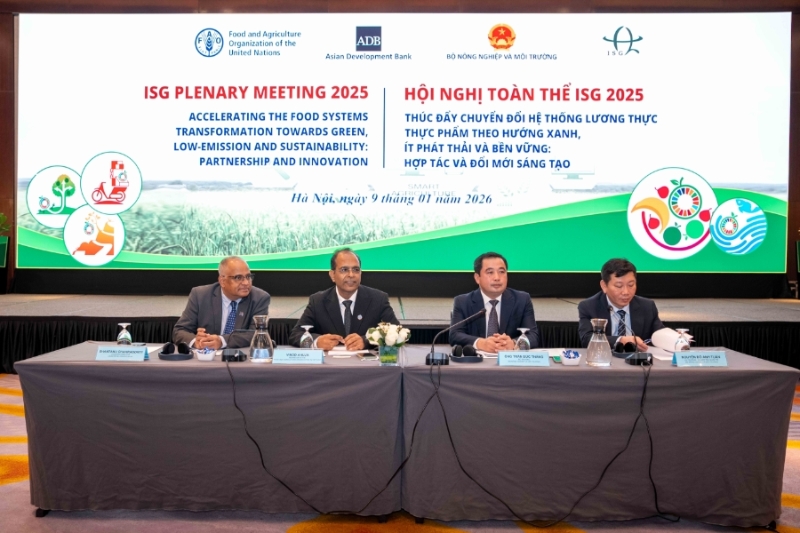
Vietnam has implemented more than 200 eco-agriculture models with support from international organizations such as the Food and Agriculture Organization (FAO) and the United Nations Development Programme (UNDP) during the 2021–2025 period.
These initiatives provided a vital foundation for expanding and upgrading sustainable farming in the coming phase.
This information was highlighted at the "International Support Group (ISG) Plenary Meeting 2025," themed "Accelerating the Food Systems Transformation towards Green, Low-Emission, and Sustainability: Parntership and Innovation" held on January 9.
According to Mr. Nguyen Do Anh Tuan, Director General of the International Cooperation Department under the Ministry of Agriculture and Environment, starting from 2026, nutrition and consumer behavior will become a primary focus of the food systems transformation program. The objective is to enhance food safety, strengthen traceability, and promote sustainable consumption patterns.
Mr. Tuan emphasized that the transformation of food systems is increasingly being approached through the lens of an "agro-food ecosystem," rather than being limited to isolated production stages.
He further noted that 2025 has clearly affirmed the prominent role of eco-agriculture in climate change adaptation and mitigation. This is reflected in Vietnam’s Nationally Determined Contributions (NDC 3.0), the project to develop 1 million hectares of high-quality, low-emission rice, and the ongoing assessment of local ecological models. Parallel to these efforts are initiatives to boost public-private partnerships (PPP) and mobilize financial resources for eco-agricultural development.
Mr. Tuan said Vietnam also continues to refine the legal and policy framework to meet the new requirements of the green transition and low-emission production.
Assoc. Prof. Dr. Tran Minh Tien, Deputy Director of the Vietnam Academy of Agricultural Sciences (VAAS), stated that future efforts will focus on effectively mobilizing financial resources and technical assistance for the ministry's key programs. These initiatives are closely linked to green growth goals, food safety, disaster risk reduction, and the application of science, technology, and digital transformation in agriculture.
From an international perspective, Mr. Nguyen Song Hà, Assistant FAO Representative in Vietnam, asserted that food system transformation strategies must be tightly integrated into key regional development programs to ensure harmony between regulations and standards.
FAO also underscored the growing importance of green finance, agricultural insurance, and carbon markets in the new era. Furthermore, the organization encouraged the collection, sharing, and scaling up of "nature-based" agricultural models that have proven effective in Vietnam. These include flood-season fish farming, rice-lotus cultivation, rice-shrimp and shrimp-forest systems, and agroforestry.

 Google translate