


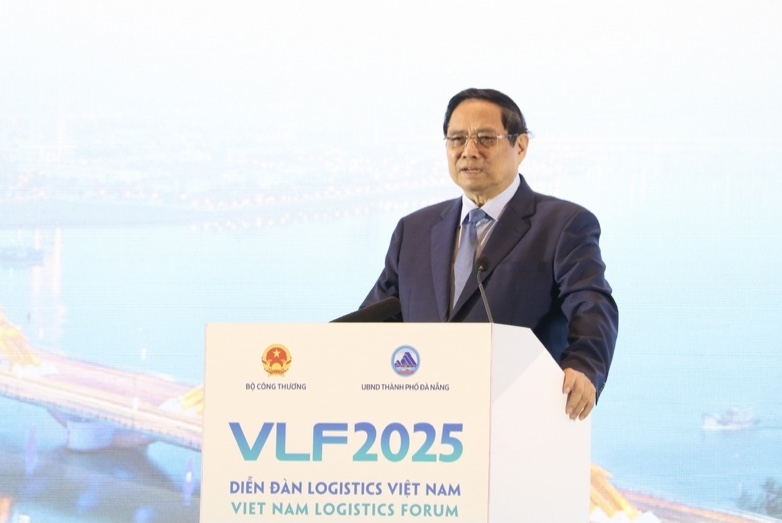
Prime Minister Pham Minh Chinh has called for a fundamental shift in the development mindset, urging a move from simply "supporting logistics" to actively "developing logistics" into a key economic sector to maximize local potential.
"We must promote regional and international linkages, consider logistics a driving force and an essential service that boosts socio-economic development, and switch from a mindset of 'management' to 'enabling and serving,' in accordance with the spirit of the new Vietnam Logistics Service Development Strategy," the PM emphasized at the Vietnam Logistics Forum 2025 held on November 29 in Da Nang.
The PM made the call to action after pointing out existing shortcomings and limitations in Vietnam's logistics sector. He noted that logistics costs in Vietnam remain high compared to regional peers (Singapore is at 8%, Malaysia at 12%). Furthermore, regional linkages and infrastructure connectivity remain unsynchronized and limited, making the supply chain vulnerable to natural disasters.
Other challenges include a distinct lack of large enterprises, lack of national-level logistics centers for international cargo transshipment, a shortage of high-quality, professional human resources suitable for an international working environment. Additionally, institutional regulations for logistics have not yet specifically covered new types of services, such as logistics for e-commerce, green logistics, and special cargo, among others.
Acknowledging Vietnam’s strategic geopolitical and geo-economic leverage, PM Chinh noted that investment in logistics remains fragmented and inadequate, leaving vast untapped potential in the sector.
To sustain an average annual growth rate exceeding 10% over the next five years, the government has established ambitious benchmarks. These include increasing the logistics sector's contribution to GDP to 5–7%, achieving an annual industry growth rate of 12–15%, and driving logistics costs down to approximately 12–15% of GDP.
He outlined a five-point strategy to achieve these numbers, focusing on institutional transparency, green and digital infrastructure, workforce upskilling, capital mobilization, and smart governance. He specifically highlighted the need to connect regulatory bodies with banking and transport sectors to foster a startup-friendly environment.
Under the motto "Open institutions – Smooth infrastructure – Smart governance," the government aims to propel Vietnam into the top 30 of the global Logistics Performance Index (LPI) by 2035.
The PM also called on industry leaders and associations to drive digital transformation and act as vital links in promoting Vietnamese logistics services globally.
According to a 2023 World Bank report, Vietnam ranked 43rd out of 139 countries in the Logistics Performance Index (LPI), placing it among the top five in ASEAN alongside Singapore, Malaysia, Thailand, and Indonesia.
Logistics costs in Vietnam have decreased to approximately 16% of GDP (down from over 20% in 2014), saving billions of dollars annually for import-export businesses.
Furthermore, logistics infrastructure has received synchronized investment, particularly regarding the network of seaports, airports, expressways, and logistics centers in key economic zones such as Ho Chi Minh City, Hai Phong, Quang Ninh, Da Nang, and Can Tho.
The logistics business sector continues to grow stronger, now boasting over 34,000 enterprises.
 Google translate