


Resolution No. 27-NQ/TW of the Politburo, signed by Party General Secretary and President To Lam on August 28, sets out a new approach to Vietnam’s regional development and national spatial organization, calling for socio-economic development space to be structured in a multi-layered, multi-polar direction, with stronger linkages among the mainland, sea, airspace, underground space, digital space and emerging development spaces, according to a report released by the Government News on September 1.
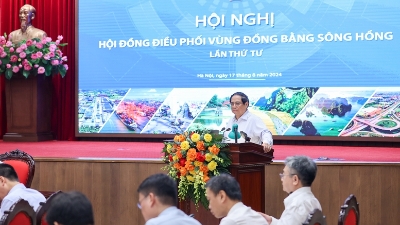
The Resolution notes that after more than three years of implementing the Politburo's resolutions on socio-economic development and national defense and security in the six socio-economic regions nationwide, awareness of the role and importance of regional development has been enhanced. Regional linkages have been strengthened, while the potential and advantages of localities and regions have been increasingly leveraged.
Against the backdrop of administrative-unit reorganization and the implementation of a two-tier local government model, the Resolution calls for strong innovation in development and growth models, with Party committees, Party organizations and authorities at all levels tasked with creating, leading, unlocking and mobilizing all available resources.
Internal resources are identified as fundamental, strategic, long-term and decisive, while external resources must be effectively combined with domestic strengths to promote rapid and sustainable development and build an independent and self-reliant economy, the resolution stated.
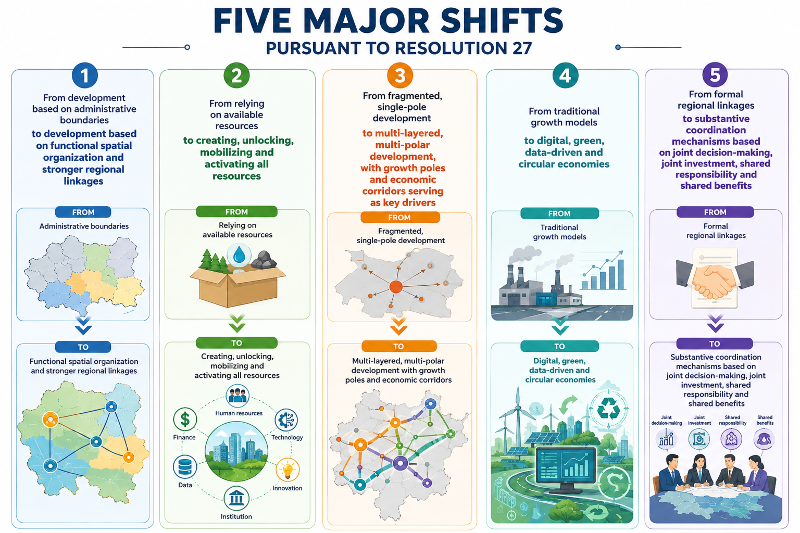
Resolution 27 stipulates five major shifts from development based on administrative boundaries to development based on functional spatial organization and stronger regional linkages; from relying on available resources to creating, unlocking, mobilizing and activating all resources; from fragmented, single-pole development to multi-layered, multi-polar development, with growth poles and economic corridors serving as key drivers; from traditional growth models to digital, green, data-driven and circular economies and from formal regional linkages to substantive coordination mechanisms based on joint decision-making, joint investment, shared responsibility and shared benefits.
The Resolution identifies regional development as a method of organizing national growth, reorganizing development space, allocating resources and enhancing national competitiveness in the new context.
It calls for the unified reorganization of national development space based on clearly defining the role, position, functions, advantages, identity and development mission of each region within the overall framework of sustainable national development.
According to the resolution, greater emphasis will be placed on linkages, complementarity and spillover effects among regions, growth poles, economic corridors, urban clusters and economic centers. New development spaces are to be effectively utilized within ecological limits and in accordance with environmental carrying capacity, while overcoming parochial approaches and fragmented or redundant development.
The Resolution sets the overall objective of restructuring, managing and effectively exploiting regional development space in close alignment with national development space, maximizing the outstanding and competitive advantages as well as the cultural identity of each region and locality.
Dynamic regions, economic corridors and growth poles are expected to play a leading and spreading role, while development must ensure strategic autonomy, energy security, food security and water security; improve people's material and spiritual well-being; and firmly safeguard national defense and security, independence, sovereignty, unity and territorial integrity, the document noted.
A key requirement of Resolution 27 is to organize regional socio-economic development space in a multi-layered, multi-polar direction, with synchronous connections among the mainland, sea, airspace, underground space, digital space and new development spaces.
The Resolution calls for the formation and development of economic corridors to effectively connect dynamic regions and national growth poles.
Regional coordination and mechanisms for mobilizing regional resources are to be strengthened to become substantive, effective and a breakthrough factor in regional development. Regional linkages will be promoted according to development spaces and value chains, with economic corridors, growth poles and dynamic urban areas serving as nuclei, according to the resolution.
It also calls for the development of a modern urban system associated with regional growth poles, alongside the completion of regional planning and the development of modern, synchronous and inter-regional socio-economic infrastructure.
Resolution 27 requires a strong transformation of regional growth models toward the development of the data economy, green economy, circular economy and digital economy.
Science, technology, innovation and digital transformation are identified as the main driving forces and the cross-cutting axis of regional development, the resolution stated.
Priority will be given to strategic infrastructure, digital infrastructure, technology infrastructure, infrastructure supporting green transformation and energy transition. These are expected to become key drivers for economic breakthroughs, expansion of development space and unlocking of resources.
The Resolution also emphasizes investment in modern and synchronous transport infrastructure capable of connecting industries, regions, localities and major economic centers, while strengthening domestic and international connectivity.
By 2045, the Resolution envisions regions operating on the basis of digital, green, data-driven and circular economic models, supported by synchronized, smart, green, safe, resilient and seamlessly connected infrastructure.
Regional development is expected to be increasingly driven by science, technology, innovation and digital transformation, with close linkages among localities within regions and between regions, according to the resolution.
It also sets out a vision of a disciplined, safe, civilized, harmonious and progressive society, with social governance supported by a comprehensive digital social platform, a sustainable ecological environment, and modern, autonomous and self-reliant national defense and security.
People are expected to have access to high-quality social services, contributing to the broader goal of building Viet Nam into a developed, high-income country that steadily advances toward socialism.
Resolution 27 replaces Resolutions 11, Resolution 13, Resolution 23, Resolution 24, Resolution 26 and Resolution 30 of the 13th Politburo on socio-economic development and ensuring national defense and security in the six socio-economic regions.

 Google translate