



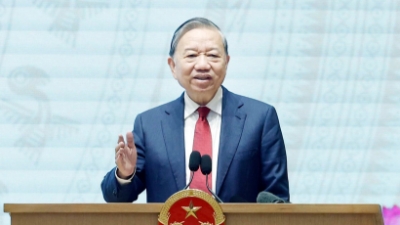
Adopting an enabling mindset, the Politburo's Resolution No. 79-NQ/TW, signed by Party General Secretary To Lam on January 6, 2026, has opened up significant development space for the state economy, with the ambitious goal of placing one to three state-owned enterprises (SOEs) among the world’s 500 largest corporations.
The Resolution affirms that the state economy is a particularly important component of Vietnam’s socialist-oriented market economy. After 80 years of national construction and development —and particularly nearly 40 years of the Doi Moi (Renewal) process, the state economy has consistently maintained its leading role.
It effectively performs the functions of guiding, spearheading, and regulating economic activities, thereby contributing to robust growth, ensuring macro-economic stability, maintaining major economic balances, and safeguarding national defense and security.
Despite these achievements, the state economic sector still faces numerous limitations and inadequacies. Therefore, to realize the goal of Vietnam becoming a developing country with modern industry by 2030 and a developed, high-income country by 2045, the resolution requires a focused, decisive, synchronized, and effective implementation of several policies and strategies for state economic development.
The resolution sets specific targets, including the ambition to have 50 state-owned enterprises (SOEs) among the 500 largest enterprises in Southeast Asia and 1 to 3 SOEs among the 500 largest enterprises globally by 2030.
It aims to build strong economic groups and large-scale SOEs with modern technology and regional and international competitiveness. These enterprises are expected to lead and guide domestic companies to deeply participate in global production and supply chains, especially in key strategic sectors of the economy. One hundred percent of SOEs are to implement modern corporate governance on digital platforms, while 100% of state economic groups and corporations will apply OECD corporate governance principles.
Regarding state credit institutions, the goal is for at least three state-owned commercial banks to be ranked among the top 100 largest banks in Asia in terms of total assets.
By 2045, the state economy is envisioned to become a solid foundation ensuring strategic autonomy, resilience, and comprehensive competitiveness of the national economy.
The resolution also outlines a shift from administrative management to development facilitation and modern governance. It calls for a clear separation of ownership functions, economic management, and political tasks. A robust mechanism is needed to protect officials who dare to think and act for the common good, distinguishing between objective errors and legal violations for appropriate handling. Additionally, it emphasizes standardizing the database on state economic entities and resources, ensuring interconnectivity to support policy formulation.
Specific solutions include completing the measurement, statistics, digitization, and cleaning of the national land data system by the end of 2026, connecting and sharing with other national data systems.
Encouraging SOEs to invest abroad to explore, exploit, and process minerals not available or in limited supply domestically is also highlighted.
Strengthening basic investigations and building a data system on marine and island resources, with plans for effective exploitation and use, is crucial for economic development combined with national defense, security, and sovereignty protection.
The resolution encourages the issuance of outstanding mechanisms, creating a comprehensive legal framework, and implementing controlled experimental frameworks (sandbox) to promote the development of space economy and low-altitude economy, including the aviation and aerospace industries.
It also advocates for various forms of social resource mobilization and public-private partnerships in investing in and exploiting underground works. Furthermore, it supports expanding the application of public-private investment methods, such as "public investment - private management" and "private investment - public use," to build and manage infrastructure projects most effectively.
For SOEs, policies are in place to encourage the development of large-scale SOEs through increased charter capital, including allowing the use of all proceeds from equitization and state capital divestment at enterprises. Increasing the post-tax profit retention rate for enterprises and reassessing assets that have been fully depreciated but still have use value are also encouraged. Mergers, acquisitions, and transfers of enterprises are promoted to leverage the overall advantages of the economic sector.
SOEs are empowered to decide on using their science and technology development funds to proactively implement or commission external research and development under a product contract mechanism. There is a mechanism allowing SOEs to independently form or link with the state and other enterprises to establish venture capital funds.
The comprehensive restructuring of the State Capital Investment Corporation (SCIC) is directed towards professional capital management, progressing towards forming a national investment fund. Resources are concentrated from restructuring capital at enterprises and other state-assigned resources to: (i) Develop large-scale, high-efficiency enterprises; (ii) invest in projects in technology, innovation, digital transformation sectors, which are crucial for the economy; (iii) implement direct investments and support resources for SOEs to invest abroad; and conduct mergers and acquisitions to access new technologies, core technologies, strategic technologies, and industries, or for high-profit objectives.
Enhancing the capacity and operational efficiency of the Vietnam Asset Management Company (VAMC) and the Vietnam Debt and Asset Trading Corporation (DATC) is essential to support the restructuring process, particularly financial restructuring and handling bad debts of SOEs and commercial banks under market mechanisms.


 Google translate