



According to Research and Markets, the global accommodation services market is projected to grow from $5.52 trillion in 2025 to $5.82 trillion in 2026, representing a compound annual growth rate (CAGR) of 5.5 per cent. Growth in the previous period was driven primarily by the expansion of tourism, hotel chains, urbanization, and business travel, as well as the development of resort destinations.
Going forward, however, growth is expected to be driven mainly by the rise of luxury travel, demand for personalized guest experiences, the adoption of smart hotel solutions, the expansion of food and beverage services, and the development of multifunctional accommodation spaces. The market is expected to continue growing strongly in the years to come, reaching $7.47 trillion by 2030 at a CAGR of 6.4 per cent.
Research and Markets identified several key trends shaping the accommodation services sector, including the rise of experience-led accommodation models, the expansion of online booking platforms, growing interest in sustainable practices, the integration of smart hotel technology, and the development of food and beverage services.
More visitors, higher spending
Tourism represents a broad economic sector encompassing a wide range of related activities, businesses, and services, with accommodation playing a key role by providing lodging, dining, shopping, and wellness experiences. In Spain, for example, the National Statistics Institute reported a record 96.8 million international visitors in 2025, with total spending by international tourists reaching €134.7 billion ($158 billion). The number of tourists choosing paid accommodation, including hotels, resorts, guesthouses, and serviced apartments, as their main form of lodging increased 3.6 per cent. Within this segment, hotel stays rose even more strongly, by 7.3 per cent. The total number of hotel nights across Spain reached a record 366.7 million.
These figures show that as tourism expands, with more international visitors and higher travel spending, demand for hotel rooms and commercial accommodation also rises. Businesses are consequently placing greater emphasis on personalization to maintain and strengthen their market positions. These features allow guests to tailor products, services, or systems to their individual preferences and needs, enhancing satisfaction and engagement.
For example, in September 2026, hotel group Accor rolled out ALL Concierge, an AI-powered conversational travel assistant, across its digital channels. The system can recognize returning guests and use information on their preferences, stay history, and membership profiles to provide personalized hotel, destination, and offer recommendations, as well as booking assistance. ALL Concierge is currently available through the ALL Accor app, ALL.com, WhatsApp, and iMessage, supporting eleven languages on the website, with further expansion underway.
Uneven but positive outlook
Across Asia-Pacific, the accommodation services sector is also expanding at an unprecedented pace. According to market researchers Deep Market Insights, the region’s accommodation services market is projected to reach around $208 billion by 2033, up sharply from $136 billion in 2024.
Hotel construction in the region is at record levels, according to Lodging Econometrics’ project trends report. As of the end of 2025, the number of projects under construction or development, excluding China, had risen to more than 2,200, representing over 430,000 rooms. This was an increase of around 9 per cent in project count and 6 per cent in room count from the previous year, with Vietnam, Thailand, and Indonesia among the region’s most active markets.
At the Meet the Experts conference (MTE Hanoi 2026) held in Hanoi on October 1, Mr. Jesper Palmqvist, Regional Vice President Asia Pacific, STR CoStar, described Vietnam as a market where investor interest, traveler demand, and hotel performance remain strong across many destinations. At the same time, rising costs, new supply, and expectations of slower growth are making operational discipline more important than ever.
Mr. Palmqvist placed this outlook against a backdrop of global uncertainty, including questions around interest rates, the trajectory of AI, and the broader economic environment. Hotel performance varies across Asia-Pacific markets, but he described the overall picture as “positive.”
“In many countries, higher room rates combined with improved operational productivity are supporting revenue and profit growth,” he went on. “India continues to benefit from strong domestic demand, while Indonesia is recording steady room rate growth. Australia and Singapore, by contrast, are seeing more stable but slower growth. These differences reinforce the need for market-specific strategies rather than a one-size-fits-all approach across the region.”
Japan provides a clear example of how the appeal of a destination can expand over time. Travelers are increasingly exploring beyond Tokyo, Osaka, and Kyoto to discover other parts of the country. “They are traveling around the country to experience the full breadth of local culture,” Mr. Palmqvist said, describing a shift in demand that he sees as highly relevant to Vietnam. Developing experiences beyond the main tourism “gateways,” he said, can help destinations build deeper and more sustainable appeal.
Vietnam’s market momentum
According to Mr. Palmqvist, Vietnam has emerged as one of the fastest-growing accommodation markets in the region. This growth is also changing how the country is positioned relative to other destinations. It remains relatively “affordable” compared with the broader market, but room rates and guest expectations are gradually rising. “The future of Vietnam’s accommodation sector will no longer rely on its being seen as a low-cost country,” he said. As hotels move further upmarket and travelers seek more distinctive experiences, Vietnam is likely to be increasingly recognized for the quality and diversity of its accommodation offerings.
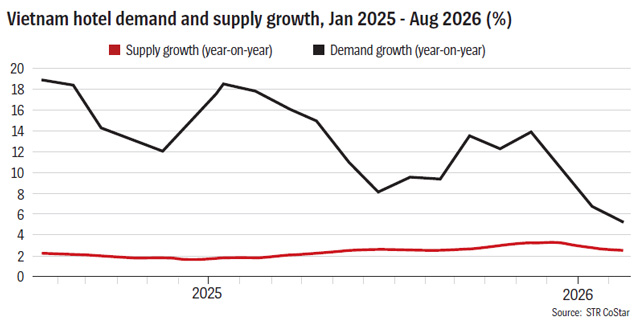
Wellness, local culture, and unique experiences are among the themes that Mr. Palmqvist believes will become increasingly important to the market’s future. However, he also cautioned that strong demand and higher room rates do not automatically translate into better profitability. “Hotels need the right people, systems, and operating processes to maximize revenue while keeping costs under control,” he said, emphasizing that labor productivity will be a critical factor in determining whether the market’s recent growth gains ultimately translate into benefits for owners and brands.
Performance also varies within Vietnam. “Growth in the central and northern markets has been accompanied by generally stable gross profit margins, while some southern markets, including Ho Chi Minh City and Phu Quoc, have recorded stronger margin growth,” he said. “This contrast shows that headline demand and revenue figures do not tell the full story. Hotel owners need to consider how room rates, occupancy, costs, and business mix interact to determine the bottom line.”
Seasonality is also particularly important for resort investments. Mr. Palmqvist cited Phu Quoc as a market with a significant gap between peak and off-peak seasons. “Strong performance during the peak season can be very attractive, but investors need to assess whether room rates and demand can be sustained during the shoulder and low seasons,’ he added. “Staffing is another practical concern: the rapid pace of hotel expansion raises the question of who will operate and work in these newly added rooms. Carefully assessing the full seasonal cycle - rather than focusing only on the strongest peak months - is essential.”
Overall, the outlook for the tourism accommodation sector remains one of opportunity, particularly for destinations with expanding air connectivity, diverse experiences, and the ability to attract new traveler segments. But this rapid growth cannot continue indefinitely. The challenge for owners and operators is to use favorable conditions today to build the capabilities needed as growth normalizes: disciplined investment, realistic seasonal planning, effective workforce management, and a focus on both profitability and revenue.









 Google translate