



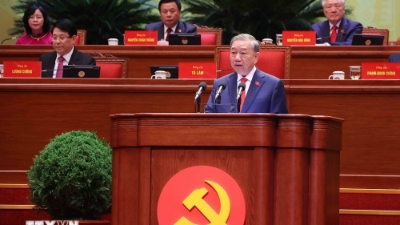
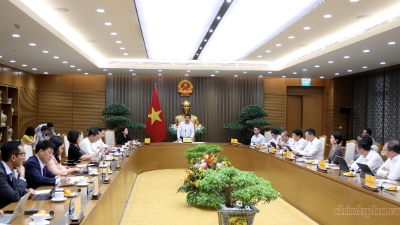
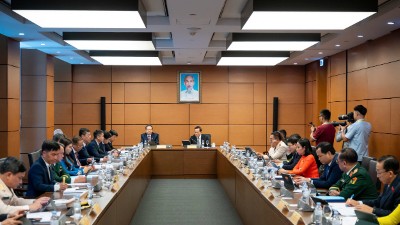
Presenting a keynote paper at the ongoing 14th National Congress of the Communist Party of Việt Nam on January 21, Vice Chairman of the Party Central Committee’s Commission for Policies and Strategies Nguyen Anh Tuan, clarified the practical foundations and proposed a strategic framework aimed at realizing the goal of double-digit economic growth for the 2026–2030 period, meeting the nation's requirements for rapid and sustainable development.
First, the strategy emphasizes maintaining macroeconomic stability, enhancing economic resilience, and upholding strategic autonomy to provide a solid foundation for both short- and long-term growth. Alongside this, there must be a strong push to revitalize traditional growth drivers while simultaneously creating and effectively exploiting new ones.
Second, the country must continue to accelerate economic restructuring in tandem with industrialization and modernization, positioning science, technology, innovation, and digital transformation as the primary engines of growth. The focus will be on developing the data economy, digital economy, green economy, and circular economy. Furthermore, the strategy highlighted the effective exploitation of new economic frontiers, including marine space, low-altitude airspace, outer space, and underground space.
The proposal also called for maximizing the potential of all economic sectors, particularly the private sector; enhancing the efficiency of the State-owned economy; and developing a sustainable collective economy. Vietnam will continue to improve the quality of Foreign Direct Investment (FDI) attraction based on new global standards. The leading roles of dynamic economic zones, economic corridors, and growth poles were also underscored.
Third, Vietnam aims to exploit international markets more effectively and diversify export destinations, while simultaneously developing the domestic market into a sustainable growth engine. The export strategy will be restructured to pivot from low-cost competition to brand-based exports characterized by high standards, advanced technology, and high added value. This involves fully leveraging Free Trade Agreements (FTAs) and tapping into emerging markets.
Fourth, the strategy focuses on the mobilization and efficient utilization of resources, particularly capital, through three main channels: public investment, domestic private investment, and FDI.
To achieve this, the Government will promote private investment and develop diverse capital markets to secure medium- and long-term funding. The plan encourages venture capital models and fintech companies to unlock capital flows for small and medium-sized enterprises (SMEs) and startups. Selective FDI attraction will prioritize high-tech and energy-efficient projects.
Fifth, there must be a strong push for breakthroughs in economic institutions, human resource development, science and technology, innovation, and infrastructure. These are considered the bedrock for rapid and sustainable growth in the coming period.
Emphasizing the need for synchronous implementation, Mr. Tuan stated that the focus must be placed on resolving growth bottlenecks and "chokepoints" while stimulating drivers with high spillover effects across the entire economy.
On this basis, Vietnam aims to establish and deploy a new growth model driven primarily by improvements in productivity, quality, and competitiveness—underpinned by science, technology, innovation, and digital transformation—to ensure the efficient use of all national resources.


 Google translate