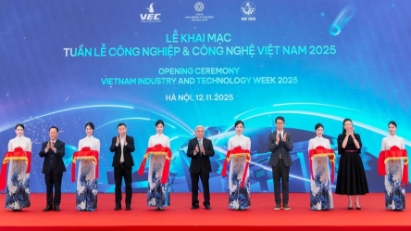
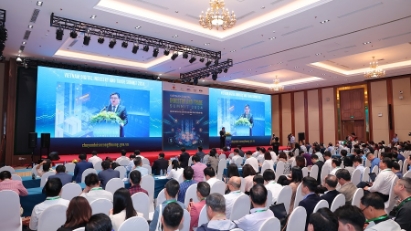
The event bringing together the five largest industry and technology trade shows, creating a platform for strategic trade promotion and connecting knowledge, technology, and the business community.
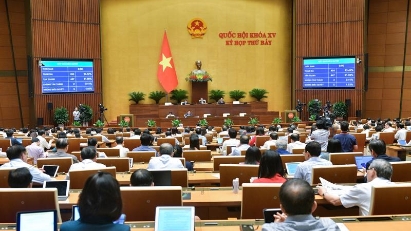
The law, scheduled to take effect on January 1, 2026, is expected to promote national digital transformation process, paving the way for domestic tech enterprises to grow sustainably, integrate deeply into the global market, and contribute to establishing a new position for Viet Nam on the world stage.
Vietnam has a vision of, by 2050, building a modern railway network and taking full control of all related technologies, from manufacturing rails and switches to self-sufficiency in electrification.
Representatives from government agencies highlighted the stellar growth of Vietnam’s digital economy at a recent conference while expressing concern over the challenges that still lie ahead.
VNG's partnership with Roblox signals a major move in Vietnam's burgeoning gaming industry, further highlighted by VNGGames' shared win at the prestigious Vietnam Game Awards.
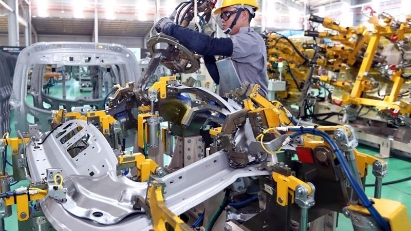
Purchasing Managers’ Index hit 50.5 in August, above the no-change point for the first time in six months and demonstrating improved business conditions in the manufacturing sector.
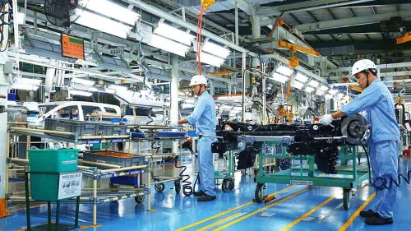
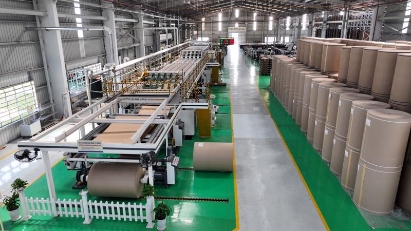
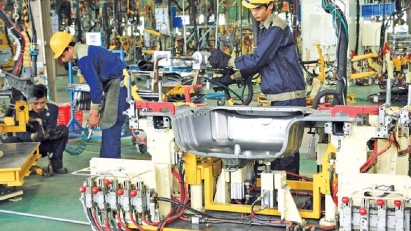
According to the General Statistics Office, the Index of Industrial Production (IIP) in October increased 3 per cent over the previous month and 6.3 per cent over October last year. Processing and manufacturing rose 5.7 per cent, mining 6.3 per cent, and electricity production and distribution 10.5 per cent. The IIP for the first ten months is estimated to have increased 9 per cent year-on-year.
Though digital transformation has helped wood businesses cut costs by 10 per cent and increase revenue by 10-20 per cent and workplace productivity by more than 20 per cent, the proportion applying digital transformation in production remains low. The Vietnam Internet Association (VIA) puts the rate at just 20 per cent. Three reasons for this are large initial cost, a lack of technological capacity and human resources, and a shortage of professional partners with good consulting capacity and solutions.
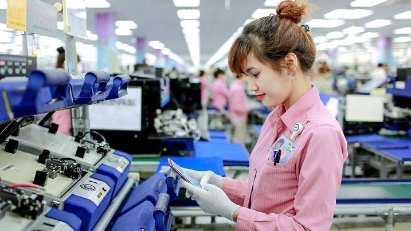
Many foreign enterprises have recently expressed an interest in investing in Vietnam’s semiconductor industry. Analysts believe the country has an opportunity to become a prominent semiconductor manufacturing center in the region, and it needs to develop medium and long-term strategies to promote the industry.
At a CEO Forum on welcoming the wave of supply chain shifts in the electronics industry, held on October 4, analysts said Vietnam is a destination for many companies producing electrical and electronic products. Its electronics industry is one of the most promising in terms of receiving a new wave of relocated investment.
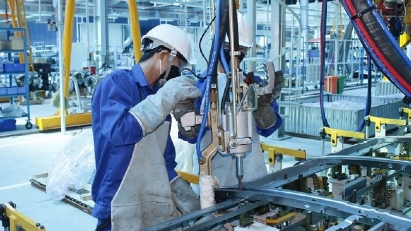
S&P Global on October 3 released its Purchasing Managers’ Index (PMI) report for Vietnam’s manufacturing industry in September, which reached 52.5 points. There were three highlights: output continued to increase sharply; inflationary pressure eased; and inventories of purchased and finished goods rose. The report shows that Vietnam’s manufacturing industry continued to maintain its growth momentum at the end of the third quarter. New orders are increasing, supporting output, employment, and purchasing activity.