


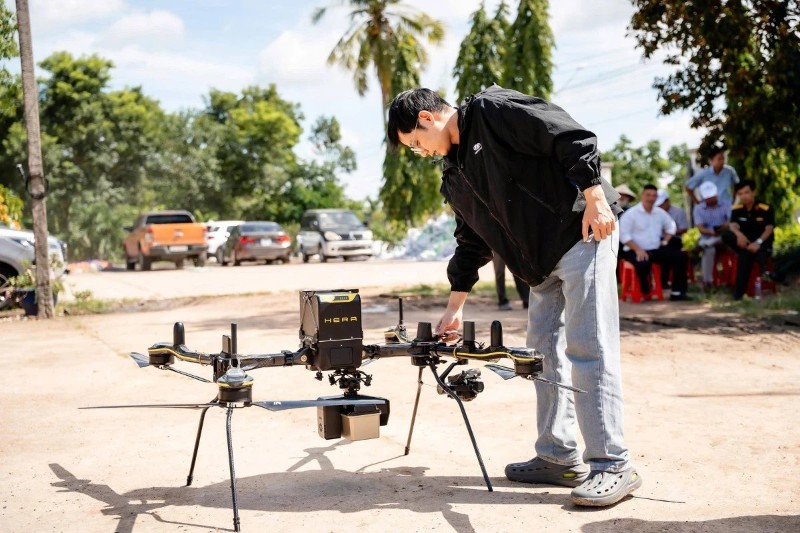
The People’s Committee of southern Tay Ninh Province has officially approved a comprehensive strategy to develop the local unmanned vehicle ecosystem through 2030, with a vision to 2035.
The decision identifies the sector as a pivotal new direction for the province, aimed at accelerating science, technology, and innovation while creating a powerful new growth engine for the local economy.
The strategy’s scope is broad, encompassing unmanned vehicles operating across air, land, and water.
For the initial 2026–2030 phase, the locality will focus primarily on the development of Unmanned Aerial Vehicles (UAVs). Unmanned ground and surface vehicles will be introduced through gradual pilot programs integrated with shared testing infrastructure, with full-scale expansion planned for the 2031–2035 period as legal frameworks mature and market signals become clearer.
Tay Ninh aspires to become the national center for testing, application, training, operations, and services within the unmanned vehicle ecosystem. By positioning itself as a "real-world" testing environment, the province aims to play a vital role in regional linkages with Ho Chi Minh City and other major research and development hubs. Rather than pursuing a fragmented approach or competing directly in basic research, the province will prioritize the mid-stream and down-stream segments of the value chain.
Between 2026 and 2027, Tay Ninh plans to establish an international-standard testing corridor and at least three controlled flight zones. This period will also see the launch of at least one specialized center for testing, training, and certification, alongside efforts to attract five major enterprises to the value chain and train a workforce of 300 to 400 personnel.
Moving into the 2028–2030 period, the province will focus on scaling these facilities to international standards and aims to train at least 1,000 personnel annually. This phase will also see the completion of an "Unmanned Vehicle Complex" and a fully integrated industrial network.
The strategy is built upon four fundamental pillars.
First, the province will develop an international-standard testing and training hub.
Second, it will foster an industrial support zone focused on the manufacturing, assembly, and integration of unmanned vehicles.
Third, Tay Ninh will serve as a site for large-scale pilot applications in fields such as tourism, agriculture, logistics, environmental monitoring, search and rescue, and border management.
Finally, the locality intends to become a premier destination for unmanned vehicle sports, exhibitions, and international competitions.






 Google translate