


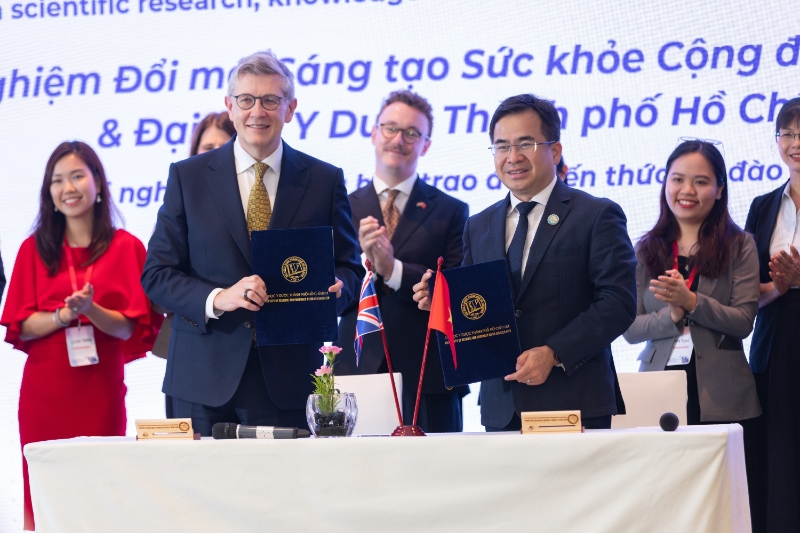
Two memoranda of understanding (MOUs) were signed between Ho Chi Minh City and the UK bodies during the the UK–Vietnam Digital Health Transformation Conference, held in the city on January 27, marking tangible progress in bilateral health cooperation.
The first MOU, signed between The Phoenix Partnership (TPP) and the Vietnam Medical Informatics Association, focuses on cooperation in the development and implementation of electronic medical records (EMR) in Vietnam for the 2026–2031 period.
The second MOU was signed between the Civic Health Innovation Labs at the University of Liverpool and the University of Medicine and Pharmacy at HCM City, aiming to strengthen cooperation in scientific research, knowledge exchange, and medical training. This collaboration is also one of the flagship healthcare initiatives under the Liverpool–Ho Chi Minh City City-to-City partnership.
Speaking to VnEconomy/Vietnam Economic Times, Professor Iain Buchan, Vice-Chancellor for Innovation and Director of the Human Health Innovation Lab at the University of Liverpool, outlined the vision for collaboration between the University of Liverpool and the University of Medicine and Pharmacy at HCM City.
According to Professor Buchan, the partnership aims to develop AI solutions that genuinely serve people’s healthcare needs by connecting data, data scientists, AI engineers, healthcare professionals, and the communities that generate and use health data. He stressed that AI must function in everyday life, not only in clinical settings.
Citing the UK’s experience, Professor Buchan noted that between one-third and one-half of medicines prescribed by the National Health Service are not used as intended, highlighting gaps in understanding real-world patient behaviour. He emphasised the need for AI systems that can interact with people in their daily lives to better capture what happens beyond the clinic.
He also underlined the importance of transforming medical education. “The two universitiesaim to train a new generation of doctors, nurses, and pharmacists who will work alongside AI as part of integrated care teams,” he said. This requires updated training models and clinicians who are not only users of AI, but also contributors to its development, with knowledge spanning data science, AI, medicine, and pharmacy.
Professor Buchan highlighted Vietnam’s strong potential, noting progress in primary healthcare development and the move toward more connected health systems in an AI-enabled data environment. However, he stressed that future training should focus not only on adopting technology but also on shaping and governing it.
Addressing the challenge of population ageing, he observed that both countries face increasing care complexity as people live longer with multiple conditions. This challenge extends beyond healthcare to social care and community-based support. He called for new care models that operate outside traditional clinical settings and emphasised the role of “civic health innovation,” which integrates healthcare, communities, and shared information.



 Google translate