


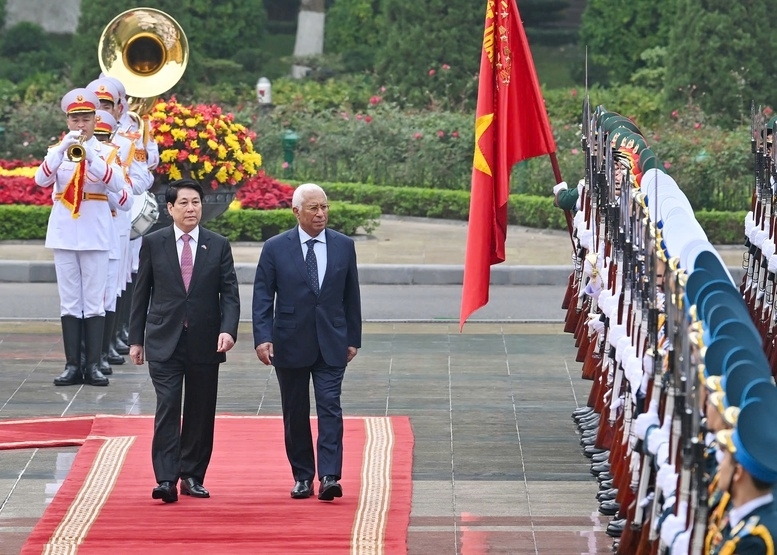
Vietnam and the EU have upgraded relations to a Comprehensive Strategic Partnership and agreed to develop an action plan to effectively implement the Joint Statement in the coming time.
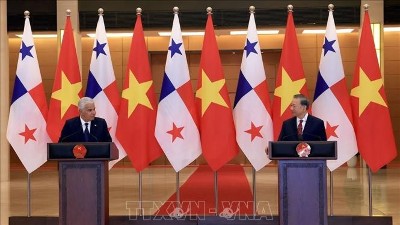
The official upgrade of Vietnam-EU relations was announced during a press briefing on January 29, co-chaired by State President Luong Cuong and European Council President António Costa following their high-level talks in Hanoi.
The European Council President paid an official visit to Vietnam at the invitation of President Cuong from January 28 to 29.
The Vietnamese State leader affirmed that the visit opens a new chapter in Vietnam-EU relations. The decision to upgrade ties to a Comprehensive Strategic Partnership reflects an increasingly high level of political trust and the substantive development of bilateral relations after 35 years of diplomatic ties.
Highly valuing the EU’s role and position as a leading global political, economic, scientific-technological, and cultural hub, the President affirmed that Vietnam always considers the EU one of its top priority partners in its foreign policy. He expressed a desire to develop deep, wide-ranging, and comprehensive relations with the EU while continuously strengthening friendship and cooperation with EU member states.
Informing the European Council President of the key outcomes of the 14th National Party Congress, President Cuong outlined Vietnam’s two "centenary goals": to become a developing country with modern industry and upper-middle income by 2030, and a developed, high-income country by 2045, when the 100th anniversaries of the Communist Party of Vietnam and the Democratic Republic of Vietnam (now the Socialist Republic of Vietnam) will be celebrated, respectively.
He affirmed that Vietnam is determined to build a new growth model based on science, technology, innovation, digital transformation, and green transition. He identified these as core tasks in the new development phase and areas with significant potential for cooperation with the EU.
On this basis, President Cuong proposed that both sides coordinate closely to implement the Joint Statement on the Vietnam-EU relationship upgrade across six key orientations. These include: strengthening political trust through the exchange of high-level delegations and contacts; effectively implementing existing cooperation mechanisms while expanding new frameworks; and identifying economic cooperation as a vital driver of bilateral ties.
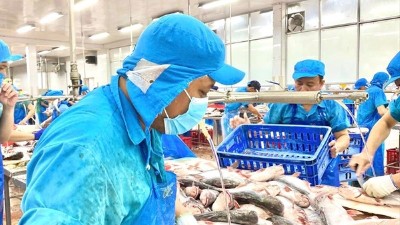
The President suggested making science, technology, and innovation a new pillar of cooperation and promoting respect for international law and multilateralism. He also requested that the EU enhance maritime economic cooperation, support Vietnam in building sustainable fisheries, and soon lift the "yellow card" regarding Illegal, Unreported, and Unregulated (IUU) fishing for Vietnamese seafood.
President Luong Cuong reaffirmed that Vietnam supports the promotion of ASEAN-EU relations and stands ready to serve as a bridge to make these ties more substantive, looking toward the 50th anniversary of ASEAN-EU diplomatic relations in 2027.
For his part, Mr. António Costa affirmed that the EU considers Vietnam a key partner within the ASEAN region and the Indo-Pacific Strategy. He noted that both sides share many similarities, including a respect for international law and support for free trade and freedom of navigation.
According to President Costa, the visit holds historical significance as Vietnam becomes the EU’s first Comprehensive Strategic Partner in ASEAN. This milestone reflects a 35-year journey of cooperation and a shared strategic vision amidst a volatile global landscape.
The European Council President emphasized the vast potential for cooperation in trade, sustainable development, innovation, maritime economy, governance, security, and people-to-people exchanges. He expressed a desire to strengthen collaboration in traditional sectors such as trade-investment, agriculture, and climate change response, while expanding into emerging fields including the green and digital transitions, the Just Energy Transition, infrastructure, and transport connectivity.
During their talks, both sides also agreed to promote cooperation in science, technology, and innovation; effectively implement the EU-Vietnam Free Trade Agreement (EVFTA); and work toward the early ratification of the Investment Protection Agreement (EVIPA). Furthermore, they committed to maintaining the Vietnam-EU Defense and Security Dialogue mechanism and enhancing cooperation in UN peacekeeping, maritime security, cybersecurity, and crisis management.
 Google translate