


The total value of export contracts between Vietnamese and Russian enterprises signed with the support of the Russian Export Center (REC), part of the VEB.RF Group, has surpassed 58.5 billion rubles (approximately $683 million).
Of this total, contracts signed through REC’s direct non-financial support — such as buyer matching, connecting Russian suppliers with Vietnamese importers, and negotiation assistance — accounted for 12.7 billion rubles (over $148 million).
The gap between these two figures highlights the comprehensive role of the Russian export support system. Beyond business matchmaking, it provides essential financial and credit instruments to assist enterprises in bringing goods to international markets. Furthermore, it reflects a strategic shift from simple "commodity trading" toward "market building."
Speaking with VnEconomy, Mr. Ilya Koltygin, Chief Representative of REC in Ho Chi Minh City, stated that the goal of Russian enterprises is no longer merely to secure a single export order, but rather to establish long-term partnerships with Vietnamese counterparts.
"This indicates that Russia-Vietnam trade is entering a stage of maturity," he said.
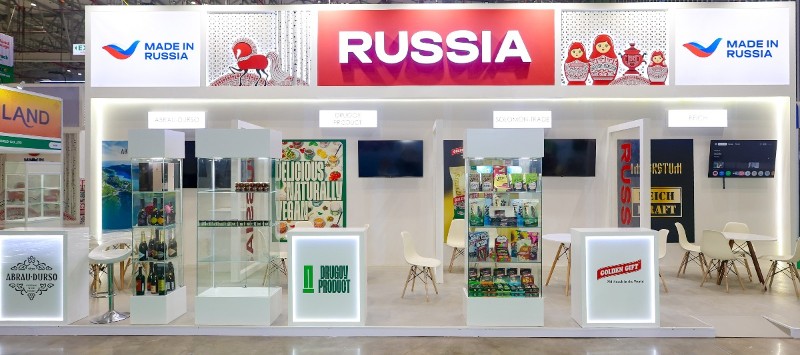
According to Mr. Koltygin, a prime example of the growing interest in the Vietnamese market was the Russian presence at the VietFood & Beverage exhibition held this past August in HCM City. At the event, REC organized the "Made in Russia" national pavilion, featuring over 20 Russian companies from the food and beverage sector. More than 180 B2B meetings were held, aiming not just for sales, but also for finding distributors, researching consumer needs, and establishing long-term cooperation.
This represents a notable change in how Russian businesses approach the Vietnamese market: instead of simply shipping products and searching for buyers, they are increasingly focusing on building distribution networks and long-term market development.
In terms of sector focus, Mr. Koltygin noted that Russian business interest is concentrated in five key industries: agriculture, chemicals, mechanical engineering, pharmaceuticals and cosmetics, and forestry and wood processing.
However, REC noted that market expansion depends not only on demand but also on the ability to meet Vietnamese standards and regulations. To address this, the center supports businesses through every stage — from partner searches and marketing to consulting on market requirements, product certification, and documentation.
Mr. Koltygin emphasized that Vietnam holds an increasingly vital position in the strategy of Russian enterprises within ASEAN. Additionally, Vietnam has the potential to serve as a strategic gateway for Russian businesses to access other markets across Southeast Asia.




 Google translate