


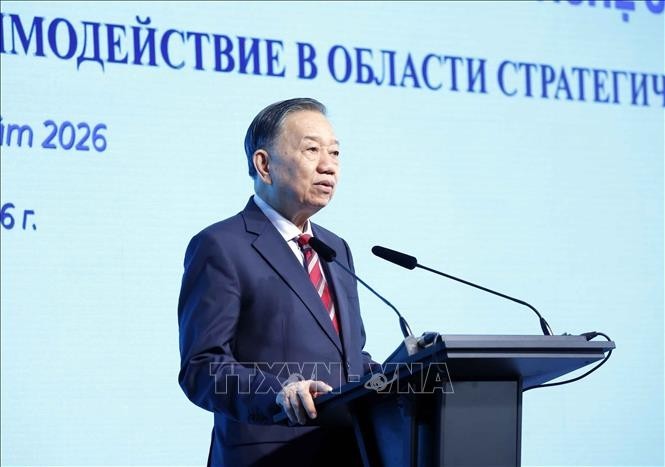
General Secretary and President To Lam and a high-level Vietnamese delegation attended the Vietnam–Russia Science and Technology Forum, themed “Connecting Strategic Technologies” in Moscow on September 9, as part of his state visit to Russia.
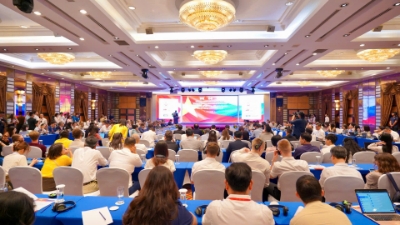
Also attending the forum were Russian Deputy Prime Minister Dmitry Chernyshenko, Minister of Science and Higher Education Valery Falkov, and nearly 500 delegates representing policymaking agencies, research institutes, technology enterprises, experts, scientists, and investors from both countries.
In his opening remarks, Deputy PM Chernyshenko affirmed that science and education are among the key areas of cooperation in Vietnam–Russia relations.
He said that artificial intelligence, new materials, new energy, and space technology are among the fields that will shape the technological landscape of the future. The two countries should not only share their achievements but also combine their respective strengths and capabilities to jointly create new breakthroughs.
Addressing the forum, the Vietnamese top leader called for new thinking, new approaches, and higher goals in Vietnam–Russia science and technology cooperation in the coming period.
Cooperation should go beyond exchanges of experts and personnel training to focus on jointly mastering technologies, jointly developing products, and jointly entering markets, he said.
Accordingly, the two countries should make strategic technology cooperation a new pillar of their Comprehensive Strategic Partnership.
The two sides should select strategic fields that combine Russia’s strengths in science and technology with Vietnam’s development needs, human resources, and market potential. These fields include nuclear energy, new energy, space and satellite technology, semiconductors and microelectronics, quantum technology, and artificial intelligence.
Priority areas should have the potential to build new technological capabilities, make direct contributions to socio-economic development, ensure security and safety, and strengthen each country’s technological self-reliance.
Mr. Lam expressed his hope that Russian technology and energy corporations would increase investment and technology transfer in Vietnam. At the same time, he encouraged Vietnamese technology companies to proactively seek investment and cooperation opportunities in Russia.
He emphasized that the effectiveness of cooperation in the coming years should not be measured merely by the number of exchange delegations or cooperation documents signed. More importantly, it should be measured by the number of technologies jointly mastered, products jointly developed, businesses jointly investing, and young scientists who have grown and developed through cooperation.
“These should be the new benchmarks for cooperation,” he said.
The Vietnamese leader expressed his belief that cooperation in science, technology, and innovation can become a new driving force, a new pillar, and a new symbol of Vietnam–Russia relations in the 21st century.
At the forum, the two sides launched the Vietnam–Russia Knowledge Network and exchanged cooperation documents on science, technology, and education between the two countries.

 Google translate