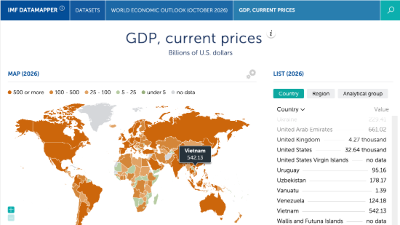
Vietnam’s nominal per capita gross domestic product (GDP) is forecasted to reach $5,259 this year, allowing the country to overtake Indonesia and climb to fifth place in ASEAN, according to the International Monetary Fund’s (IMF) October 2026 World Economic Outlook report.
The Ministry of Finance estimated that the policy would reduce budget revenue by approximately VND6,700 billion (more than $260 million) over two years.
According to the Ministry of Agriculture and Rural Development, Vietnam will transfer 5.15 million tons of CO2 to Lowering Emissions by Accelerating Forest Finance (LEAF), to reduce emissions from 4.26 million ha of forests in the south-central region and the central highlands in the 2022-2026 period and receive nearly $52 million.
At a working session with Prime Minister Pham Minh Chinh on December 8, Vietnam Social Security set a target of 23.1 million people participating in social insurance by the end of 2025 and 18 million in unemployment insurance, accounting for 45 per cent and 35 per cent, respectively, of the workforce, while the health insurance coverage is to be 95 million people, or 95 per cent of the population.
Deputy Minister of Industry and Trade Do Thang Hai told the “Maintaining the link to ensure the supply chain of Vietnamese goods” conference on December 8 that although the fourth wave of Covid-19 seriously affected production and distribution in Vietnam, the development of domestic goods nonetheless remained strong. According to the Ho Chi Minh City Department of Industry and Trade, Vietnamese enterprises have sufficient capacity to produce quality goods that meet strict requirements in markets such as the US, the EU, and Japan, so can set criteria for manufacturers serving the domestic market.
The Ministry of Natural Resources and Environment will finish the National Strategy on Climate Change to 2050, develop an Action Plan to reduce methane emissions by 2030, and implement the National Green Growth Strategy, among other tasks, as a part of Vietnam's COP26 commitments. The greatest challenge for the country is a lack of relevant human resources.
Vietnam had disbursed just 63.86 per cent of the public investment plan assigned by the Prime Minister as of November 30; a decline year-on-year. Permanent Deputy Prime Minister Pham Binh Minh therefore asked that the heads of relevant ministries and agencies uphold their responsibility and that strict inspections and supervision be boosted to accelerate disbursement.
Deputy Minister of Industry and Trade Do Thang Hai said at the Vietnam-US Trade Forum 2021 on December 7, with the theme “Seizing opportunities, adapting to develop in new situations”, that bilateral trade between Vietnam and the US has seen impressive growth over the years. They still hold great potential for cooperation in a number of fields, such as energy, healthcare, digital commerce, education, and agriculture. Most of the largest US corporations are already present in Vietnam, and many American investors believe that Vietnam will become an ideal, important, and safe investment location in global supply chains.