


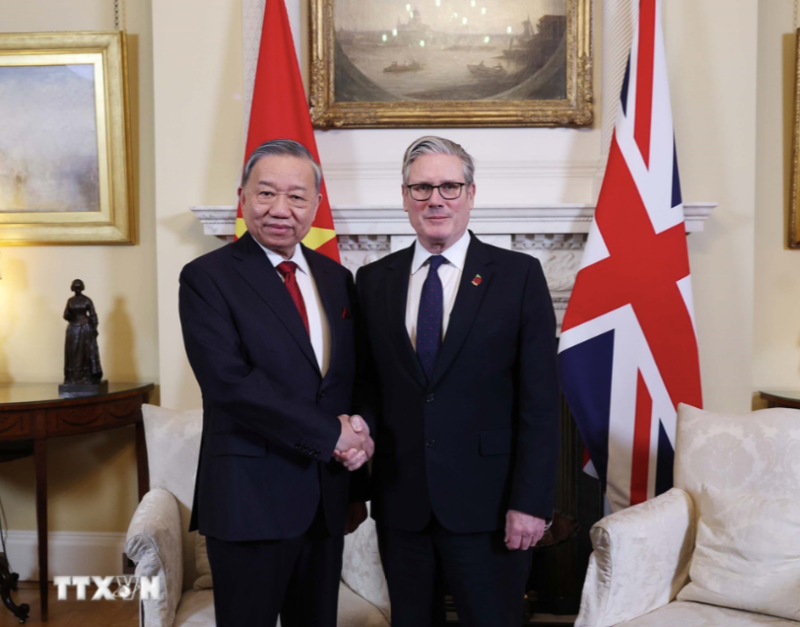
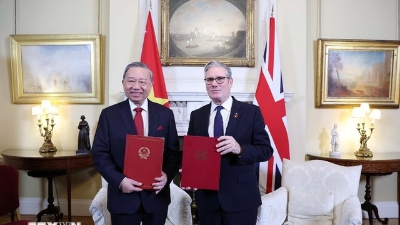
On the occasion of the official visit by General Secretary of the Communist Party of Vietnam To Lam to the UK on October 28-30, at the invitation of UK Prime Minister Keir Starmer, the two leaders agreed to elevate Vietnam-UK relations to a Comprehensive Strategic Partnership. What does this signify?
The upgrade of the Vietnam-UK bilateral relationship to a Comprehensive Strategic Partnership (CSP) marks a truly historic milestone. It also comes in a pivotal year, as we have just celebrated 15 years of Strategic Partnership between the two countries and more than 50 years of diplomatic relations. During that time, the relationship has continually expanded and deepened across many important areas.
There are several highlights in recent years that I consider particularly noteworthy. First of all, bilateral trade and investment have grown strongly thanks to the UK-Vietnam Free Trade Agreement (UKVFTA) and the UK’s accession to the Comprehensive and Progressive Agreement for Trans-Pacific Partnership (CPTPP), alongside Vietnam. We have seen a sharp increase in Vietnamese exports to the UK, while UK exports to Vietnam have also risen significantly. In the past year alone, bilateral trade reached over £9 billion ($11.8 billion) - a three-fold increase from a decade ago and a very impressive figure.
There has also been strong growth in certain sectors, such as agriculture, which is playing an increasingly important role in trade between the two countries. Education is another strong area, with more than 12,000 Vietnamese students studying in the UK, and a growing number of high-quality UK training programs being delivered right here in Vietnam, making them more accessible to more people.
We are also seeing significant progress in cooperation on the green economy. Both the UK and Vietnam have committed to achieving net-zero emissions, and Vietnam’s 2050 target is driving a far-reaching green transformation of its energy and industrial systems. The UK is working closely with Vietnam to achieve this, particularly through the Just Energy Transition Partnership (JETP).
At the same time, the two countries are working increasingly closely on international issues, aiming to maintain regional peace, stability, and security so that people from both nations can thrive in safety.
All these solid foundations have paved the way for the establishment of a CSP - a step forward in defining a shared vision for the future.
As you mentioned, trade and investment cooperation between Vietnam and the UK has achieved notable progress. What are the expectations for future cooperation under the CSP?
I recall some of the remarks Party General Secretary To Lam made in London during his recent visit: the UK’s strengths in technology, innovation, education, and finance are perfectly aligned with Vietnam’s ambitions to move from middle-income to high-income status. The combination of Vietnam’s great potential - a young, skilled workforce; strong manufacturing capacity; and recent key policy directions such as Resolutions No. 57 and No. 68 - aligns well with what the UK can contribute.
For example, in developing International Finance Centers in Ho Chi Minh City and Da Nang, the UK is working closely with Vietnamese agencies, inviting British investors and experts to provide advice and support.
Another area of great potential is technology and innovation. UK companies are showing strong interest in AI, fintech, semiconductors, and next-generation telecoms, while Vietnamese tech firms like FPT are expanding their operations in the UK. This shows that two-way cooperation is quite dynamic.
In the energy sector, the UK’s experience provides an inspiring model. The country has developed more than 15 GW of offshore wind power and has completely eliminated coal from the national grid, remaining coal-free for a year - a testament to its successful low-carbon transition. Vietnam is at a similar stage. The country has made major progress in renewable energy, particularly solar, and aims to reach 17 GW of offshore wind capacity by 2035. The UK can share its expertise, technology, and supply chain capabilities to help Vietnam achieve this goal.
All of this needs to be underpinned by high-quality human resources - an area where the UK can also make a significant contribution, through education, vocational training, and skills development, helping to prepare Vietnam’s workforce for the global market.
What are the UK’s strategic priorities with Vietnam, and what recommendations would you suggest to further strengthen bilateral relations?
The CSP provides a framework to deepen our relationship across a wide range of fields. I think we should do so to support our security, as the UK and Vietnam share a strong interest in a world that remains open and governed by international rules. This means trade, and both the UK and Vietnam have been committed not just to trade between each other but also internationally to free and fair trade.
At the same time, we are both committed to the international rules-based system, such as the UN Charter, the principles of sovereignty, territorial integrity, and the right of all nations to determine their futures. I think these are principles that are being challenged in an unstable and unpredictable world.
I am excited that the UK continues to deepen our partnership, supported by Vietnam, with ASEAN. I think ASEAN is a key region for maintaining peace and stability here in Southeast Asia. So that is one aspect. Another is our shared prosperity. The UK and Vietnam have established the right structures to build for the future on our shared prosperity and to take advantage of developing technologies and innovation.
Finally, Vietnam’s commitments to net-zero and to developing its economy alongside the protection of the natural environment are really important. We have seen with some of the challenges we have faced, such as extreme weather conditions and recent typhoons, that climate change affects all of us. It’s a risk to all our countries, so joint action is needed to deal with the risks of climate change and to mitigate some of the impacts we are seeing. We need adaptation and need to work together on resilience, and the UK and Vietnam are already doing so, looking at coastal protection and how we can build resilience into our economies.
This is very important for the future, and reaching net-zero isn’t just about hitting one target. It’s about saying that our economies will only be successful not only if they grow from one year to the next but if they grow over decades. We can sustain that, protect that, and ensure our citizens can enjoy the natural world. We need to work together on all of these things, and our CSP gives us a strong bedrock on which to do that.
What are the advantages and challenges for Vietnam compared to other countries in the region that attract UK investment?
Vietnam has huge advantages, which are well established: a young and well-educated workforce, a strategic geopolitical location, and three decades of strong experience in welcoming investment, whether it be in manufacturing or in high-skilled areas of international supply chains.
Vietnam has established this strong position, and I think that position is backed by clear policy and regulatory frameworks. We have seen recognition of that in some of the directions set out by the Politburo and by the government. Government frameworks need to evolve to support innovation the deployment of new technologies. That is something that will continue to keep Vietnam’s leading position in the region as an attractive investment environment.
The wider business environment is supported by predictability. Businesses like to know where they stand in areas such as regulations and permits, taxation and business regulation. All of these things are very important, and continuing efforts to reform and demonstrate transparency to international businesses will maintain Vietnam’s leading position within the region.
But it’s also very important to show how Vietnam continues to integrate internationally. One of the advantages Vietnam has had, and can continue to maintain, is its openness and integration with supply chains that reach into ASEAN but also extend well beyond, into Europe, China, and the US. I think that’s a key part of the attractiveness of what Vietnam has to offer.
If we look at Vietnamese exports and the products that have succeeded in the UK, it’s really impressive to see electronics, textiles, and famous Vietnamese products like dragon fruit and cashew nuts. I think Vietnam’s brand is growing. Awareness of the quality and the overall attractiveness of what Vietnam has to offer is increasing, but that also needs to continue to build.




 Google translate