


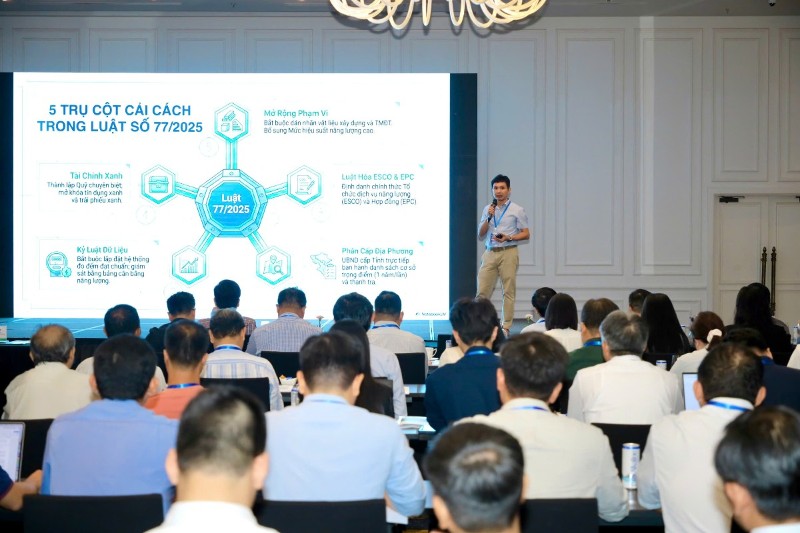
The Ministry of Industry and Trade (MoIT) hosted the workshop "Energy Efficiency: Driving Forces from Policy and Technology" on July 24 in Ho Chi Minh City.
This event serves as the launchpad for a series of 10 specialized seminars to be held across all three regions of Vietnam throughout 2026. This initiative is a core component of the National Program on the Economical and Efficient Use of Energy for the 2019–2030 period (VNEEP3).
In his opening remarks, Mr. Dang Hai Dung, Deputy Director of the Agency for Innovation, Green Transition and Industry Promotion under the ministry, noted that MoIT officially launched the Vietnam Energy Efficiency Community in 2025 as an open platform connecting regulators, experts, organizations, and businesses.
Building on the initial successes of this platform, the 2026 workshop series will be rolled out across various provinces nationwide to serve as a forum for stakeholders to strengthen connections, update technological trends, and foster collaboration between management agencies and solution providers, ultimately creating a more robust and sustainable energy efficiency ecosystem.
The technical agenda of the workshop focused on three primary pillars: the application of Artificial Intelligence (AI) in energy operations, the development of smart industrial park models, and financial mechanisms for energy-saving projects.
Regarding AI, experts highlighted it as a powerful tool for businesses to enhance performance through real-time monitoring, control, and system optimization. These AI systems allow for continuous optimization based on actual operational data, reducing energy consumption and production costs without the immediate need to replace entire existing infrastructures.
The smart industrial park model was a point of significant interest, featuring integrated management technologies designed to optimize operations across entire zones, covering everything from electricity and water systems to waste treatment and internal logistics.
This approach allows for shared investment costs and creates economies of scale that individual companies would find difficult to achieve independently. Furthermore, the workshop introduced smart factory solutions linked to digital transformation aimed at optimizing production processes and boosting overall productivity.
Addressing a major practical concern, the seminar also provided detailed information on financial mechanisms and investment support policies. While many enterprises recognize the benefits of energy efficiency, they often face a significant bottleneck when attempting to access capital. To help navigate this, the workshop offered specific guidance on available funding sources, eligibility criteria, and the necessary procedures for businesses to secure financial backing for their green initiatives.


 Google translate