



Family businesses have long been a cornerstone of Vietnam’s private sector, contributing not only through their scale of operations and job creation but also by preserving entrepreneurial values, business know-how, and long-term ownership across generations. Today, they are entering what many see as a defining moment.
The Vietnamese Government’s stronger commitment to private sector development, reinforced by Politburo Resolution No. 68-NQ/TW, is creating new opportunities for family-owned enterprises to expand their role in the country’s economic transformation. At the same time, capital market reforms aimed at improving transparency, raising corporate governance standards, and advancing Vietnam’s market upgrade roadmap are broadening access to financing and creating more favorable conditions for sustainable growth.
Yet alongside these opportunities comes a new set of expectations. As businesses scale up and prepare for leadership transitions, governance, succession planning, and technological readiness are emerging as critical determinants of long-term competitiveness.
According to PwC’s “12th Family Business Survey 2025 - Leading Vietnam’s Family Businesses into a New Era,” Vietnamese family businesses are among the most ambitious globally but many have yet to establish the governance foundations needed to sustain that ambition.
Growth ambitions outpace global peers
Despite ongoing geopolitical uncertainty, economic volatility, and rapid technological disruption, Vietnamese family businesses are entering the next phase of development with considerable confidence.
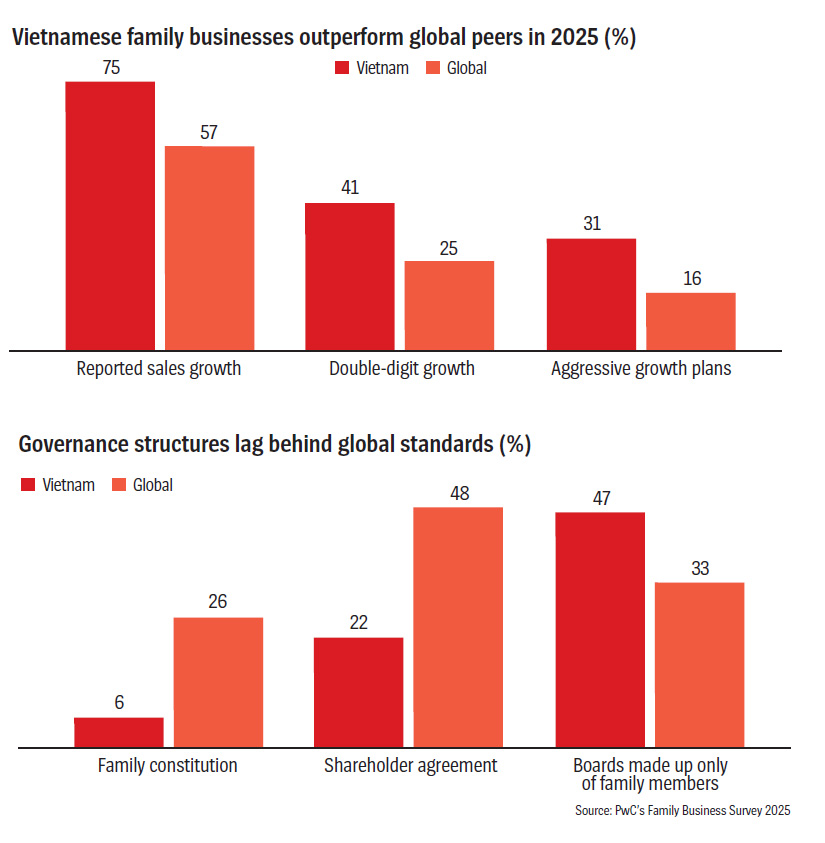
PwC’s survey found that 75 per cent of Vietnamese family businesses reported revenue growth during the previous financial year; significantly higher than the global average of 57 per cent. Meanwhile, 41 per cent posted double-digit revenue growth, compared with 25 per cent globally.
Perhaps most strikingly, nearly one-third of respondents - 31 per cent - said they intended to pursue “quick and aggressive” growth over the next two years - almost double the global average of 16 per cent and more than double the level reported by Vietnamese businesses in PwC’s previous survey.
The findings suggest that Vietnam’s family enterprises are increasingly confident in their ability to capitalize on the country’s favorable economic outlook.
That confidence is reinforced by a policy environment that now explicitly recognizes the private sector as the principal engine of economic growth. For many business owners, Politburo Resolution No. 68 represents more than a policy document - it signals official recognition of the strategic role private enterprises will play in Vietnam’s next stage of development.
PwC argues that this combination of policy support and entrepreneurial confidence presents family businesses with a rare opportunity to expand beyond traditional markets while investing in new technologies, digital transformation, and innovation.
Opportunity comes with mounting pressure
However, the environment in which these companies operate has also become considerably more demanding. Nearly all respondents - 97 per cent - said change is occurring continuously within the Vietnamese market, exceeding the global average of 89 per cent. Vietnamese business leaders also reported feeling the effects of technological disruption, changing consumer expectations, and economic volatility more acutely than their global counterparts.
AI illustrates the dilemma many family businesses now face. On one hand, technological advancement was identified by respondents as the single greatest opportunity for future growth. On the other, nearly half viewed AI as a significant execution risk, reflecting uncertainty over implementation, investment, and organizational readiness.
The result is a noticeable gap between strategic ambition and operational behavior. Though businesses recognize the importance of transformation, most remain focused on expanding their existing operations rather than pursuing new ventures. Digital transformation is frequently viewed as a means of optimizing current businesses instead of fundamentally reinventing business models.
PwC’s findings also suggest that many leaders continue to respond to market disruption rather than anticipate it. For example, 44 per cent said they react quickly once changes become apparent, while only 9 per cent proactively anticipate and adapt to emerging trends.
In a market increasingly shaped by AI, digitalization, and shifting consumer behavior, such a reactive approach may become an increasingly significant competitive disadvantage.
Governance still the weakest link
While Vietnamese family businesses possess strong entrepreneurial instincts and long-term commitment, formal governance structures have not kept pace with business expansion. PwC found that only 6 per cent of surveyed companies have established a formal family constitution, compared with 26 per cent globally. Likewise, only 22 per cent have formal shareholder agreements; less than half the global average of 48 per cent.
Boards also remain heavily concentrated within founding families. Nearly half of surveyed businesses reported boards composed entirely of family members, while more than one-third lacked directors with external industry experience.
Such governance structures may have served companies well during earlier stages of growth, when decision-making was centralized around founders. But as businesses expand, diversify, and prepare for succession, they may become constraints rather than competitive advantages.
PwC argues that stronger governance should not be viewed as bureaucracy but as an enabler of faster and more confident decision-making. Formal governance mechanisms , including family constitutions, shareholder agreements, and more professionally structured boards, can help clarify roles, reduce internal conflict, and improve organizational resilience.
The survey also highlights broader internal barriers to transformation. Rather than external market conditions, respondents identified shortages of internal expertise and insufficient alignment between generations as some of the biggest obstacles to future resilience.
Succession as strategic transformation
Against this backdrop, succession planning is evolving beyond a simple transfer of ownership. Speaking at a PwC seminar launching the report, Ms. Luong Thi Anh Tuyet, Private Leader at PwC Vietnam, said succession should now be viewed as a dual transformation.
As Vietnamese family businesses continue to mature and professionalize, she said, succession is no longer simply about inheritance but about simultaneously strengthening governance while preparing the next generation to become capable leaders.
“This requires a balanced combination of the practical experience accumulated by the current generation and a more structured governance approach, as well as a balance between the responsibilities inherited by the next generation and the leadership capabilities they gradually establish, particularly at a time when digital transformation and AI are reshaping the competitive landscape,” she said.
Looking beyond legacy
As Vietnamese family businesses prepare for their next stage of growth, PwC argues they must also rethink how they deploy their long-term capital. As businesses expand and family wealth becomes more diversified, an increasing number of entrepreneurial families are establishing family office structures to manage investments, preserve wealth, and support business growth. Increasingly, however, these structures are being used not only to safeguard assets but also to invest in innovation, emerging technologies, sustainability, and new regional opportunities, reflecting a shift from wealth preservation to long-term value creation.
The report notes that family businesses possess a natural competitive advantage through access to patient capital, yet many continue to invest conservatively, favoring short-term returns over transformational investments in areas such as technology and sustainability. Using long-term capital more strategically, PwC argues, could become one of the defining characteristics separating high-performing family businesses from the broader market.
With favorable demographics, a strong entrepreneurial culture, and an increasingly supportive policy environment that places the private sector at the center of Vietnam’s economic development, family businesses are entering this next chapter from a position of strength. But maintaining that momentum will require more than preserving traditional business models. It will depend on strengthening governance, embracing innovation, and preparing the next generation to lead increasingly complex organizations.
“In today’s pivotal moment, the long-term resilience of family enterprises depends on a strategic imperative: integrating their strengths of purpose, patient capital, and reputation with a modern focus on agility and governance,” said Ms. Tuyet. “By mastering this combination, they will not only safeguard their legacy but also expand their influence in the Vietnamese economy and beyond.”








 Google translate