


After 40 years of “Doi Moi” (Economic Renewal), Vietnam’s private sector must now become “the most important driving force” of the national economy. Looking back, the journey of Vietnam’s private enterprises has been nothing short of remarkable. Prior to Doi Moi, private ownership of the means of production was viewed as a source of exploitation. Today, Vietnam has more than a million operating enterprises and around 5 million household businesses. The private sector now contributes roughly 50 per cent of GDP and generates the majority of jobs, playing a pivotal role in maintaining economic stability and growth.
Vanguard of industrialization
According to Mr. Dau Anh Tuan, Deputy Secretary General of the Vietnam Chamber of Commerce and Industry (VCCI), the turning point behind this breakthrough was the introduction of the Law on Enterprises in 1999. The legislation restored citizens’ right to do business under the progressive principle that people are free to do anything not prohibited by law.
By 2025, this position was reaffirmed through Politburo Resolution No. 68, officially designating the private sector as a vanguard force in Vietnam’s industrialization and modernization.
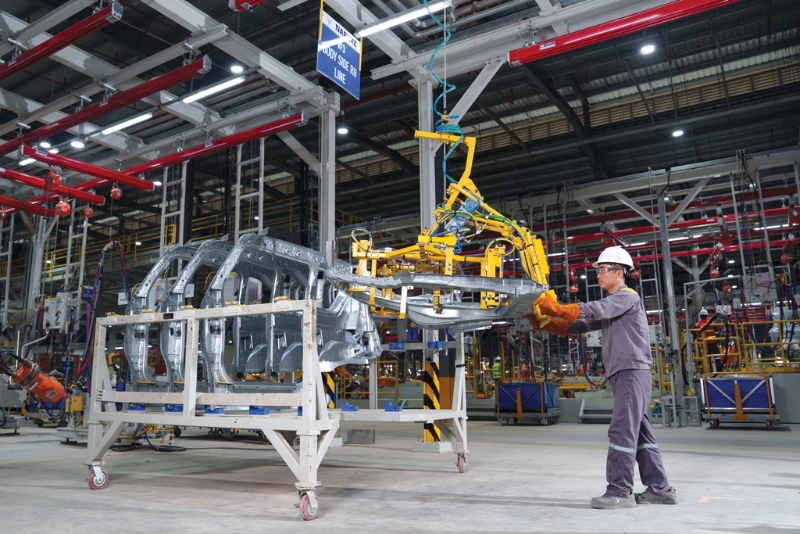
In manufacturing, THACO has built an extensive mechanical engineering ecosystem, while VinFast carries ambitions of becoming a global electric vehicle player and Hoa Phat has established itself as one of Southeast Asia’s leading steelmakers. In other strategic sectors, FPT is expanding regionally through AI and semiconductor solutions, while Vinamilk and Masan continue to strengthen their leadership in consumer goods.
A closer look at the automotive industry, one of the most technologically-integrated sectors, highlights the importance of these leading corporations. Mr. Le Khac Hiep, Vice Chairman of Vingroup, said that rather than following the conventional path of assembly-based production, VinFast chose to master core technologies through highly-automated manufacturing complexes.
The presence of an anchor company such as VinFast has helped activate Vietnam’s domestic support industry ecosystem. Once production reaches a sufficiently large scale, projected at more than 175,000 vehicles in 2025, support industries gain the confidence and incentive to invest more deeply in technology.
As a result, the localization rate of electric vehicles has already reached 60 per cent and is expected to rise to 80 per cent in 2026. Some suppliers have reportedly expanded their asset base 12-fold within just seven years of joining the supply chain.
Barriers in development
Despite these bright spots, Vietnam’s enterprise landscape still suffers from fundamental weaknesses that must be addressed directly. Mr. Tuan pointed to a core reality: Vietnamese businesses may be numerous, but they are not yet strong; dynamic, but not yet deep-rooted. Their position within global value chains remains modest.
The industrial structure also reveals a major imbalance. Much of the revenue generated by the country’s largest private enterprises is concentrated in finance and real estate, while manufacturing and processing, the foundation of national prosperity, still account for a relatively small share.
Meanwhile, nearly 97 per cent of Vietnamese enterprises are small and medium-sized enterprises (SMEs), most employing fewer than ten workers.
This limited scale makes investment in technological innovation difficult. The proportion of Vietnamese enterprises connected to global value chains has declined sharply. Labor productivity in the domestic private sector also lags significantly behind both the State-owned and FDI sectors. Investment in R&D remains limited, and many businesses continue to operate under family-style management structures with insufficient transparency and professional governance.
Another paradox lies in the weakening connection between domestic firms and global value chains, coupled with lower labor productivity compared to State-owned and FDI enterprises. More concerning is the fact that tens of thousands of businesses exit the market each year, yet in-depth analyses of the underlying reasons, whether capital shortages, land-related barriers, or administrative procedures, are few in number.
The imbalance between domestic and FDI sectors also deserves closer scrutiny. As of the first quarter of 2026, the FDI sector accounted for approximately 75 per cent of Vietnam’s total trade turnover, leaving domestic firms with only around 25 per cent. Questions surrounding market share shifts and the ability of local enterprises to break through in specific industries remain largely unanswered.
Even at the local level, many officials still lack accurate data on actively-operating, tax-paying, and profitable businesses, relying primarily on business registration statistics that may not reflect actual operations.
One of the most critical bottlenecks in the private sector is the absence of a strong layer of medium-sized enterprises; firms capable of becoming tier-1 and tier-2 suppliers within production chains. Research suggests these companies face limited competitiveness partly because of difficulties integrating into value chains.
Foreign corporations often invest in factories, facilities, and standardized systems before securing contracts. Vietnamese businesses, by contrast, typically wait until contracts are secured before making major investments. Under such an approach, competitiveness becomes difficult to sustain.
In addition, Vietnamese enterprises continue to face constraints related to capital, land access, administrative procedures, and human resources. As a result, opportunities for private Vietnamese firms to become suppliers for major multinational corporations remain lacking.
Strategic support
Looking ahead, Mr. Tuan recommended building a deeper statistical system to better understand why businesses leave the market, thereby enabling more targeted policy responses. Above all, protecting property rights and ensuring policy stability are essential to encourage long-term investment.
Experts also argue that Vietnam must rethink how it supports businesses. Rather than spreading support too thinly, the government should focus on strategic support centered around leading corporations. Mechanisms are needed to encourage these leaders to bring SMEs into their ecosystems and value chains.
At the same time, long-term capital flows must be unlocked. Mr. Nguyen Quang Thuan, Chairman of FiinGroup, emphasized that Vietnam’s capital demand for the next five years, estimated at VND38,500 trillion ($1.48 trillion), is enormous. Solutions include deeper reform of capital markets, expansion of the corporate bond market, and improvements to the country’s credit rating to reduce financing costs.
Vietnam should also consider establishing infrastructure investment funds and national growth funds to channel capital into strategic sectors while strengthening institutional safeguards and statistical systems.
Mr. Phan Duc Hieu, Member of the National Assembly and the National Assembly’s Economic and Financial Committee, argued that internationalization and technological mastery are equally important. Major corporations should accelerate their shift toward manufacturing and technology, invest substantially in R&D, and pursue overseas expansion strategies rather than competing solely for domestic market share.
Mr. Nguyen Van Phuc, former Vice Chairman of the National Assembly’s Economic Committee, stressed that the development of large economic groups has always gone hand-in-hand with legal reform. Key pillars of a strong conglomerate include capital concentration, technological capability, market integration, modern governance, innovation, and enterprise links.
At the same time, Vietnam must rethink its lawmaking approach. Too much emphasis is currently placed on the speed of legislation rather than its quality. Laws may be enacted quickly, only to require repeated amendments that create bottlenecks for the investment environment. Investors do not necessarily fear high taxes, but they do fear constantly changing regulations that lack stability and predictability. This poses a serious threat to market confidence.
Equally important is investment in legal talent. The quality of personnel involved in lawmaking remains uneven in many areas, with limited professionalism and insufficient formal training in legislative drafting. Without stronger legal institutions and more capable policymakers, Vietnam will struggle to build a legal framework robust enough to support the growth of domestic enterprises and foster more leading economic conglomerates.





 Google translate