


The first half of 2026 unfolded against a backdrop of mounting global uncertainty, as economies continued to grapple with rising trade protectionism, shifting tariff policies, supply chain realignment, and geopolitical tensions. Vietnam also faced the internal dual challenge of sustaining strong economic growth while safeguarding macro-economic stability, containing inflation, and laying the groundwork for faster, more sustainable development.
As the government rolled out a series of major policy initiatives, particularly following the adoption of Politburo Resolution No. 19-NQ/TW after the 3rd Plenum of the 14th Party Central Committee, the focus of economic management shifted from policymaking to implementation. The priority became translating reforms into tangible outcomes by unlocking resources, improving execution, and ensuring that policy decisions delivered measurable economic results.
Against this backdrop, Vietnam’s economic performance in the first half of 2026 reflected not only robust growth but also the initial impact of efforts to turn policy into development.
Strengthening together
According to the National Statistics Office at the Ministry of Finance, Vietnam’s GDP expanded 8.18 per cent year-on-year in the first half; one of its strongest growth rates ever despite a volatile global environment. More significant than the headline figure, however, was the broad-based nature of the recovery, with production, investment, and market demand strengthening simultaneously to support the country’s full-year growth target.
Manufacturing remained the economy’s primary growth engine. The industrial and construction sector expanded 9.81 per cent, led by manufacturing, which grew by more than 10 per cent and continued to make the largest contribution to overall GDP growth. Meanwhile, the services sector maintained solid momentum, supported by recovering domestic consumption, trade, and tourism.
The simultaneous improvement in both industrial production and services suggests that Vietnam is building a more balanced growth model, reducing its reliance on a limited number of sectors or individual growth drivers.
Investment trends also point to growing confidence in the country’s medium and long-term prospects. Total disbursed social investment increased across all three key sectors during the first half of the year: the State sector, the domestic private sector, and the FDI sector.
Public investment continued to accelerate to expand infrastructure and stimulate economic activity, while private businesses remained a major contributor to total investment. FDI inflows also maintained positive momentum despite intensifying global competition for investment capital. The simultaneous expansion of investment across all three sectors underscores the confidence of the government, domestic businesses, and foreign investors in Vietnam’s economic outlook.
Trade and the domestic market also remained important pillars of growth. Merchandise exports reached more than $266.5 billion in the first half of the year, up 21 per cent from a year earlier. Notably, import growth was driven largely by machinery, equipment, and production materials, indicating that businesses are expanding production capacity rather than scaling back in response to global economic uncertainty.
At the same time, labor market conditions continued to improve as employment increased, particularly in industry and services, helping sustain household purchasing power and support domestic consumption.
From momentum to sustained growth
The combined strength of production, investment, and market demand has created a solid foundation for continued economic expansion. However, the first-half results represent only the initial stage of implementing Vietnam’s broader policy agenda. Global uncertainty persists, while competitive pressures, digital transformation, and the transition to a greener economy are becoming increasingly important challenges.
Maintaining growth in the second half of the year will therefore depend not only on preserving economic momentum but also on improving the quality of policy implementation to unlock new sources of productivity and expand the country’s development potential.
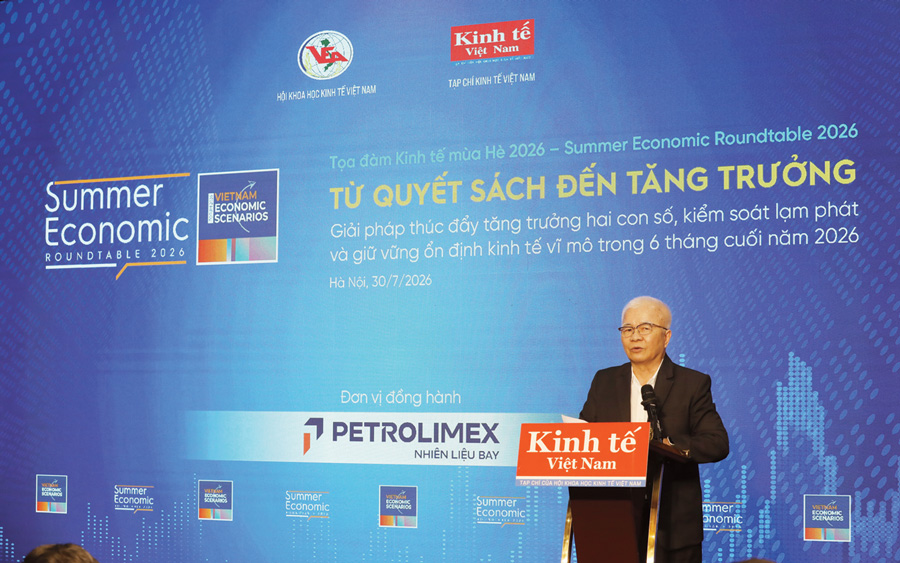
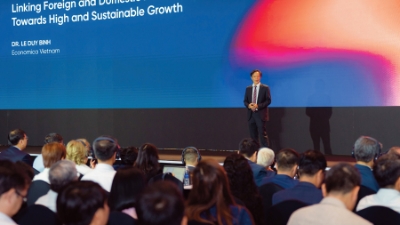
Against this backdrop, the Vietnam Economic Association and Tap chi Kinh te Viet Nam / Vietnam Economic Times / VnEconomy organized the Summer Economic Forum 2026 on July 30, with the theme “From Policy Decisions to Growth: Solutions to Promote Double-Digit Growth, Control Inflation, and Maintain Macro-economic Stability in 2H 2026.”
The Forum’s central message was clear: policy decisions can drive economic growth only when they are effectively implemented and translated into higher productivity and stronger national competitiveness.




 Google translate