


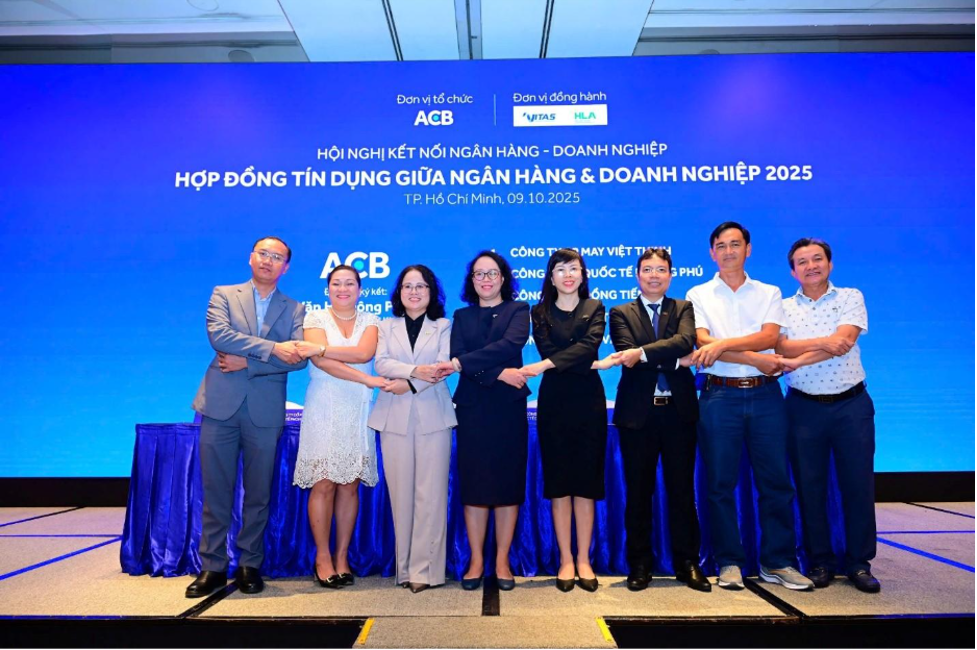
ACB is once again positioning itself as “the right partner at the right time,” rolling out a specialized financial solution package for Vietnam’s textile and garment industry as the sector navigates a turbulent 2025 that nevertheless delivers notable gains in both domestic and export performance.
By year-end, Vietnam’s textile and garment export turnover is estimated at $46 billion, a 5.6 per cent increase from 2024. The US remains the industry’s largest market, while Vietnam continues to rank among the world’s top three textile and garment exporters. A trade surplus of $21 billion highlights the sector’s critical contribution to the national trade balance. Adding to that momentum, the domestic value-added rate has climbed to roughly 52 per cent, reflecting improving self-sufficiency in raw materials, a long-standing structural challenge.
The importance of stable capital flows
The industry’s outlook underscores the importance of stable capital flows as Vietnam steps into an increasingly competitive global arena. With a “quality-first” strategy complemented by political and macroeconomic stability, the country continues to secure trust and orders from demanding markets.
At ACB’s October conference, “Textile & Garment Industry – Supply Chain: Solutions Amid Volatility,” Mr. Vu Duc Giang, Chairman of the Vietnam Textile and Apparel Association (VITAS), stressed the essential role of credit institutions in helping Vietnamese enterprises accelerate growth, seize market opportunities, and remain resilient amid global economic fluctuations.
According to ACB Deputy CEO Ngo Tan Long, the bank has provided dedicated support to the textile and garment industry for years and is expanding its financing portfolio for 2025–2027. “We understand the specific characteristics of the industry, so we have designed tailored financing options which include unsecured lending based on cash flow with credit limits up to twice the borrower’s equity, and medium- to long-term credit frameworks that allow enterprises to invest in machinery without undergoing repeated assessments,” he said.
VITAS maintains that “Greenization – Digitalization” will be the industry’s strategic direction for 2026, helping enterprises strengthen internal capacity and elevate competitiveness as sustainable and eco-friendly fashion gains global traction. In alignment with that shift, ACB has allocated VND5 trillion through its Green Credit Package, offering interest rates 2–3 percentage points lower than conventional loans.
As export targets rise for 2026, ACB reports strong demand for its exchange-rate and interest-rate hedging tools, along with cost-optimized international payment services. The bank says 70–80 per cent of its online trade finance and international payment processes are now automated, significantly reducing processing times and improving convenience. All solutions are developed and recommended based on each enterprise’s practical needs.
Textiles: A continuing FDI magnet
Data from the Department of Vietnam Customs show that in the first 10 months of 2025, textiles and footwear ranked among the top six export groups of FDI enterprises in Vietnam, generating $36.5 billion in export value. The textile and garment sector remains a major draw for investors from South Korea, Taiwan, China, Hong Kong, Japan, and India, with more than 3,000 projects operating nationwide.
To ensure this large capital inflow is effectively deployed, and to reinforce Vietnam’s position in the global textile supply chain, ACB offers stage-specific financial solutions to help FDI enterprises integrate smoothly into the local business environment. These include advisory and payment support at the establishment stage; import financing and guarantees during factory construction; trade finance, medium- and long-term credit, and cash-flow management during production; and preferential international payment fees, foreign-exchange products, flexible credit, and ERP connectivity during expansion. ACB’s multilingual teams, specializing in English, Chinese, and Korean, help investors shorten administrative procedures and adapt more easily to Vietnam’s market conditions.
ACB representatives say the bank is also working with corporate clients to plan year-round financial strategies for 2026. Many businesses have production schedules fully booked through the first quarter and are negotiating orders for the second. In provinces affected by severe storms and flooding in northern and central Vietnam, ACB is offering preferential lending to support post-disaster reconstruction and maintain manufacturing continuity.
With financial solutions designed specifically for both domestic and foreign enterprises in the textile and garment sector, ACB affirms its confidence and commitment to meeting the industry’s development needs under any market conditions.
For more information on financial solutions for textile and garment enterprises, visit ACB branches and transaction offices nationwide or contact the 24/7 Contact Center at +84 28 38 247 247.


 Google translate