


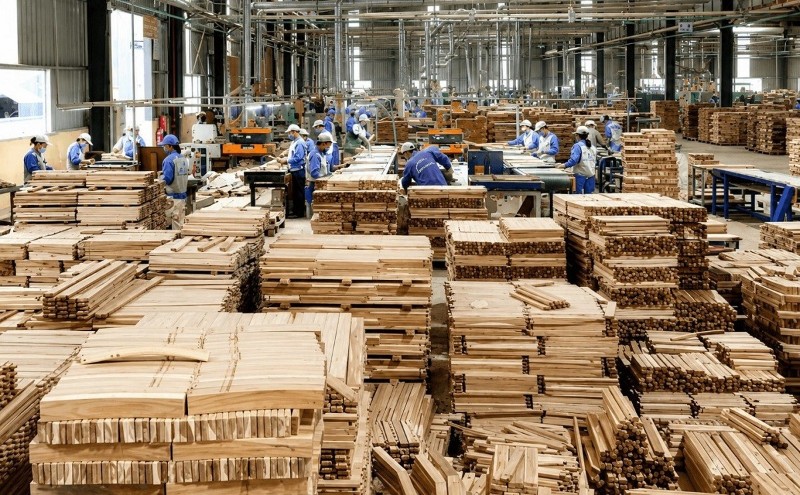
Vietnam’s wood processing and export industry is entering its year-end sprint with the goal of reaching the $19.2 billion milestone, reported the Government's online newspaper (chinhphu.vn)
To sustain production momentum and fulfill surging year-end export orders, ensuring a stable supply of raw materials and smooth working capital flows for businesses is the top priority. However, practical implementation of value-added tax (VAT) policies and origin verification for imported timber continues to face significant hurdles.
According to Chairman of the Handicraft and Wood Industry Association of Ho Chi Minh City (HAWA), Mr. Phung Quoc Man, the timber and furniture sector is actively working to expand markets and sharpen competitiveness. Nevertheless, for small and medium-sized enterprises (SMEs), incurred costs and tied-up working capital stemming from VAT refund delays are placing heavy pressure on business operations.
Sharing this view, Chairman of the Board of Directors of Lam Viet JSC, Nguyen Liem, pointed out inconsistencies in how VAT policies are interpreted and applied across different agencies and localities. Specifically, tax treatment for identical shipments of standard imported raw timber varies between Quy Nhon Port (Gia Lai Province) and Cat Lai Port (Ho Chi Minh City). Similarly, while the Dong Nai Provincial Tax Department classifies kiln-dried sawn timber as tax-exempt, several other localities apply an 8% tax rate. This lack of uniformity has caused numerous invoices for kiln-dried sawn timber and wood byproducts to be rejected or temporarily excluded from VAT refund dossiers, resulting in prolonged capital lockup.
Beyond tax policies, proving the origin of imported raw timber also poses a major challenge. Mr. Liem noted that requirements for multiple plantation forest certificates, coupled with consular legalization rules for timber imported from developing nations in the Americas (where Vietnam lacks consular offices), have lengthened customs clearance times and generated massive container detention and demurrage fees.
Commenting on the issue, Ms. Tran Hao Nhien, a wood industry representative, proposed that regulators shift the requirement from proving "plantation-grown timber" to proving "legal timber" to align with international trade practices, as many major exporting countries supply timber from government-licensed natural forests.
Proactively navigating trade barriers and building bilateral cooperation
Alongside domestic hurdles, Vietnam’s largest export market—the United States, which accounts for roughly 50% to 55% of total wood export turnover—is increasingly erecting layers of trade remedies and tariffs.
According to the Vietnam Timber and Forest Product Association (VIFOREST), exports of wood and wood products to the United States reached $9.46 billion in 2025. In the first 10 months of 2026, shipments to the US market totaled approximately $7.5 billion out of the industry's overall $15 billion in exports. This substantial market share brings heightened risks of anti-dumping and countervailing duty investigations.
To create a breakthrough in the final months of the year, Vice Chairman and General Secretary of VIFOREST, Mr. Ngo Sy Hoai, recommended that the Government and relevant ministries consider eliminating export duties on sawn timber processed from imported logs, as well as scrapping the 5% export tax on black wood pellets. Removing these tax obstacles would not only add $500 million to $700 million in annual export value, but also position Vietnam as a processing and distribution hub for US timber in Asia—serving as an "extended arm" for the American wood industry while helping to balance bilateral trade.
The fundamental solution for the timber sector to achieve sustainable growth and meet its $19.2 billion target—comprising over $18 billion in wood products and $1.2 billion in non-timber forest products—lies in shifting its growth model from volume to quality, maximizing added value per cubic meter of harvested timber. Additionally, practical experience from leading enterprises underscores that technology adoption plays a decisive role.









 Google translate