


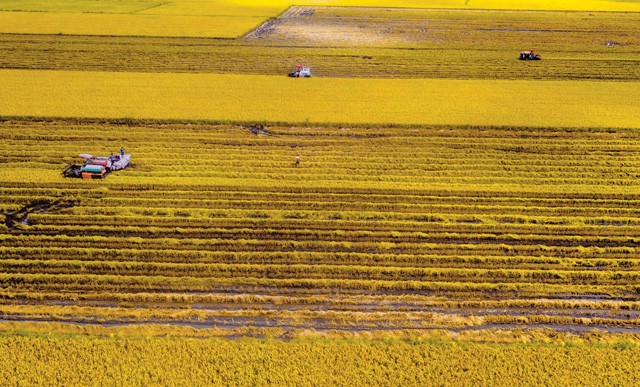
The Mekong Delta accounts for more than half of Vietnam’s rice output and over 90 per cent of its rice exports, yet the region faces mounting pressure from climate change, extreme weather, saltwater intrusion, and resource depletion, with related losses estimated at $2.4 billion annually. Rice cultivation is also a major source of greenhouse gas emissions in the agriculture sector, underscoring the need to transform production methods while preserving the region’s role in national food security and exports.
In this context, Vietnam is stepping up efforts to reduce emissions, improve farmers’ livelihoods, and strengthen the competitiveness of its rice industry through a new Canada-funded initiative targeting sustainable, climate-resilient production in the Mekong Delta.
On October 28, Oxfam in Vietnam, together with government agencies and other partners, launched the “Enhancing Sustainable and Climate-Resilient Low-Emission Rice Value Chains” project, known as GORICE, in Can Tho city. Funded by the Canadian Government through Global Affairs Canada, the project runs from 2025 to March 2030 across Can Tho and nearby An Giang and Vinh Long provinces. It aims to accelerate the adoption of climate-smart rice production, expand access to green finance and carbon markets, and strengthen cooperation across the rice value chain.
Changes in the field
Vietnam is mobilizing international partners and financial resources to support the 1 million ha program, according to Dr. Nguyen Do Anh Tuan, Director of the Department of International Cooperation at the Ministry of Agriculture and Environment (MAE). Preliminary estimates suggest the country could mobilize an additional $150 million in non-refundable aid, with nearly $20 million prepared for the initial phase of programs running from 2026 to 2030. However, the transition requires more than technical assistance or expanded cultivation areas.
Dr. Tuan emphasized the importance of connecting successful models with the national program to avoid duplication and facilitate replication across the region. Local authorities, businesses, and research institutions must coordinate their efforts, from integrating project activities into regional development plans to transferring farming technologies and establishing reliable systems for measuring emissions.
Farmers must also remain at the center of the transition, with access to knowledge, technology, and resources, as well as a fair share of the additional value generated by more sustainable production. This is particularly important as international and domestic markets increasingly demand rice with verifiable origins, lower emissions, and responsible production practices.
Mr. Hoang Quang Phong, Vice Chairman of the Vietnam Chamber of Commerce and Industry (VCCI), said businesses could play a pivotal role by providing financing, transferring production processes, maintaining quality standards, and securing market outlets. “To ensure long-term participation, they need reliable raw-material zones supported by transparent data, long-term contracts rather than seasonal purchasing arrangements, sufficient working capital, and mechanisms to share risks when prices fluctuate,” he noted.
Through GORICE, the Chamber plans to strengthen links between businesses and cooperatives, improve access to green finance, and help develop domestic demand for low-emission rice while expanding markets for higher-quality products.
Building value
International cooperation is expected to help bridge the gap between Vietnam’s sustainability ambitions and the technologies, financing, and verification systems needed to implement them. H.E. Jim Nickel, Ambassador of Canada to Vietnam, said the partnership combines Canada’s expertise in climate-smart agriculture, carbon accounting, measurement, reporting, and verification (MRV), climate finance, and agricultural innovation with Vietnam’s local knowledge and leadership.
The collaboration is intended to improve the rice industry’s competitiveness while reducing emissions, encouraging private investment, and mobilizing climate finance. It also seeks to create longer-term opportunities for farmers, particularly women.
Ms. Nguyen Thi Thu Huong, Deputy Director of the Department of Crop Production and Plant Protection at the MAE, said the 1 million ha program was designed not only to expand sustainable cultivation but also to improve the quality, value, and reputation of Vietnamese rice.
Farmer incomes, she noted, verifiable emissions reductions, and the industry’s competitiveness should therefore serve as key measures of progress. GORICE will focus on three areas: promoting climate-smart rice production; expanding access to green finance, carbon markets, and sustainable business opportunities; and strengthening multi-stakeholder cooperation to create a more supportive policy environment.
The initiative also places emphasis on women, young people, ethnic minorities, and other vulnerable groups, seeking to expand their access to green technologies, finance, and participation in sustainable agricultural development.
Turning low-emission rice production into a commercially-viable model remains a central challenge for Vietnam. While early results from the national program have been encouraging, wider adoption will depend on whether farmers and businesses can capture tangible economic benefits.
According to Mr. Pham Quang Tu, Deputy Country Director of Oxfam in Vietnam, pilot models under the national program have increased farmers’ profits by VND1.5 million to VND9.3 million ($58 to $358) per ha, reduced chemical fertilizer use by 20-30 per cent, cut pesticide applications by two to three rounds, and lowered seeding rates by 30-50 per cent. Emissions have also fallen by an estimated three to four metric tons of carbon dioxide equivalent per ha per crop.
Driving inclusive growth
Despite these gains, the area fully implementing low-emission cultivation practices remains limited, while low-emission rice accounts for only a small share of exports. Farmers do not always apply the required techniques consistently, many cooperatives face management constraints, and access to financing, technology, and markets remains insufficient.
Price incentives are another obstacle. Low-emission rice has yet to achieve a clear and consistent premium over conventional products, weakening the financial motivation for farmers to adopt new practices. Incomplete emissions measurement and verification systems, together with underdeveloped mechanisms for sharing the benefits of carbon reductions, further limit the economic returns from sustainable cultivation.
GORICE seeks to address these barriers through a more integrated approach. Alongside technical training in seed selection, soil and water management, fertilizer application, and rice straw treatment, the project will strengthen cooperation between farmers, cooperatives, and businesses, improve traceability, and support the development of sustainable rice brands.
It also aims to help farmers and cooperatives access green credit and explore carbon-related opportunities, while improving cooperative management, production standards, and emissions data transparency.
By 2030, the project targets 48,200 direct beneficiaries, including 20,500 rice growers whose livelihoods are expected to improve. Women are expected to account for 50 per cent of these growers, while ethnic minorities will represent 20 per cent. The initiative also aims to support more than 600 female farmers with agricultural inputs, engage over 30 businesses in low-emission value chains, help 12 business plans access green finance, expand climate-smart cultivation across 180,000 ha, and reduce emissions by more than 700,000 metric tons of CO2-equivalent.
Gender equality and social inclusion are integral to this approach. Beyond direct assistance, the project will provide support in leadership, negotiation, and financial management, while promoting women’s participation in production planning, cooperative governance, and decisions on how economic benefits are distributed.
The broader objective is to ensure that small-scale producers and vulnerable groups can participate meaningfully in the transition rather than remaining concentrated in production activities with limited influence over the value chain. Achieving these goals will require coordinated action from government agencies, businesses, cooperatives, financial institutions, and research organizations.
For Vietnam’s rice industry, the green transition ultimately depends on aligning environmental performance with commercial incentives. By combining lower-emission farming practices with stronger market connections, green finance, and more inclusive value chains, GORICE aims to help turn sustainable rice production into a viable long-term business model, one that improves farmers’ livelihoods while strengthening the resilience and competitiveness of the Mekong Delta.

 Google translate