


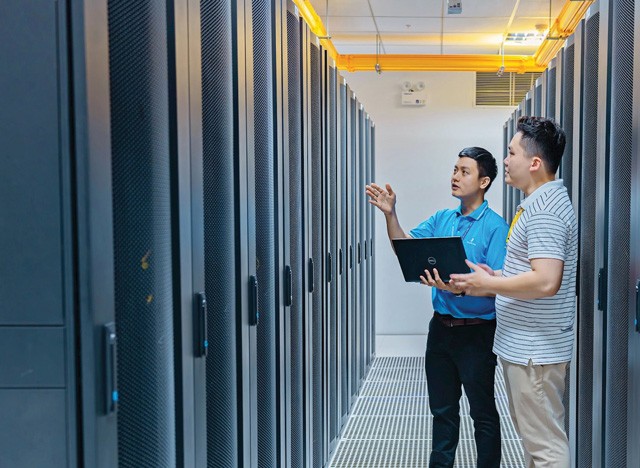
The appearance and adoption of AI has been changing the development equation for data centers in Vietnam, as rapidly-growing computing demand raises requirements for power, cooling, connectivity, space, and energy efficiency. At the Vietnam Cloud & Datacenter Convention 2026, organized by W.Media in Ho Chi Minh City on August 20, experts and businesses said the market is entering a new phase of development, with a range of models being considered, from hyperscale and high-density data centers to liquid cooling, domestic cloud, hybrid cloud, and edge computing.
Alongside resource optimization, access to power, land, and connectivity as well as deployment timelines are increasingly influencing investment decisions. This is creating room for both large-scale projects and more flexible models that can be deployed in phases to better match demand in Vietnam.
Regulatory and infrastructure challenges
According to Mr. Le Quang Dam, General Director of Marvell Vietnam, the AI boom is significantly changing the traditional data center model. “An AI data center with a capacity of around 1 GW consumes roughly as much electricity as nearly 100,000 households,” Mr. Dam said. “For larger data centers, demand can reach several gigawatts, equivalent to the electricity consumption of an entire city.”
AI data centers also require significant amounts of water for cooling. As power density rises, the heat generated by computing systems increases, putting greater demands on cooling infrastructure. “AI systems can deliver extremely high computing performance, but at the same time they consume significant amounts of electricity and water,” he said.
This creates challenges not only for technology companies but also for data center infrastructure planning and development. As AI facilities become larger, improving energy efficiency will be increasingly important to limit pressure on power supplies and the environment.
From its experience deploying data center models in Ho Chi Minh City, Mr. Hai Nguyen, CEO of USDC Technology, said Vietnam is creating more room for foreign investment in data centers. The Law on Telecommunications 2023 also does not impose a foreign ownership cap specific to data center businesses.
However, power planning remains a challenge for foreign investors. “The Ministry of Industry and Trade has recently asked telecommunications authorities to collect information on projects that businesses plan to develop through 2030, so that power infrastructure can be planned accordingly,” Mr. Hai said.
He also noted that, alongside power infrastructure, expanding submarine cable stations and diversifying international connectivity would help improve the resilience and redundancy of Vietnam’s digital infrastructure as demand from data centers and AI continues to grow.
Meanwhile, AI development is also changing enterprises’ requirements for data infrastructure. Mr. Henry Nguyen, Vietnam Country Manager at Synology told the Convention that data sovereignty is becoming an increasingly important consideration when businesses choose data storage and processing infrastructure. “Businesses increasingly want to know exactly where their data is stored, who has access to it, and whether they can maintain full control over that data,” he explained.
The rapid adoption of AI is creating another requirement: businesses want to deploy the technology without moving sensitive internal information, such as contracts, documents, and operational data, outside their own systems because of concerns over security and control.
Mr. Henry Nguyen also highlighted the growing importance of data backup and disaster recovery as corporate data volumes expand and the risks of system failures and cyberattacks increase.
Greater efficiency and sustainability
As computing demand rises, improving the efficiency and sustainability of data center infrastructure is becoming increasingly important. Beyond expanding power and cooling capacity, the industry is also looking at ways to reduce energy consumption at the source.
According to Mr. Dam, a more effective approach would be to address energy consumption at its source rather than focusing solely on removing the heat generated by computing systems. “Instead of only looking for ways to remove heat more efficiently, if we can reduce heat generation and power consumption at the source, we can achieve significant energy savings,” he believes.
At the AI infrastructure level, he identified three key technology directions for improving energy efficiency. The first is advanced semiconductor technology, with increasingly smaller transistor sizes. Marvell is developing designs using processes such as 5nm (nanometer), 3nm, and 2nm. Smaller transistors can help reduce power consumption during processing.
The second is advanced packaging technology. Rather than placing components on a single plane, 2.5D and 3D packaging can shorten the distance between components. This can optimize space while reducing the energy required for data transmission.
The third is the shift from electrical to optical connectivity. Optical connections can transmit signals at high speeds with lower resistance, helping reduce the energy required to move data, particularly as connectivity expands from within servers to between servers, data centers, and even across geographic locations.
These three technology directions, Mr. Dam continued, provide a foundation for developing chips for AI infrastructure with greater energy efficiency while meeting increasingly demanding computing requirements.
Mr. Hai, for his part, said the data center market is also becoming more diversified in terms of scale and deployment models. Alongside large facilities, demand is growing for smaller systems that can be deployed quickly and expanded in phases.
With modular and prefabricated models, power, cooling, and technology infrastructure can be integrated and tested before being transported to the deployment site, significantly shortening construction time. Meanwhile, edge data centers bring computing, storage, and connectivity closer to users, making them suitable for applications driven by AI, 5G and the Internet of Things (IoT).
At the data protection layer, businesses can implement multi-layer backup strategies, including immutable and air-gapped copies. According to Mr. Henry Nguyen, this approach provides an additional layer of protection against data being altered, deleted, or encrypted during cyberattacks, while allowing businesses to take greater control of system recovery.

For Vietnam, deeper participation in the AI technology value chain will not only create job opportunities but also help build a talent pool capable of leading high-tech sectors in the future.

Mr. Colin Wang, Technical Manager at Attom Technology in the US, said one of the key challenges is deployment speed. Data centers are traditionally built using subsystems from different suppliers, but current demand requires faster deployment.
The solution, he went on, is to integrate these systems into a single solution covering cooling, power, racks, and monitoring. For small businesses or branch facilities, systems can be deployed within one or two days. For larger data centers, prefabricated container-based solutions can significantly shorten construction time. “A traditional data center can take one to two years to complete,” Mr. Wang said. “With prefabricated solutions, this can be reduced to one or two months.”
Deployment speed is becoming increasingly important as AI advances rapidly and new generations of GPUs and CPUs emerge continuously. If infrastructure takes one or two years to build, the technology selected at the beginning of a project could risk becoming outdated by the time the facility becomes operational.
“We integrate the infrastructure, and install, connect, and commission everything at the factory before transporting it to the site,” he explained. “On-site installation can then be completed in around a month.” This approach enables businesses to put servers into operation, deploy applications, and start operations more quickly than with conventional data center construction.
Building Vietnam’s role
Beyond infrastructure and chips, Mr. Dam also highlighted the role of technology talent in Vietnam’s AI development. Marvell began operations in Vietnam around 12 years ago, with a small team of engineers. The local workforce has since grown to more than 650 engineers, participating in multiple stages of advanced technology development.
Vietnamese engineers are now capable of contributing to high-end technologies, he said, including high-speed optical connectivity solutions for advanced AI systems. This is also part of Marvell’s long-term commitment to Vietnam, not only through expanding its workforce but also by enabling local engineers to participate more deeply in R&D and technological innovation.
From Marvell’s perspective, developing AI infrastructure is not a task that any single company can handle alone. The AI ecosystem encompasses a host of components, requiring collaboration between multiple businesses and technology partners. “No company can do everything on its own in AI and AI infrastructure,” he said. “We need collaboration and partnerships.” For Vietnam, he believes deeper participation in the AI technology value chain will create not only employment opportunities but also a pool of talent capable of leading high-tech sectors in the future.
As demand for AI computing continues to rise, the question for data centers is no longer simply how much additional space can be built, but how much computing capacity can be delivered per unit of electricity and resources consumed. This will be one of the key factors determining how Vietnam can scale its AI infrastructure in a more efficient and sustainable manner.






 Google translate