


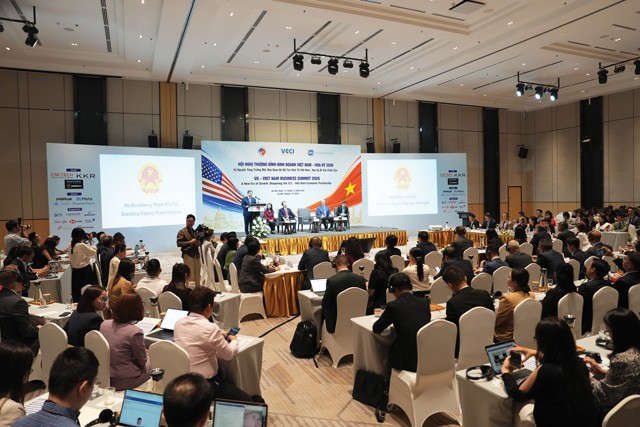
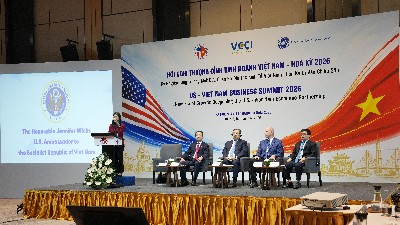
When Vietnam and the US normalized diplomatic relations 30 years ago, bilateral trade totaled just $450 million, according to the American Chamber of Commerce in Vietnam (AmCham Vietnam). That figure has now grown to more than $209 billion, an increase of over 460-times. “It gave international investors the confidence to establish manufacturing operations in Vietnam while serving American customers, creating jobs, transferring technology and skills, raising incomes, and helping Vietnam move steadily up global supply chains,” Mr. Mark Gillin, Chairman of the National Board of Governors of AmCham Vietnam, told the Vietnam - US Business Summit 2026 on October 14 in Hanoi. “This relationship has been successful and consequential, not only for our two countries but for many others as well.”
Vietnam-US economic relations have continued to grow strongly in recent years. The comprehensive strategic partnership and deepening cooperation between the two nations reflect the complementary strengths of their respective economies. According to Deputy Minister of Industry and Trade Truong Thanh Hoai, Vietnam possesses advantages in production capacity, an abundant and youthful workforce, and the ability to integrate into international supply chains, while the US holds strengths in foundational technologies, energy, finance, innovation, and modern industrial management.
Cooperative prospects
Vietnam expects to continue policy dialogue to facilitate trade and investment while also expanding imports of products in which the US holds a competitive advantage and for which there is demand in Vietnam, particularly in energy, machinery, high-tech equipment, and raw materials for production. “We believe that bilateral cooperation should shift its focus from expanding scale to enhancing quality, technological content, and value-added, with energy, AI, and science and technology serving as key drivers,” the Deputy Minister said.
In addition, US companies contribute not only capital, technology, and advanced management expertise but also create opportunities for cooperation, supply chain integration, and capacity-building for Vietnamese businesses. Mr. Nguyen Quang Vinh, Vice Executive President of the Vietnam Chamber of Commerce and Industry (VCCI), said that prominent names such as HP and Nvidia in the technology sector, FedEx in logistics, and Accelerate Energy in the energy sector not only bring in capital, technology, and advanced management expertise but also create numerous opportunities for collaboration, supply chain integration, and the enhancement of capabilities for Vietnamese businesses.
Mr. David Fogel, Assistant Secretary of Commerce and Director General at the US and Foreign Commercial Service, also affirmed that Vietnam is a valuable market for US businesses, thanks to growing bilateral trade, a rapidly-expanding middle class, and increasing demand for American goods and services across a wide range of sectors.
The US Department of Commerce has assisted US businesses in securing major contracts across the aerospace, defense, energy, and infrastructure sectors, with a total project value exceeding $12 billion and a US export contract value of nearly $11 billion. Alongside these deals, data also indicates a 57 per cent increase in US exports to Vietnam between 2020 and 2025. “Vietnam and Southeast Asia are priority markets where our team at the US Department of Commerce is focused on fostering collaboration,” said Mr. Fogel. “We look forward to working with Vietnam to bring world-class AI hardware and innovative solutions to the Vietnamese market.”
Mr. Gillin added that Vietnam and the US are currently entering a new phase of transition, referred to as “Doi Moi 2.0” (Economic Renewal 2.0). The successes achieved during the initial stage of their bilateral relationship have laid a foundation for the next era of cooperation, a period marked by Vietnam’s implementation of long-awaited reforms and the two nations moving closer toward a potential new trade agreement. “These are positive signals that open up promising prospects for future collaboration,” he said.
Priorities for the future
According to the Ministry of Industry and Trade, Vietnam seeks to strengthen cooperation with the US in the energy sector in areas such as liquefied natural gas (LNG), energy infrastructure, power transmission, smart grids, energy storage, and energy efficiency. The Ministry prioritizes the application of technology in smart manufacturing, energy management, logistics, e-commerce, and supply chains.
To turn potential into outcomes, it is essential to further enhance cooperation among regulatory bodies, business associations, and enterprises. Business associations, in particular, play a central role in converting collaborative opportunities into specific projects and tangible results. “I am confident that the Vietnam-US partnership will continue to make significant strides forward, contributing positively to the development and prosperity of both nations,” Deputy Minister Hoai said. “This is a crucial moment for the two countries to further elevate their cooperation, effectively leverage their complementary strengths, and work toward long-term development goals.”
Additionally, VCCI has put forward three key recommendations to foster more substantive, balanced, and sustainable economic, trade, and investment relations between Vietnam and the US. While it looks forward to the continued maintenance of a stable, transparent, and highly-predictable policy environment, it is also essential to strengthen dialogue between the government and the private sector to promptly address challenges and obstacles, thereby facilitating bilateral trade and investment.
As for the US business community, VCCI encourages companies, particularly major corporations with significant technological capabilities and investment resources, to expand their direct investments in Vietnam, with an emphasis on depth, quality, value-added, and a long-term vision. Both sides should enhance collaboration in strategic, high-tech sectors such as AI, digital technology, semiconductors, green transition, energy, and other industries critical to national economic competitiveness.
Furthermore, Vietnamese enterprises need to proactively enhance their competitiveness, meet international standards, and improve their management capabilities to integrate more deeply into supply chains and generate greater value. At the same time, they should actively seek partners and expand trade and investment cooperation in the US, thereby contributing to a balanced and sustainable bilateral economic relationship. “We are confident that, with the support of both governments and the proactive efforts of the business community, these strategic directions will be translated into concrete cooperative opportunities, investment projects, and tangible business outcomes, delivering practical benefits to both economies,” Mr. Vinh noted.
Meanwhile, Mr. Fogel expects Vietnam and the US to continue efforts toward a reciprocal trade agreement, creating conditions to rebalance the trade relationship.
Mr. Gillin added that Vietnam has significant room to improve productivity through the application of technology and AI while simultaneously cutting unnecessary costs related to regulations, logistics, customs procedures, and various uncertainties, including the reliability of power supply.
To effectively capitalize on these opportunities and navigate uncertainties, three principles should be prioritized. Adaptability requires a legal and regulatory framework flexible enough to accommodate technologies and business models that cannot yet be envisioned. Proactiveness entails fostering an environment where businesses can innovate without needing authorization at every step. And efficiency requires clear recognition that any expenditure unnecessary for regulatory compliance diminishes the resources available for innovation, productivity enhancement, and growth.
Mr. Gillin believes that over the past three decades, dialogue has enabled Vietnam and the US to reconcile differences in their respective national interests regarding trade, thereby building a successful economic relationship. “In light of the opportunities presented by AI, both nations must not only balance their respective national interests but also work together to assess the opportunities and risks of a future that neither can yet fully foresee,” he added. “To address challenges, Vietnam and the US need to strengthen cooperation in key sectors, including energy, digital technology, semiconductors, financial services, and education.”




 Google translate