


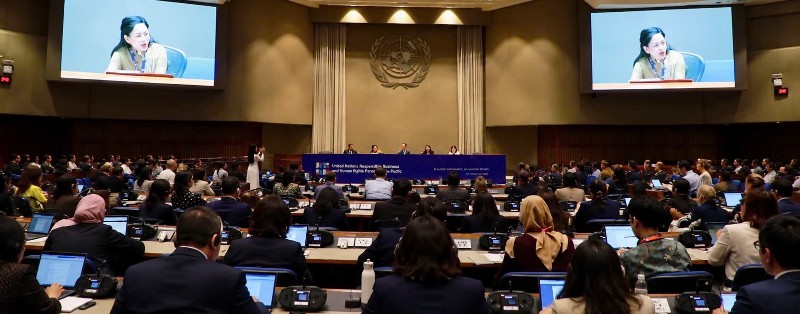
The 8th UN Responsible Business and Human Rights Forum took place in Bangkok, Thailand from September 14 to 17, under the theme "Building Resilience, Advancing Rights."
This annual Forum was co-organized by seven UN agencies—UNDP, UN Women, ILO, UNICEF, UNEP, IOM, and the Office of the High Commissioner for Human Rights (OHCHR)—in collaboration with the UN Working Group on Business and Human Rights, and with support from Walk Free, the governments of Australia, Japan, and Sweden, and the European Union.
Notably, within the framework of the forum, Ms. Le Hong Thuy Tien, CEO of Imex Pan Pacific Group (IPPG), was the sole speaker from Vietnam at the session titled "Rising Together: Inclusive Procurement as an Untapped Lever for Competitive and Resilient Supply Chains in Asia-Pacific." The session was moderated by Ms. Karima Chaisaengchan, Regional Programme Manager for "WE RISE Together" at UN Women Asia-Pacific.
Inclusive Procurement Opens Market Access for Women-Owned Businesses
Women-owned businesses hold significant potential to contribute to economic growth, job creation, and the building of more resilient economies. However, many of these businesses continue to face systemic barriers regarding access to capital, business networks, and markets.
These obstacles are even greater for women facing intersecting forms of discrimination, including women with disabilities, ethnic minority women, LGBTQI+ individuals, and women living in rural or underserved areas. Consequently, many capable businesses fail to launch, grow, or remain profitable—not due to a lack of potential, but because they are excluded from opportunities.
Inclusive procurement offers a practical approach to bridging this gap.
Every year, public and private organizations worldwide spend between $11 trillion and $13 trillion on the procurement of goods and services. Yet, according to the International Trade Centre (ITC) and UN Women, less than 1 per cent of this spending reaches women-owned businesses.
This situation reflects not only inequality but also a vast, untapped economic opportunity.
By making procurement systems more inclusive and removing barriers to entry, governments and businesses can create fairer access to existing markets, enabling diverse businesses to grow and leveraging procurement as a strategic tool to foster women's economic empowerment and inclusive growth.
During the session, experts from the business community, government, and regulatory bodies will share actionable strategies and valuable lessons from the Mekong sub-region. Discussions will focus on promoting gender-responsive procurement in both the public and private sectors, as well as enhancing supply chain diversity through improved supplier data and the adoption of inclusive procurement practices. Additionally, experts will discuss expanding market access through targeted supplier development and strengthened market linkages.
These discussions highlight that the importance of inclusive procurement extends far beyond mere regulatory compliance. When effectively designed and implemented, inclusive procurement enables businesses to identify and partner with diverse suppliers, dismantle structural barriers to market entry, strengthen local economies, manage supply chain risks, and build supply chains that are more competitive, sustainable, and responsible.
Finally, the discussions will examine how to translate high-level commitments into concrete actions, and how businesses, policymakers, and regulators can collaborate to create an enabling ecosystem for inclusive, human rights-respecting markets across the Asia-Pacific region.
In this context, Vietnamese enterprises can transform their purchasing power into a driving force for supplier development.
Women-owned businesses in Vietnam can transform purchasing power into a driving force for inclusive supply chains
Ms. Le Hong Thuy Tien, representing the Vietnamese business sector, stated that IPPG currently partners with 138 international brands, operates approximately 1,500 stores, employs over 25,000 people (62 per cent of whom are women), and works with more than 1,000 suppliers.
IPPG is also the first private corporation in Vietnam to sign a partnership agreement with UN Women. In her capacity as an IPPG executive, Ms. Thuy Tien signed the commitment to the Women’s Empowerment Principles (WEPs) and was honored by UN Women with the 2021 WEPs Award in the category of "Leadership Commitment and Action for Gender Equality."
"I come from Vietnam—a country where, nearly 2,000 years ago, the Trung Sisters led an entire nation; and today, Vietnamese women own or lead about one-quarter of the country's businesses," Ms. Thuy Tien shared. "My own journey took me from being a flight attendant to managing a corporation with 25,000 employees, 62 per cent of whom are women. Therefore, today's topic truly resonates with my personal journey."
According to Ms. Thuy Tien, to leverage corporate purchasing power for competitiveness and responsible business practices, commitments to gender equality must first be integrated into governance policies, rather than remaining merely as statements, charitable activities, or CSR initiatives.
She believes that large enterprises need to open market access opportunities for women-owned businesses while maintaining standards regarding quality, price, capacity, and compliance, while simultaneously measuring results based on the number of women-owned suppliers contracted and their capacity for sustainable growth within the supply chain. More importantly, these commitments must generate tangible business benefits for the large enterprises themselves, because "only when there is real value can a commitment be sustainable."
At IPPG, this perspective is embodied in the question: “What can a business become after working with IPPG?” Through IPP Travel Retail and the "WE RISE Together" program, IPPG provides in-depth consulting to women-owned businesses; recently, it connected approximately 30 such enterprises to its retail network in Ho Chi Minh City. Companies such as Hoa Sua Bird’s Nest, Hoi An Organic Silk, and Blue Saigon Pens have reported sales growth after one year, secured a presence in IPPG’s airport stores, and begun exporting their products.
“Every square meter of airport shelving serves as an ‘on-site export platform’ allowing Vietnamese women to export to the world without ever leaving Vietnam,” the IPPG's CEO stated.
In the luxury brand retail segment—where fixtures and fittings were previously supplied primarily by foreign contractors—IPPG persuaded brands to expand their list of suppliers. After a year of consulting and oversight from IPPG, FIXX—a women-owned business—now manufactures fixtures for IPPG’s stores and exports to Australia and other markets. “Procurement is no longer merely about purchasing goods; it has become a foundation for growth,” Ms. Tien concluded.
Reflecting on over 30 years of business in a competitive environment, she maintains that the guiding principle must be “equal opportunity, not favoritism.” While IPPG incorporates "women-owned business" status into its supplier evaluation criteria, it does not lower commercial standards. According to the CEO of Imex Pan Pacific Group (IPPG), “Women do not need lower standards; they need a fair opportunity to meet high standards.”
Drawing lessons from the Covid-19 pandemic, Ms. Thuy Tien noted that supply chains reliant on too few sources are vulnerable, whereas diversifying to include local suppliers enhances business flexibility and resilience. “Equality is not a burden on businesses—it is a gateway to genuine growth.”
Vietnam is currently seeing policy shifts aimed at creating more market opportunities for women-owned businesses. Starting in 2025, certain public procurement contracts valued at up to VND20 billion ($770,000) will be prioritized for women-owned enterprises, alongside a national program supporting women’s entrepreneurship for the 2026–2035 period. “The Government creates the policies, and UN Women facilitates connections and capacity building, but ultimately, it is the businesses that sign the contracts,” she said.
Citing the Vietnamese proverb, “A single tree makes no mountain; three trees together make a high peak,” she expressed her hope that the Government, UN Women, and the business community would join forces to “build a mountain of shared prosperity.”
When asked to name a single action to turn commitments into measurable change, she chose a very specific approach: making the share of procurement spending allocated to women-owned businesses a Key Performance Indicator (KPI) for specific executives—linked to bonuses and subject to quarterly reviews, just like revenue targets. “A commitment without specific figures is merely a wish. A figure without someone accountable is just a report. A figure with someone accountable—and with consequences—that is real change,” she stated.
Concluding the discussion, the IPPG CEO argued that businesses should not simply create a “special shelf” for women’s products. Products that are of high quality deserve to be placed on the same shelves as the very best products, because “that is what equality truly means.”
“We often talk about ‘giving women a seat at the table.’ I want to go further: let them design the table, manufacture the table, sell the table—and if they have the capability, let them build an entire business from that table. This is not just about inclusive procurement; it is about economic empowerment,” the IPPG's CEO emphasized.


 Google translate