


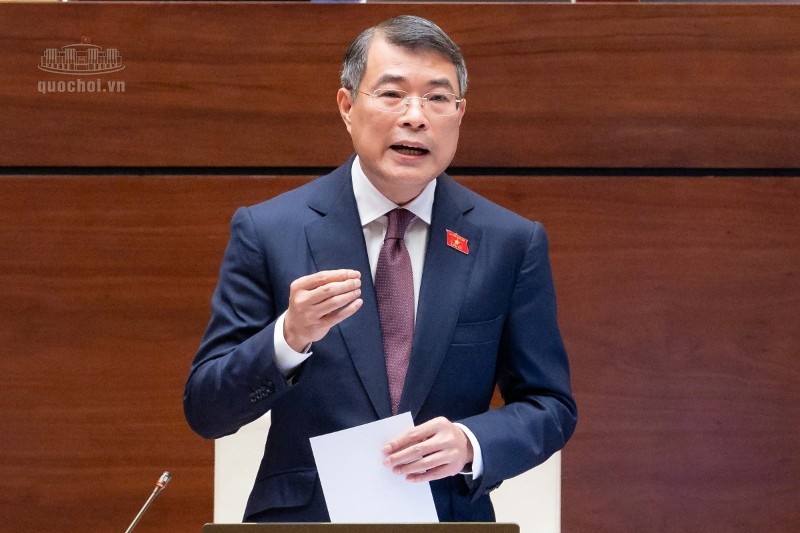
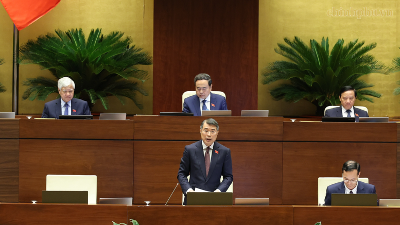
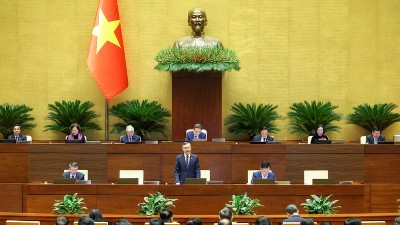
During the National Assembly (NA)'s Q &A session on November 12, Prime Minister Le Minh Hung said the Government is advancing mechanisms to encourage foreign direct investment (FDI) enterprises to transfer technology, increase the use of domestic suppliers, and train high-quality human resources, thereby boosting competitiveness and helping Vietnamese firms integrate deeper into global supply chains.
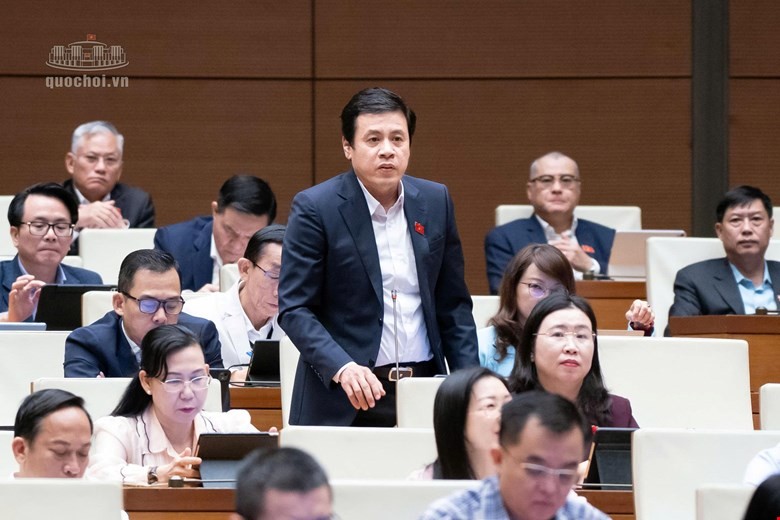
At the session, NA Deputy Trinh Xuan An from southern Dong Nai City asked the Prime Minister to clarify priority policies for 2027 and beyond aimed at helping Vietnamese enterprises—particularly small and medium-sized enterprises (SMEs)—expand orders, increase their share of exports, create stable jobs, and raise workers' incomes.
Mr. An noted that although Vietnam’s total import-export turnover in 2026 is projected to surpass $1 trillion, export activities remain heavily reliant on the FDI sector, while domestic firms still struggle with capital costs and supply chain integration.
In response, PM Hung stated that the Government has been rolling out multiple programs to strengthen domestic corporate capacity, starting with continued institutional reform.
According to the Government leader, a standardized, streamlined, transparent, and actionable legal framework—combined with administrative procedure reforms and cuts to business conditions—will help reduce compliance time and costs, creating favorable conditions for business growth. In particular, safeguarding the legitimate rights and interests of enterprises is essential for giving them the confidence to invest and expand production and business operations.
Regarding measures to elevate corporate capacity, PM Hung noted that the Government has issued and implemented supporting industry development programs, a merchandise export promotion strategy through 2030, trade promotion schemes, market expansion initiatives, and the enforcement of free trade agreements (FTAs).
A central focus is strengthening linkages between FDI firms and domestic businesses. The PM said that to implement Politburo Resolution 10 on development of foreign-invested economic sector, the government has submitted the amended Law on Investment to the National Assembly, which is expected to introduce strong incentive mechanisms for foreign enterprises.
These mechanisms focus on three pillars: technology transfer; expanding procurement from Vietnamese suppliers; and accelerating the training of high-quality human resources to enable domestic firms to join supply chains.
Concurrently, the Government has instructed the Ministry of Industry and Trade and Vietnam’s overseas trade office network to continue supporting the entry of Vietnamese goods into international markets and pushing for market access through bilateral and multilateral FTAs.
According to the PM, alongside incentives on taxation, land, access to capital, and science and technology, Vietnamese enterprises themselves must proactively upgrade their capabilities to meet supply chain requirements.
Commissioning technology to boost productivity and self-reliance
In the field of science and technology, the PM said the state will proactively collaborate with businesses, research institutes, and universities to roll out a technology commissioning mechanism for products with practical applications in production and business.
Commissioned products must be reasonably priced, especially for SMEs, to encourage technology adoption, boost productivity, cut costs and intermediaries, and improve product quality.
The Government has identified enterprise support as a top priority, while intensifying engagement with business associations and the corporate community to put support programs into practice.
For monitoring and evaluation, PM Hung stated that indicators such as the export share of domestic firms, Vietnamese enterprises' contribution to the import-export structure, and their local content ratio in supply chains will be included in annual socio-economic reports for National Assembly oversight.
Addressing a question from NA Deputy Tran Anh Tuan from Ho Chi Minh City on strengthening strategic self-reliance, the PM emphasized that self-reliance stems not only from guidelines and policies but also from the real strength of the economy.
Accordingly, the Government will continue reinforcing the capacity of the economy and the corporate sector, enhancing productivity and competitiveness, and driving rapid, sustainable growth. This also serves as a foundation for Vietnam to engage more proactively in international integration, participate in on an equal footing, and contribute increasingly effectively to international economic institutions and relations.
 Google translate