


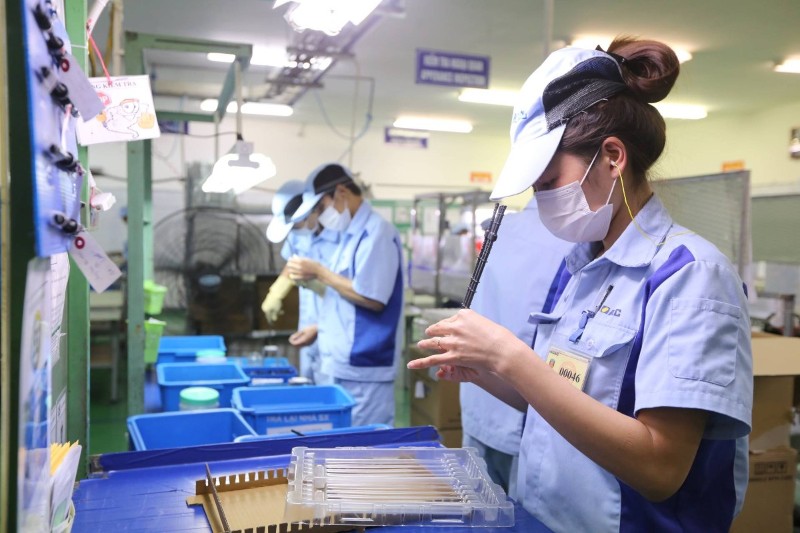
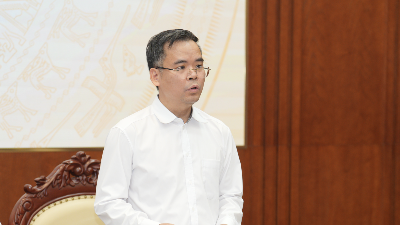
Vietnam is moving to a new phase of foreign direct investment (FDI) attraction, prioritising quality, technology transfer and stronger links with domestic businesses, Deputy Minister of Finance Tran Quoc Phuong said at a forum on October 8.
Speaking at the “Connecting Vietnamese Businesses to Global Supply Chains” forum, Mr. Phuong said total foreign investment attracted by Vietnam over nearly four decades reached more than $570 billion.
The quality of FDI has also improved, with a growing number of large-scale projects in electronics, semiconductors, artificial intelligence (AI) and digital transformation, reinforcing Vietnam’s role in global high-tech supply chains.
However, he acknowledged persistent shortcomings. Linkages between domestic and foreign-invested businesses remain limited, while technology transfer and research and development (R&D) activities have yet to meet expectations. The proportion of Vietnamese companies participating in global supply chains also remains low.
He said Politburo Resolution 10-NQ/TW, issued on June 8, 2026, marks a fundamental shift in Vietnam’s approach to FDI. The country will not attract foreign investment at any cost or allow FDI to replace domestic capabilities, but instead use it to strengthen the domestic economy, improve technological capacity and enhance competitiveness.
Mr. Phuong highlighted a “three-legged stool” model, combining Resolution 10 on the FDI sector, Resolution 68 on the private sector and Resolution 79 on the state sector. The coordinated development of all three is expected to support Vietnam’s ambition of achieving double-digit economic growth during 2026-2030.
Under Resolution 10, investment selection will prioritise quality, efficiency, innovation and links with domestic enterprises. High-tech, R&D, AI, semiconductor, digital and green-transition projects will receive priority.
Ms. Bui Thu Thuy, Deputy Director of the Foreign Investment Agency, said the Ministry of Finance is preparing amendments to the Investment Law. Under the proposed rules, FDI incentives would depend on investors’ technological performance and commitments to link with domestic companies. Investors would also face stricter post-investment monitoring, with quarterly and annual reporting required. Failure to meet registered commitments could result in incentives being withdrawn.
The Foreign Investment Agency has also completed a KPI framework to monitor implementation of Resolution 10, with ministries and local authorities required to update progress monthly and quarterly through a central government monitoring system.




 Google translate