


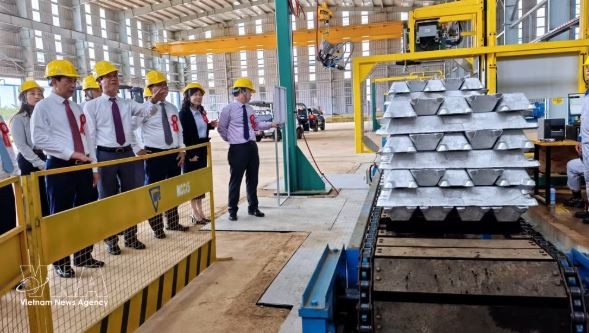
The first domestically made aluminum ingot products were announced at a ceremony held on July 26 at the Dak Nong Aluminum Electrolysis Plant in Nhan Co Industrial Park, Nhan Co Commune, Lam Dong Province.
Thus, Vietnam has successfully produced its first domestically made aluminum ingot products, marking the completion of the country's bauxite–alumina–aluminum production chain and a major milestone in the development of its metallurgy and deep-processing industries, the Government News remarked in its news story on the event.
After more than 11 years of investment and construction, the Dak Nong Aluminum Electrolysis Plant successfully produced its first aluminum ingot with a purity of 99.71 percent, becoming the first facility in the country to complete the full value chain from bauxite mining and alumina refining to aluminum electrolysis.
The plant's first phase has an annual production capacity of 150,000 tons. Output is expected to increase to 300,000 tons by the end of 2026 before reaching its designed capacity of 450,000 tons per year in the first quarter of 2027.
It is expected that once operating at full capacity in 2027, the plant would generate production value of approximately VND35-36 trillion, thus helping reduce aluminum imports by an estimated $1.5 billion each year.
General Phan Van Giang, Politburo member, Deputy Prime Minister and Minister of National Defense, was quoted by the Government News as saying at the ceremony that the successful production of the first aluminum ingot is a historic milestone for Vietnam's metallurgy industry, adding that it demonstrates the country's determination to develop deep-processing mineral industries, enhance value addition and strengthen economic self-reliance.
The Deputy Prime Minister on ministries and relevant agencies to continue improving policies for the development of the aluminum industry, while supporting enterprises in mastering advanced metallurgical technologies, training high-quality human resources and accelerating digital transformation in production.
He said the project reflects the growing technological capability, management capacity and skilled workforce of Vietnamese enterprises, enabling the country to shift from exporting raw materials and semi-finished products toward producing strategic industrial materials.
Domestically produced aluminum is expected to serve key sectors, including electricity, mechanical engineering, automobile manufacturing, railways, aviation, defense, construction and high-tech industries.
Vietnam is estimated to possess around 5.8 billion tons of bauxite resources, most of which are located in the Central Highlands.





 Google translate