



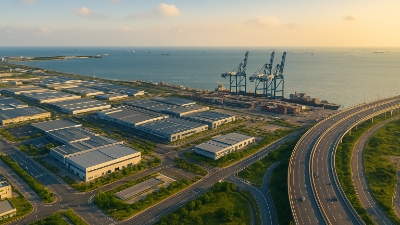
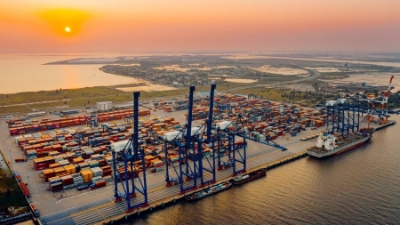
Promoting the establishment of the Cai Mep Ha Free Trade Zone (FTZ) is a specific move to realize the National Assembly's Resolution 98/2023/QH15. These outstanding mechanisms are expected to help Ho Chi Minh City transform its advantages in seaports and multimodal transport, creating new drivers for growth.
At the 2nd meeting of the city's Party Executive Committee held on December 15, HCMC Party Secretary Tran Luu Quang stated that alongside the International Financial Center, the free trade zone is a new and challenging task, but it will become a new growth driver for the city in attracting investment and generating revenue.
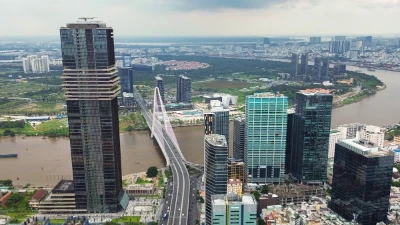
At the meeting, Mr. Duong Ngoc Chau, Secretary of Tan Phuoc Ward's Party Committee, noted that the Cai Mep Ha FTZ holds a strategic location, situated adjacent to the country’s largest deep-water port cluster and directly connected to vital transport routes such as National Highway 51 and the inter-port road. At the same time, it converges national energy infrastructure with the LNG terminal and gas pipeline system.
"This is an important foundation to attract logistics, high-tech industries, and large-scale investment capital," said Mr. Chau.
To prepare for this mega-project, the city has identified four key tasks: creating consensus among the people; strictly managing land, clearing sites, and preventing illegal construction; preparing on-site human resources through vocational training in logistics, seaports, mechanics, and trade-services; and proactively planning the urban area towards sustainability.
On December 11, 2025 the National Assembly passed a Resolution amending and supplementing a number of articles of Resolution 98/2023/QH15, adding an outstanding legal framework for the HCMC free trade zone model.
According to the resolution, the free trade zone is established to pilot outstanding mechanisms and policies aimed at attracting investment, finance, trade, services, and high-quality human resources.
The HCMC People's Council has the authority to decide on the order and procedures for establishing and expanding the boundaries of the free trade zone. Meanwhile, the City People's Committee has the power to decide on these issues regarding the free trade zone associated with the seaport in the Cai Mep Ha area.
Regarding taxes, enterprises implementing new investment projects in the free trade zone are entitled to a Corporate Income Tax (CIT) rate of 10% for 20 years (including a tax exemption for 4 years and a 50% reduction in tax payable for the subsequent 9 years).
The city has autonomy in selecting strategic investors based on principles of public transparency, relying on criteria regarding capital, capacity, experience, and technology commitments.

 Google translate