


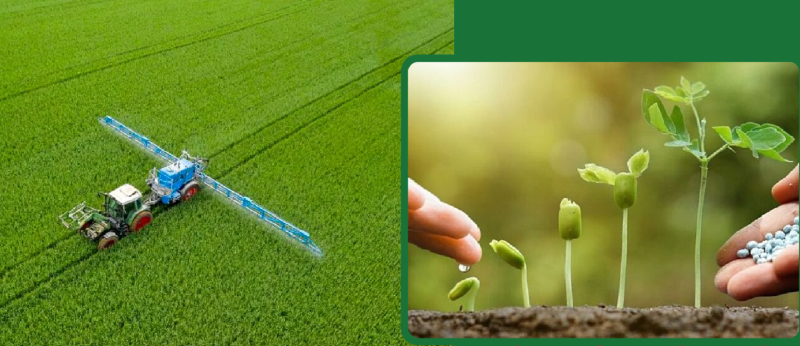
According to data from the Department of Crop Production and Plant Protection at the Ministry of Agriculture and Environment (MAE), Vietnam had nearly 800 fertilizer production facilities nationwide as of the end of June 2025, with a combined annual capacity of more than 20 million tons. Of these, 261 facilities produce inorganic fertilizers, 161 produce organic fertilizers, and 308 produce both inorganic and organic products. The total organic fertilizer output capacity is estimated at around 4.7 million tons annually.
Green transformation in the fertilizer industry is not only about meeting increasingly stringent environmental standards but also a fundamental solution to improving efficiency in agricultural production and enhancing the competitiveness of Vietnam’s agricultural products.
Inevitable equation
Domestic facilities are now able to produce most key fertilizer types, including phosphate fertilizer, urea, and NPK, fully meeting domestic demand. DAP plants cover around 60 per cent of demand, while potassium and SA fertilizers remain entirely dependent on imports. For organic fertilizers, domestic producers are able to meet both local demand and export requirements, without reliance on imported raw materials.
Many enterprises have actively invested in research and successfully applied science and technology to develop organic and bio-fertilizers for production. Notably, a number of products have demonstrated the ability to cut greenhouse gas emissions by 10-20 per cent, or even more.
According to Mr. Nguyen Tri Ngoc, Standing Vice Chairman of the Fertilizer Association of Vietnam, fertilizers are an indispensable input for agricultural production, contributing roughly 40-60 per cent of crop productivity. This critical role also makes the fertilizer sector a sensitive “link” in terms of environmental impact and the agricultural ecosystem. Improper fertilizer use, whether excessive or insufficient, can lead to soil degradation, water pollution, greenhouse gas emissions, and direct impacts on human health.
Against this backdrop, greening the fertilizer industry has become an inexorable trend amid growing demand for emission reductions, energy efficiency, and the application of clean technologies. Mr. Ngoc noted that this process goes beyond cutting emissions or meeting environmental standards; it is closely tied to improving agricultural efficiency, ensuring food security, and enhancing the value of Vietnam’s agricultural products. Expanding the use of organic and bio-fertilizers, applying clean technologies, and using resources more efficiently are seen as key pillars of this transition.
Conversely, the green transition also presents clear opportunities for businesses to strengthen competitiveness, access sustainable agriculture markets, and meet the increasingly strict requirements of international partners.
“We already have initiatives related to greening agriculture and using fertilizers to drive that process,” he said. “One example is the 1-million-ha high-quality rice project, aimed at reducing greenhouse gas emissions. This is a positive model for agricultural greening, with fertilizers playing a direct role in that transformation.” He stressed that greening the fertilizer industry is an inexorable trend, and to integrate and participate in green agriculture the fertilizer industry must move one step ahead to catalyze broader agricultural greening.
Some enterprises have already taken the lead, proactively upgrading technology and conducting in-house research to develop green products for production. Mr. Phan Van Tam, Deputy General Director of Binh Dien Fertilizer, said greening has been identified as a core development strategy, implemented across the entire value chain from production to fertilizer use. The company has focused on adopting environmentally-friendly technologies to reduce greenhouse gas emissions while improving input efficiency in cultivation.
The company has participated in several programs led by the MAE in recent years, most notably the Soil Health Program and the project on sustainable development of 1 million ha of high-quality, low-emission rice linked to green growth in the Mekong Delta to 2030. Through its involvement, Binh Dien has found that sensible fertilizer use, in line with proper technical processes, can significantly reduce emissions, not only during fertilizer production but also in on-field application.
Clear roadmap and coordinated policies
However, the path towards greening the fertilizer industry remains beset by barriers. Mr. Ngoc pointed out that current efforts face major challenges, particularly high investment costs and a lack of coordinated legal frameworks. Not all enterprises have sufficient resources to invest in new technologies in a short period, especially small and medium-sized enterprises with limited financial capacity. Access to “green credit” remains difficult due to complex lending procedures and the absence of a clear legal framework.
From a practical perspective, Mr. Hoang Quang Phong, Vice Chairman of the Vietnam Chamber of Commerce and Industry (VCCI), noted that the greening of the fertilizer industry is constrained by multiple issues, including the lack of a concrete legal framework for green production, non-uniform technological processes, high transition costs, fragmented standards systems, uneven awareness about green production, and the persistence of counterfeit and imitation products that undermine market trust.
To promote an effective green transition, Mr. Ngoc emphasized the State’s role in refining policies, establishing appropriate incentive mechanisms, and strengthening dialogue and cooperation between regulators, associations, and businesses. Investment in R&D, along with workforce training, is also considered crucial for enabling enterprises to master technology and implement greening in a sustainable manner.
He called for revisions and improvements to laws such as the Law on Standards and Technical Regulations, the Law on Product and Goods Quality, and the Law on Crop Production, to better align with integration realities. He also advocated for a shift in quality management from pre-inspection to post-inspection to reduce unnecessary barriers for businesses. Technological innovation, he added, must be accompanied by systematic human resource training to ensure both quality and greening objectives are met.
From the perspective of manufacturers, Mr. Phung Ngoc Bo, Head of the Technical Committee at the Vietnam National Chemical Group (Vinachem), emphasized that green transformation is not only a response to climate change but also a key driver of production efficiency, value creation, and competitiveness for chemical products amid deeper integration. Nevertheless, the sector continues to face major hurdles, including large capital requirements, outdated technologies that are difficult to integrate with new solutions, and pricing pressure as green products often carry higher costs.
As a result, tailored support mechanisms and policies are needed for foundational industries such as fertilizers and chemicals during the green transition. These include building a stable and transparent legal framework for circular and low-carbon production; providing financial support and green credit to facilitate access to preferential domestic and international funding; and supporting technological innovation, research, technology transfer, localization, and mastery of clean, low-carbon technologies for waste recovery, recycling, and treatment suited to Vietnam’s production conditions. Policies should also encourage domestic and foreign investors to participate in capital contributions and partnerships for green fertilizer production projects, circular plants, and high-tech industrial parks.
According to Mr. Ha Van Thang, Chairman of the Vietnam Council of Agricultural Enterprises (VCAC), organic bio-fertilizers are not merely agricultural products but integrated solutions encompassing technology, management, and environmental protection. The development and effective use of organic bio-fertilizers can help reduce greenhouse gas emissions, protect soil resources, enhance the value of agricultural products, and advance towards green, circular, low-emission agriculture. He therefore called for stronger research efforts, technology transfer, and the completion of policy mechanisms to support the fertilizer sector’s transition towards green and sustainable development.


 Google translate