



Vietnam’s economic outlook for the second half of the year presents both opportunities and challenges, as major shifts in the global economy become increasingly pronounced. Three structural trends - supply chain realignment, international investment flows, and technological transformation - are reshaping the country’s growth trajectory. Against this backdrop, achieving double-digit economic growth will require more than policy determination. It also demands structural solutions, including the development of long-term financing instruments capable of supporting sustained investment.
Globally, infrastructure bonds are a distinct financial instrument specifically designed to finance major projects such as railways, airports, seaports, logistics networks, and green infrastructure. They represent a specialized segment of capital markets valued in the trillions of dollars. Between 2021 and 2025 alone, global infrastructure bond issuance stood at some $3 trillion, underscoring the instrument’s critical role in channeling capital into long-term development.
Missing piece
Vietnam already has several types of bonds that can finance infrastructure, including project bonds, construction bonds, municipal bonds, and corporate bonds. Yet the country has not established a dedicated infrastructure bond instrument. This raises an important question: why create a new financing vehicle when existing ones already exist?
In practice, each financial instrument serves a different purpose. Existing bonds are generally suited to small and medium-sized projects with relatively short payback periods. Strategic infrastructure projects, by contrast, often have investment horizons ranging from 10 to 30 years or even longer. This mismatch in maturities limits the ability of current financing instruments to meet long-term funding needs while increasing maturity, interest rate, and reinvestment risks.
For this reason, infrastructure bonds should be designed with distinct features. Long maturities are fundamental, supported by credit enhancement mechanisms such as mandatory credit ratings, payment guarantees, or revenue-sharing arrangements during the early years of a project. Tax and fee incentives, along with standardized trading through centralized listing and custody systems, would further strengthen the market. More importantly, infrastructure bonds would complement rather than replace existing bond products, helping deepen Vietnam’s capital markets while expanding financing capacity for strategic projects.
International experience demonstrates that successful infrastructure bond markets require a comprehensive ecosystem that includes clear legal frameworks, risk-sharing mechanisms, well-developed local currency capital markets, reliable credit rating systems, and active participation by long-term institutional investors.
Brazil offers a notable example. Beginning in 2011, the country shifted from relying primarily on development bank lending toward infrastructure bond issuance. The transition was supported by tax incentives for individual investors, centralized exchange listings, and independent credit ratings. Over the following decade, the country raised an estimated $80-$90 billion through infrastructure bonds.
India, meanwhile, has strengthened investor confidence through specialized financial institutions and credit guarantee mechanisms that improve the creditworthiness of infrastructure bonds. Tax incentives and investment vehicles such as Infrastructure Investment Trusts (InvITs) have enabled investors to gain exposure to operating infrastructure assets, including highways, airports, and electricity transmission networks.
In Europe, the European Investment Bank has helped improve project credit ratings through revenue risk-sharing arrangements. Regulators have also lowered capital requirements for insurance companies investing in rated infrastructure bonds, encouraging greater participation from long-term investors. Japan, meanwhile, has successfully mobilized substantial funding through specialized institutions using the Fiscal Investment and Loan Program (FILP) bond system without placing direct pressure on the national budget.
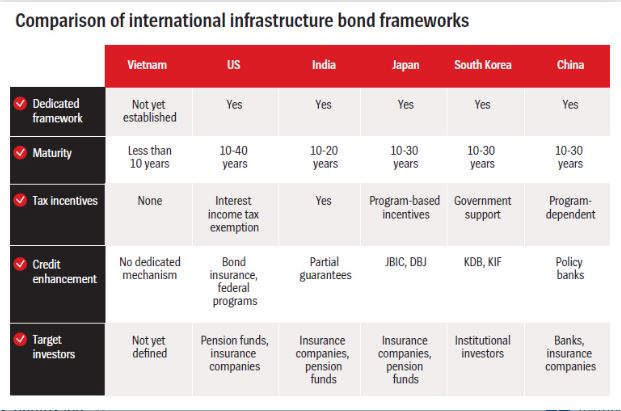
Compared with these international models, Vietnam still lacks a dedicated legal framework for infrastructure bonds, targeted tax incentives, and a clearly-defined investor base. This represents a significant gap, particularly as the country’s infrastructure financing needs over the next decade are expected to reach hundreds of billions of dollars. Existing bond instruments alone are unlikely to solve the problem, especially given that most bonds currently issued in Vietnam have maturities of less than ten years, making them ill-suited to long-duration infrastructure projects and increasing maturity, interest rate, and reinvestment risks.
Infrastructure financing and social welfare
If developed effectively, an infrastructure bond market would evolve beyond a single financial product into a diversified ecosystem spanning energy, logistics, transportation, and urban infrastructure. Each segment could establish its own benchmark yield curve, improving market transparency and attracting institutional investors, particularly pension funds, insurance companies, and international investment funds.
Another promising approach is program-based issuance rather than financing individual projects. Under this model, a single bond program could finance a portfolio of projects, such as multiple urban railway lines or renewable energy developments. Diversifying project exposure would reduce risk, lower due diligence costs, and make infrastructure bonds more attractive to international investors.
Infrastructure bonds linked to social welfare benefits also represent an innovative concept. Investors could participate with flexible investment amounts, either through lump-sum purchases or gradual contributions over time. They would continue to receive principal and interest throughout the investment period, while at maturity they could choose to convert their returns into social welfare benefits.
Such benefits could include free or discounted public transportation, healthcare services, retirement living, social housing, or access to senior living communities integrated with public transport infrastructure.
While financial products linked to social welfare already exist in some countries, directly integrating infrastructure financing with long-term social benefits remains relatively uncommon. As Vietnam enters a period of rapid population aging over the next 10-15 years, such a model could help address two strategic priorities simultaneously: mobilizing capital for infrastructure investment while supporting long-term social welfare needs. It would also allow citizens to participate directly in national infrastructure development, creating a sense of shared ownership while aligning individual financial interests with broader economic development.
The inclusion of infrastructure bond development in Vietnam’s financial market reform agenda signals a clear policy direction. The remaining challenge is creating sufficient incentives to encourage widespread public participation and attract household savings into national infrastructure investment.
Realizing their potential will require a dedicated legal framework for infrastructure bonds, at a minimum through a government decree. Appropriate tax incentives, a robust credit rating system, greater transparency, and effective guarantee mechanisms will also be needed to reduce financing costs. At the same time, Vietnam should broaden its base of long-term investors by encouraging greater participation from pension funds, insurance companies, and infrastructure investment funds.
Over the longer term, infrastructure bond development should be integrated into Vietnam’s broader capital market strategy to reduce reliance on bank lending and establish more sustainable sources of long-term financing. If implemented successfully, a dedicated infrastructure bond market could become one of the key pillars supporting the country’s ambition for sustained, high-quality economic growth in the decades ahead.








 Google translate