


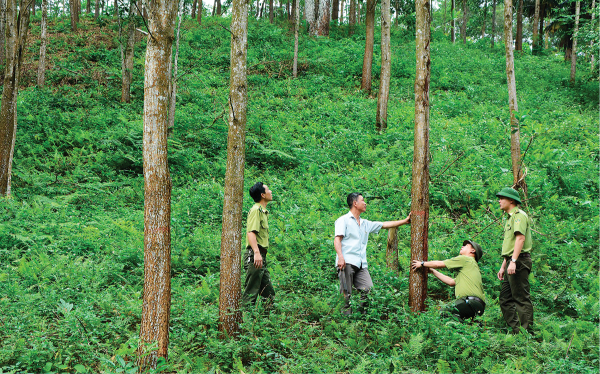
Nghe An Province in central Vietnam has identified forestry as a key economic sector within its green growth and sustainable development strategy. Aiming to reach an export turnover of $400–500 million annually for wood and forest products by 2030, the province expects to achieve a significant shift from traditional production to a "multi-value" forest economy.
The province strives to maintain an annual afforestation area of at least 22,000 ha. Priority will be given to planting large-timber forests and converting existing plantations into large-timber models to enhance economic efficiency.
Additionally, the province is focusing on developing non-timber forest products, medicinal plants, and specialty crops under the forest canopy across approximately 9,000 ha, creating additional revenue streams and sustainable livelihoods for residents, particularly in mountainous regions.
Another vital indicator is the target of over 70,000 ha of forest receiving sustainable forest management certificates, meeting the requirements of both domestic and international legal timber markets. Average plantation productivity is targeted at 25–30 m3/ha/year, with an average timber harvest output of 2.2–2.5 million m3 per year. The value of raw material plantations is expected to increase by 1.5 to 2 times per unit area compared to the 2021–2025 period.
Additionally, the locality is focusing on refining management practices, restructuring forestry development spaces, and investing in synchronized infrastructure. The province aims to fundamentally complete the allocation and leasing of forest land and forest resources in accordance with planning, ensuring that 100% of forest areas have clearly assigned management entities.
As planned, the High-Tech Forest Seedling Production Center will be brought into stable and efficient operation, which is considered a crucial foundation for improving seedling quality, reducing production costs, and increasing the competitiveness of the province's forestry products.
Furthermore, Nghe An is concentrating on building infrastructure and information technology systems to accelerate digital transformation in forest management, protection, development, and fire prevention. The province plans to gradually modernise its systems for monitoring forest dynamics and managing forest resources.
Looking toward 2045, the province envisions the formation of large-scale concentrated raw material zones with optimized crop structures. Priority will remain on large-timber forests, indigenous species, and certified sustainable forests. The under-canopy economy will be developed toward a multi-value approach, integrating medicinal herb cultivation, non-timber forest product exploitation, eco-tourism, carbon credits, and other forest environmental services.



 Google translate