


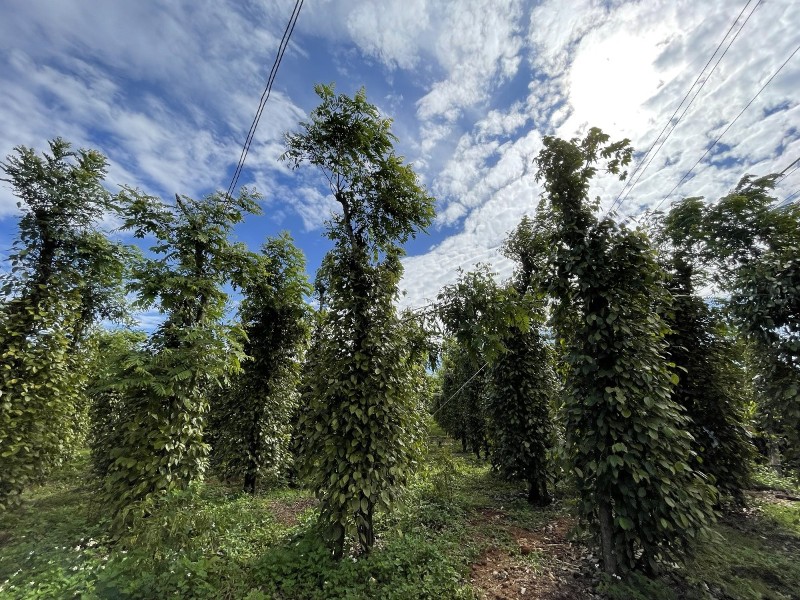
Vietnam’s pepper exports in the first seven months of 2026 reached 168,823 tons, valued at $1.099 billion. This represents an increase of 16.7% in volume and 11.1% in value, compared to the same period in 2025, reported the Vietnam Customs.
The US continues to be Vietnam's largest export market. During the seven-month period, the country exported 41,474 tons to the US, totaling $299.31 million, a year-on-year increase of 26.6% in volume and 20.6% in value.
Germany ranked second with 9,233 tons valued at $68.13 million, accounting for approximately 5.5% of total export volume. However, exports to this market saw a decline of 13.8% in volume and 17% in value compared to the same period in 2025.
In addition to traditional markets, Vietnamese pepper is recording robust growth in other regions. Turkey emerged as the most notable growth market, with 5,647 tons exported to it in the first seven months, valued at $33.25 million, soaring by 102.3% in volume and 96.4% in value.
According to the Vietnam Pepper and Spice Association (VPSA), major pepper-producing and exporting countries are adopting distinct competitive strategies. Brazil has the capacity to increase supply and compete on volume; Malaysia focuses on high-quality pepper and premium branding; while Indonesia maintains a leading role in white pepper products.
Despite maintaining its position as the world's largest pepper exporter, Vietnam's pepper industry is facing demands to enhance its competitiveness—specifically regarding quality, food safety, traceability, and sustainable development.
Currently, importers are setting increasingly stringent requirements for product quality and standards. If the industry does not transform in a timely manner, Vietnamese pepper risks losing market share to other producing nations. Therefore, establishing international-standard raw material areas and forming close links between enterprises, farmers, and cooperatives are considered vital solutions.
The VPSA is directing several groups of solutions to develop the export pepper value chain. In this framework, export businesses and cooperatives serve as the two organizing hubs, farmers are at the center of quality creation, and regulatory agencies play a constructive role in establishing standards, data, and shared infrastructure.
One of the top priorities is stabilizing raw material areas rather than pursuing the expansion of cultivation land. Pepper-growing localities need to map out cultivation areas based on soil and water conditions, the age of the plants, disease risks, and the capacity to link with processing facilities.
The development orientation for the pepper industry through 2030 also needs to shift its focus from land area targets to sustainable yields and economic efficiency per hectare. The goal of having 40% of pepper cultivation areas meeting GAP (Good Agricultural Practices) standards or equivalent, and 50% assigned with growing area codes, must be translated into specific annual implementation plans.






 Google translate